Best Nugget Ice Makers
Honest Take · Running Cost & Noise

What it costs to run, and how loud it really gets.

Every listing for a countertop nugget ice maker tells you the daily output in pounds. None of them tell you the wattage, and almost none of them put a number on the noise. Those two gaps are the actual questions people ask before buying one of these for a kitchen, a bar cart or a small office. We did the arithmetic with the assumption stated in the open, and laid out what the published specs — and the mechanics of how these machines work — tell us about the noise.

By Ilane TallUpdated October 22, 2026Research-based — no testing lab, no invented scores

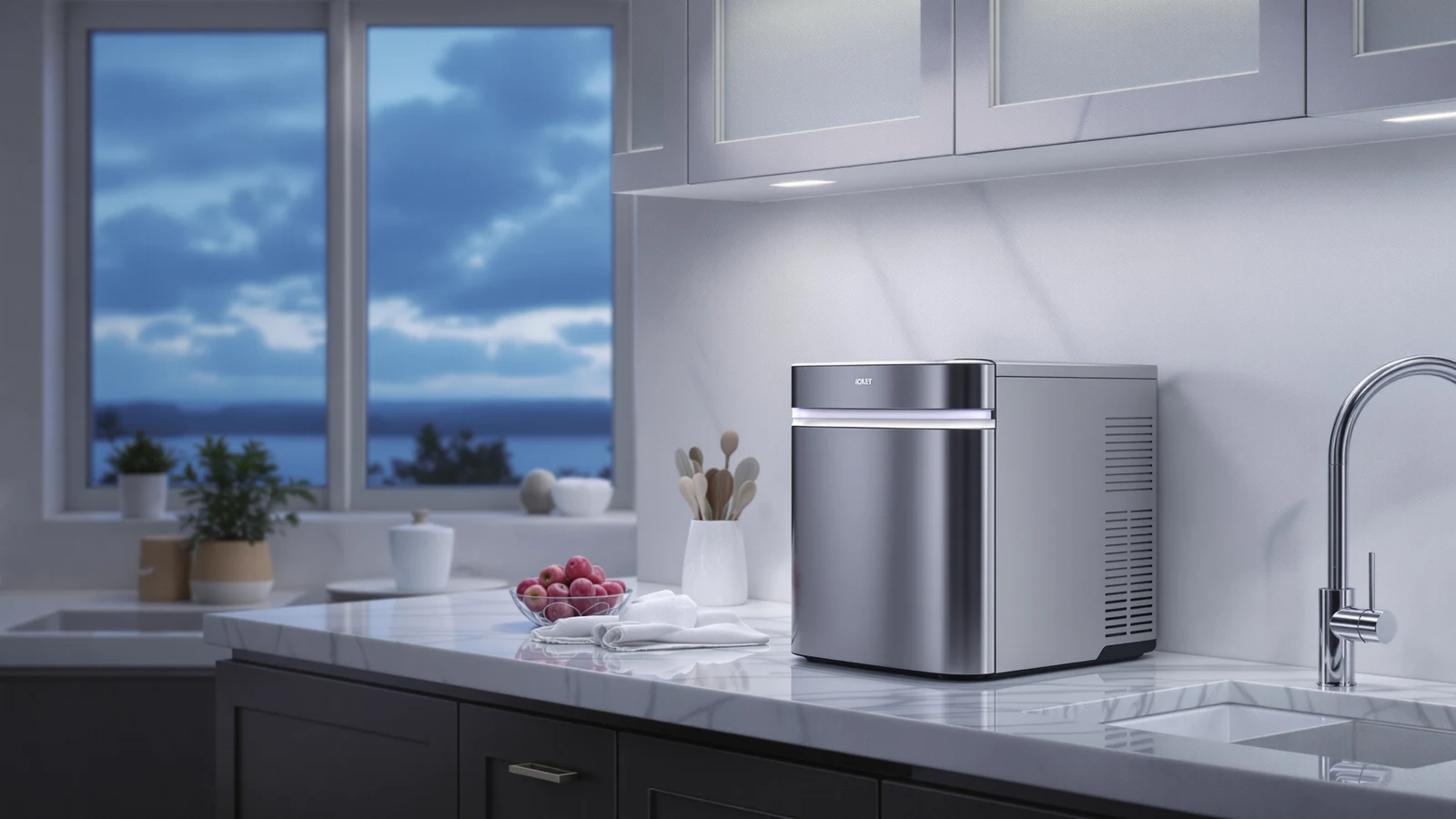
Countertop nugget ice maker running on a kitchen counter at night, its control light glowing, plugged into a wall outlet
Affiliate disclosure: we may earn a commission if you buy through the Amazon links on this page, at no extra cost to you. See how we picked below.

Search any nugget ice maker and the specification box reads the same way every time: pounds per day, tank size maybe, a price. What it almost never includes is the number an electrician would actually want: the wattage. For noise, you get adjectives at best — "quiet operation," "whisper-quiet design" — words a marketing team chose, not a measurement anyone can check. Of the three machines in this guide, exactly one publishes an actual decibel figure; the other two don't, and we won't pretend otherwise.

So this is a guide built around that gap. We'll show the assumption we used to get from "no published wattage" to "a real number of cents," state it plainly so you can swap in your own electricity rate, and then walk through what's mechanically normal about the noise a compressor-based ice maker makes versus the sounds that mean something is wrong. None of this requires us to have tested these machines ourselves, and we haven't — it requires reading what's published and being honest about where the data stops.

The missing number

Why no listing publishes a wattage

A nugget ice maker is a small refrigeration appliance: a compressor, a condenser, an evaporator plate, and an auger motor that extrudes the compacted ice. Every one of those parts draws current, and in principle a manufacturer could print a wattage rating the way a space heater or a microwave does. In practice, almost none of them do it on the Amazon listing, and the CyberChill, the Silonn and the GoveeLife Pro we're comparing here are no exception — not one of their titles or published specification sheets states an amp draw or a wattage figure.

The likely reason is unglamorous: pounds-per-day is the number that sells the machine, and a compressor's power draw isn't one fixed figure anyway — it cycles on and off and runs at a different load depending on room and water temperature. A manufacturer printing a single number would be printing an average that's true under some conditions and wrong under others, so it's simpler to leave it off the box. That's also why listings rarely connect the "first ice" minutes some of them publish to the hours needed to hit the daily pound total — the headline number and the one that governs your electric bill are rarely the same number.

Stated, not hidden

Our assumption, stated in the open

Because none of the three products here — the CyberChill, the Silonn 44lbs, or the GoveeLife Pro — publishes a wattage, we can't give a verified cost for any specific one. What we can do is apply a general-domain reference point for the class of appliance they belong to, say exactly what it is, and let you substitute your own numbers.

The assumption, stated plainly

150 watts while the compressor is actively cycling

Small compressor-based countertop appliances in this weight and size class — portable ice makers, mini fridges — commonly draw somewhere in the 100–200 watt range while running. We're using the midpoint, 150 watts, paired with $0.17 per kilowatt-hour, a commonly cited U.S. residential average rate. Your own rate is on your utility bill and will likely differ — swap it in and the arithmetic below scales directly.

Two things this doesn't claim: that any of the three draws exactly 150 watts — the larger 60 lbs/day GoveeLife Pro plausibly runs a bigger compressor than the 44 lbs/day CyberChill, which a flat figure can't capture — and it treats the compressor as running near-continuously while making ice, ignoring the standby draw between batches, small enough on refrigeration equipment generally to round to nothing here.

The arithmetic

Cents per hour, and what a party costs

Run the assumption through the math and the number that falls out is small enough to be the headline: 150 watts is 0.15 kilowatts, and at $0.17 per kilowatt-hour that's roughly 2.5 cents for every hour the compressor is actively running. Everything else below is just that figure multiplied by however long you run the machine.

A single batch, on the GoveeLife Pro's published "6-Minute Ice" claim, costs about a quarter of a cent. Silonn's listing for its 44lbs model includes a 12-hour timer, built so the machine can run unattended through a long event — the full 12 hours under our assumption costs about 30 cents. Run any of these three flat out, nonstop, for a full 24 hours, far beyond normal use, and you're still at roughly 60 cents.

Which brings us to the number this guide is really built to answer: what does a party cost? Host people for six hours and keep the machine running to stay ahead of the home bar emptying the bin, and six hours at 2.5 cents an hour is about fifteen cents — the entire electricity cost of ice for a six-hour party. The real recurring cost here is the machine itself and, eventually, descaling supplies, not the power bill.

One honest caveat: a normal household doesn't run one of these for 24 hours, or even six. Most owners make a batch or two a day and let the bin's own melt-and-remake cycle — covered in why nugget ice melts in the bin — top it off the rest of the time. For typical daily use, the real figure is likely closer to a few cents a day than the 24-hour ceiling above, which we give because it's the easiest to verify against your own rate, not because it's what a normal week looks like.
What's actually normal

Compressor noise: what's normal, and what the one published spec tells us

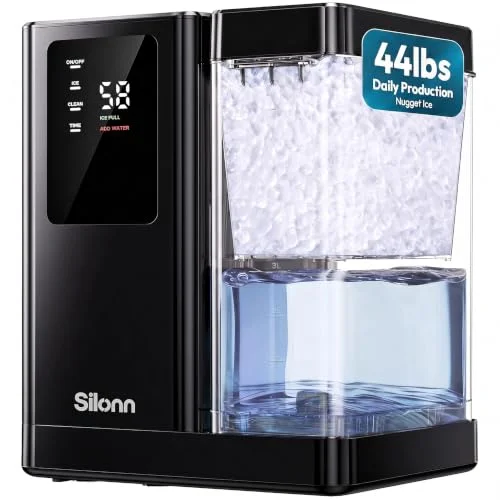
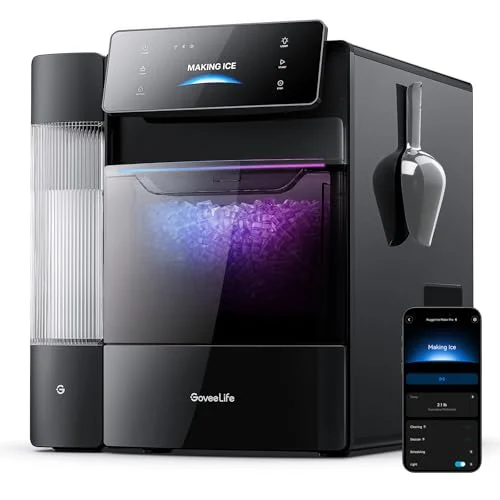
Noise is harder to pin down than cost, because almost nobody publishes a figure. Of the three machines here, only the GoveeLife Smart Nugget Ice Maker Pro states one in its own product name: 40dB. We have no equivalent number for the CyberChill or the Silonn 44lbs — their listings simply don't state a decibel rating, so we won't claim either is quieter or louder than the Pro's stated figure.

What 40 decibels means on the standard dB(A) scale: it sits in the range most people associate with a running refrigerator or a quiet library — audible in a silent room, easy to talk over, well below the roughly 60dB of normal conversation. A machine rated at 40dB is not silent; a compressor cycling on is a mechanical event, and it makes a low, steady hum while it runs. The rating tells you that hum sits closer to background-appliance noise than to anything that would dominate a room.

There's also a noise source specific to this category that has nothing to do with the compressor. Nugget ice is made by an auger — a rotating screw that compacts ice shavings against a cold cylinder wall and extrudes them as the soft pellets the category is named for. That motor makes its own grinding or crunching note layered on top of the compressor's hum, present on every machine that makes this style of ice regardless of brand or price. For a first-time owner, that's the sound most likely to surprise you — not because anything's wrong, but because it isn't what a cube-ice freezer tray sounds like.

Telling them apart

The hum, the drop, and the sounds that mean something is wrong

Normal

The hum, the grind, the drop

A steady low hum means the compressor is running, coming and going in cycles the same way a refrigerator's does. A rhythmic grinding or crunching under that hum is the auger extruding ice, present on every nugget machine by design. A periodic soft thud is a batch dropping from the extruder into the bin. None of these three indicate a fault; together they are what "making ice" sounds like.

Worth checking

Harsh grinding, rattling, hissing

A harsh, metal-on-metal grinding note that's new or louder than before often points to an ice jam in the auger or mineral scale caught where it shouldn't be — the kind of buildup our cleaning and descaling guide walks through preventing. Persistent rattling or buzzing usually means the unit isn't level or something has worked loose. A continuous, loud hissing — distinct from the brief hiss of refrigerant settling after a cycle ends — can indicate a leak, and a unit doing that should be unplugged rather than run through another cycle.

A compressor that clicks repeatedly and shuts off without settling into its hum is a different signal: on most compressor-driven appliances that pattern points to an overload or thermal-protection relay cutting power, and it's reasonable to stop, unplug, let it sit, and check clearance on all sides before trying again. None of this is specific to the CyberChill, the Silonn, or the GoveeLife Pro by name — these are general mechanical facts about how small compressor appliances fail, not a reliability claim about any one product, which we have no owner data to speak to.

The practical fix

Where to put it so you stop noticing

Because a nugget ice maker's noise is mostly mechanical — a compressor and an auger, not a fan whine you can dial down — the biggest lever most people have is placement, not the model they buy. A compressor needs airflow around its back and sides to shed heat; sealing one inside a closed cabinet traps heat, which makes it work harder and run longer, and turns the cabinet into a small resonance chamber that makes an ordinary hum sound louder than it would in the open.

Vibration is the other half. A hard, hollow surface — a thin countertop over an empty cabinet, a glass-top cart — transmits a compressor's hum into the furniture around it and makes the whole thing sound louder than it is. A rubber mat or cork trivet under the unit absorbs a meaningful amount of that vibration for a few dollars. Combine that with a few inches of clearance for airflow, a solid rather than hollow surface, and distance from a bedroom wall if you'll run it overnight, and most of what people describe as "louder than expected" disappears — not because the machine changed, but because the room stopped amplifying it.

Side by side

The three, on cost and noise

ModelDaily outputPublished noise specRelevant to cost/noisePriceGet it
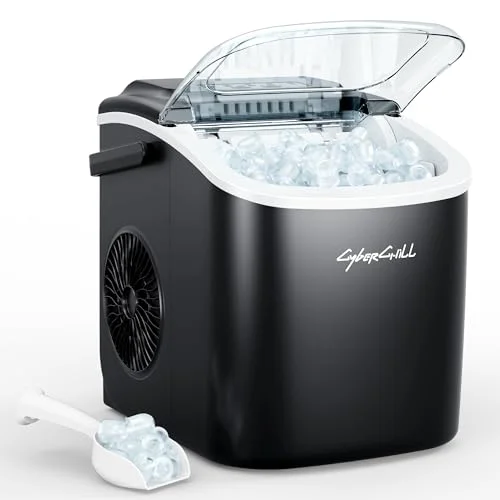
CyberChill Countertop 44 lbs/day Not stated Cheapest entry point $69.99 Get it
Silonn 44lbs with 3L Tank 44 lbs/24h Not stated 12-hour timer for long runs $218.45 Get it
GoveeLife Smart Pro 60 lbs/day 40dB (stated) Only one of the three with a published dB figure $349.99 Get it
The three, read for this question

What each one actually tells you about running it

01Only published dB figure

GoveeLife Smart Nugget Ice Maker Pro

Best if a verified noise number matters to you

60 lbs/day·6-minute ice·40dB stated

The GoveeLife Pro is the only one of these three whose product name commits to a decibel figure — 40dB — rather than a vague adjective, sitting in the same general territory as a running refrigerator. It's also the highest daily-output machine here at 60 lbs; its "6-Minute Ice" claim is the time to a batch, not the hours needed to reach that total — worth keeping straight when thinking about cost or noise over a full day.

The only one of the three that gives you a number instead of an adjective. That alone is worth something.

GoveeLife Smart Nugget Ice Maker Pro
Price
$349.99
Check price →
02Built for the long run

Silonn Nugget Ice Maker 44lbs

Best for a long event you don't want to babysit

44 lbs/24h·3L removable tank·12-hour timer

Silonn doesn't publish a noise figure for this model, so we won't put a number on it — but the 12-hour timer built into its listing is directly useful for the cost question. Set it running for the full 12 hours under our stated assumption and the electricity for the entire run comes to roughly 30 cents. The 3-litre removable tank means fewer interruptions during a timer-driven run, independent of sound.

The timer is the spec that matters here, not a number we don't have for the noise.

Silonn nugget ice maker with removable tank
Price
$218.45
Check price →
03Cheapest way to find out

CyberChill Countertop Nugget Ice Maker

Best for finding out whether running cost ever becomes an issue

44 lbs/day·Pebble ice machine

At $69.99, this is the least expensive route into the category, and its listing states the fewest specifics of the three — no tank volume, no dB rating, no timer. What doesn't change at this price is the physics: it's still a compressor-and-auger machine, and under the same assumption an hour of active running costs roughly the same 2.5 cents regardless of which of these three you own.

Fewer published specs to compare, but the running-cost arithmetic doesn't change with the price tag.

CyberChill countertop nugget ice maker
Price
$69.99
Check price →
Our method

How we picked — and what we can’t tell you

What we did

Published specs, a stated assumption, and the arithmetic

We compared the published product titles, specification sheets and current Amazon prices for these three countertop nugget ice makers, read them specifically for any wattage or decibel figure, and found exactly one published decibel rating among them — the GoveeLife Pro's 40dB. Where a figure wasn't published, we built a working assumption from general facts about comparable small compressor appliances, stated it in the open, and ran the cost math from there rather than inventing a product-specific number.

What we didn’t

We don’t run a testing lab

We do not physically test these machines, own them, measure their noise with a meter, or publish invented scores or ratings. We also don't have verified owner review data for these three listings, so we haven't paraphrased sentiment that doesn't exist — what you've read above is published specs, an assumption we've shown our work on, and general mechanical facts about how compressor-and-auger ice makers run and fail.

FAQ

Common questions

How much does it actually cost to run a nugget ice maker?

Under our stated assumption of 150 watts while the compressor is actively cycling and $0.17 per kilowatt-hour, running one costs roughly 2.5 cents per hour. A 12-hour timer-driven run, like the one built into the Silonn 44lbs listing, comes to about 30 cents. A full 24 hours flat out, far more than typical use, is still only around 60 cents. Most households, making a batch or two a day, likely spend closer to a few cents a day in practice.

Why doesn't any listing publish a wattage?

None of the three machines we compared — the CyberChill, the Silonn, or the GoveeLife Pro — states a wattage or amp draw. Pounds-per-day is the number that sells the machine, and a compressor's power draw isn't one fixed figure anyway; it cycles on and off and varies with room and water temperature, an awkward number to print accurately. That's why this guide states an assumption instead of a verified figure.

Is the grinding or crunching sound normal?

Yes, on every nugget ice maker. These machines use a rotating auger to compact and extrude the soft pellet ice the category is named for, and that motor makes a grinding or crunching sound under the compressor's hum as normal operation. What's worth checking is a sudden change — a harsher, metal-on-metal note that's new or noticeably louder — which can point to an ice jam or scale buildup instead.

Where should I put it so it's not so loud?

Give it clearance on the back and sides for airflow rather than sealing it inside a closed cabinet, which traps heat and makes the compressor work harder. Set it on a solid surface with a rubber mat or cork trivet underneath rather than a hollow countertop or glass cart, since those transmit the hum into nearby furniture. Airflow plus vibration damping fixes most of what people describe as "louder than expected."