Best Nugget Ice Makers
Head-to-Head · GE Profile Opal

Two lbs a day apart. Two hundred fifty dollars apart.

The Opal Ultra and the Opal Mini make the same soft, chewable pellet ice from the same GE mechanism, and their daily output figures are close enough to round to the same number. What actually separates them is the water tank, the fill method and the bin — and a third model, the MINI PRO, sits between them on price without quite matching either one on paper. We compared the published specifications and current prices for all three.

By Ilane TallUpdated October 15, 2026Research-based — no testing lab, no invented scores

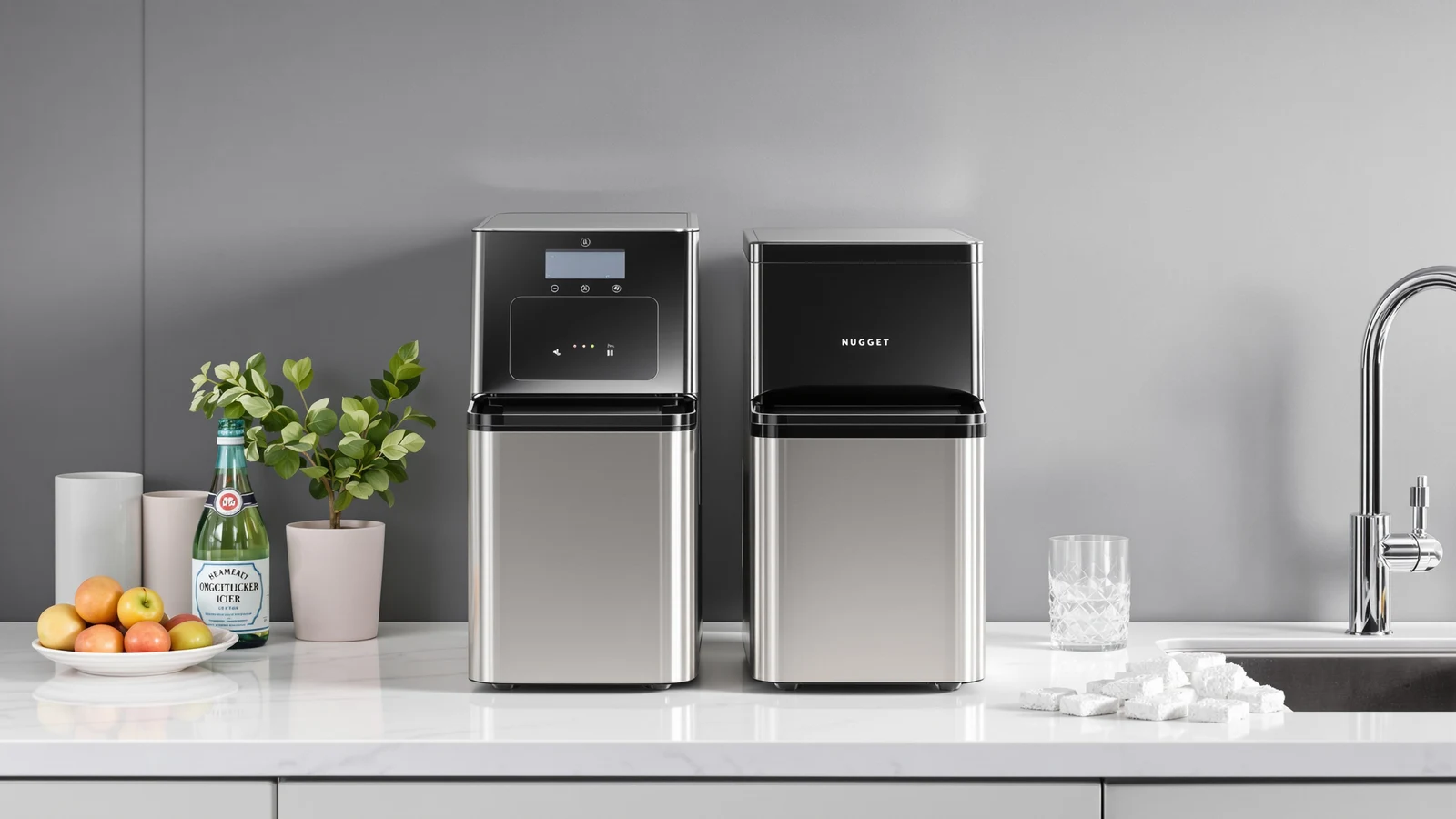
GE Profile Opal Ultra and GE Profile Opal Mini nugget ice makers side by side on a kitchen counter
Affiliate disclosure: we may earn a commission if you buy through the Amazon links on this page, at no extra cost to you. See how we compared below.

Open the listings for the GE Profile Opal Mini and the GE Profile Opal Ultra side by side and the first thing you notice is how similar the two machines actually are. Both make the same soft, chewable nugget ice. Both are built by GE around the same Opal mechanism that made this category mainstream in the first place. Both ship with a six-pack of descaler and a scoop, which tells you GE expects you to maintain either one on the same schedule. The daily output figures — 36 lbs for the Mini, 38 lbs for the Ultra — are two pounds apart, which on a full day of continuous running is not a number that should decide a $250 purchase on its own.

What the Ultra actually buys you is further down the spec sheet, in the water tank and the bin, and that is where this comparison spends most of its time. We also bring in a third machine GE sells in the same family: the Opal MINI PRO, priced at $379, roughly in the middle of the other two. Its own listing is thinner on detail than either of its siblings, and we say so plainly rather than guess at the gaps. For a rundown of the fourth GE question — why the ice melts in the bin on every machine in this family, not just these three — see our explainer on bin recirculation.

Spec #1

38 lbs against 36 lbs: the difference that is not the difference

GE states 38 lbs a day for the Opal Ultra and 36 lbs a day for the Opal Mini. Read quickly, that two-pound gap looks like the reason the Ultra costs $250 more. It isn't, and the arithmetic makes the point for itself: a 6 percent difference in daily output is not the kind of number that changes how a kitchen actually runs. If your household needs 36 lbs of nugget ice in a day, it needs 36 lbs of nugget ice in a day whether the machine on the counter is rated for 36 or 38.

Daily-output figures are also, by their nature, the easiest number on a spec sheet to print and the hardest for a shopper to verify, because they assume the reservoir stays full and the machine runs uninterrupted for twenty-four hours — a condition nobody meets on a kitchen counter. We cover that assumption in more depth in our guide to why tank size, not daily output, is the number that decides your week. The short version here: if the Ultra is worth $250 more than the Mini, it isn't because of these two numbers. It's because of what comes next.

Spec #2

1.6 lbs an hour against 1.5

GE also publishes an hourly rate for each machine: 1.6 lbs an hour for the Ultra, 1.5 lbs an hour for the Mini. This is a more honest number than the daily figure, because it describes what the machine is actually doing while it runs, rather than a theoretical full day nobody experiences. The gap between the two is, again, small — about 7 percent — and it compounds from the same underlying mechanism rather than a materially different compressor or auger.

What the hourly rate is useful for is sizing a single session: if you're filling a cooler for a weekend or running the machine for a few hours before guests arrive, 1.5 versus 1.6 lbs an hour will show up as roughly one extra pound of ice over a six-hour stretch. That is not nothing, but it is also not the headline reason to spend an extra $250. The headline reason is the tank.

Spec #3

The 1-gallon side tank: what it changes day to day

This is the real difference between these two machines. The Opal Ultra ships with a 1-gallon XL side tank that detaches completely for filling and cleaning. GE states the Ultra produces up to three times more ice before you need to refill it than a standard model — that's GE's own claim about its own product, not a figure we measured, and we repeat it here attributed to the manufacturer rather than asserted as independently verified fact. The Opal Mini, by contrast, is built around a Top Fill Water Reservoir with no stated gallon capacity in its own listing; GE's language emphasizes how you add the water, not how much the reservoir holds at once.

In practical terms, a detachable gallon-sized tank means fewer interruptions across a long day of hosting, or a household that runs through ice constantly without anyone remembering to top up a smaller reservoir. It also means a heavier, bulkier component to lift out, fill at the sink and set back in — the trade almost always runs in the direction of fewer refills in exchange for a larger single task each time. If your pattern is light, occasional ice-making rather than all-day production, a gallon of standing capacity mostly sits unused between sessions, which is the core argument for not paying extra for it. We go through this tradeoff for the whole category, not just these two machines, in our tank size guide.

One number from the same machine, the Ultra, is relevant here too: GE pairs that gallon tank with a 3-lb removable bin, the largest standing bin of the three machines in this comparison (the Mini's bin is stated at 2 lbs; GE's listing for the MINI PRO does not publish a bin figure at all). A bigger bin does not mean more ice is sitting frozen and ready — nugget ice melts back into the reservoir and gets remade on every countertop machine in this family, which is a normal part of how the category works, not a defect specific to any one of these three.

Spec #4

Top-fill, bin size and footprint

Fill method is the detail that decides where a machine is allowed to live on your counter, and both the Mini and the MINI PRO use top-fill designs, per their own listings — you add water from above rather than pulling the unit forward to reach a rear or internal reservoir. That means either one can sit flush against a backsplash or wedged into a corner and still be refilled with a straight pour. The Ultra's 1-gallon side tank is a different mechanism: it's a tank that detaches sideways for filling at the sink, not a top-fill reservoir you top up in place. Both approaches solve the same underlying problem — getting water in without wrestling the whole machine — by different means, and which one fits your kitchen depends on whether you'd rather pour from above or carry a tank to the tap.

On bin size, the only two figures GE publishes in the listings we have are the Mini's 2-lb bin and the Ultra's 3-lb bin; the MINI PRO's own listing does not state a bin capacity, so we don't assert one. As covered above, none of these numbers describe frozen storage sitting in reserve — they describe the size of the holding compartment the auger feeds into before meltwater recirculates back to the reservoir. A smaller bin isn't a shortfall; it just means the buffer between batches is smaller, which matters only if you're measuring out ice faster than the machine remakes it.

Footprint is the one dimension none of the three listings in this comparison publish with the confidence we'd want to repeat here as fact. GE's product names lean on words like "Mini" and "Portable" to signal size, and the Ultra's gallon side tank implies a wider stance than either sibling, but exact width-and-depth figures sit in secondary specification tables that aren't consistent across all three listings. If counter space is your binding constraint rather than price, treat the listing's own dimension chart as the only source and measure your counter before you order — our guide to compact nugget ice makers goes into this in more depth for shoppers where inches, not dollars, are the deciding spec.

The in-between model

Where the MINI PRO fits

GE sells a third machine in this family: the Opal MINI PRO, priced at $379 — $80 more than the Mini, $170 less than the Ultra. Its name promises something between the two, and on the two specs its listing actually states, that's roughly what you get: 36 lbs a day, the same figure as the standard Mini, with a top-fill design and the same six-pack-descaler-and-scoop bundle as its siblings. The headline addition is in the name itself — "w/Side Tank" — meaning the MINI PRO carries a detachable side tank the standard Mini does not have.

Here is where we stop and say plainly what we don't know: GE's listing for the MINI PRO does not publish a tank volume, an hourly rate, or a bin capacity. We're not going to guess that its side tank matches the Ultra's full gallon, or invent a number in between, because the listing itself doesn't commit to one. What we can say is that the MINI PRO is positioned as a stainless-steel upgrade over the Stone Grey standard Mini, with a side tank added to its top-fill design, at a price that splits the difference between its two siblings without splitting the difference on daily output. If a detachable tank matters to you but $549 doesn't, the MINI PRO is the listing to check directly for the volume figure before buying — not something to take on faith from its name.

Side by side

All three, compared

ModelDaily outputHourly rateTank / fillBinPriceGet it
GE Profile Opal Mini 36 lbs/day 1.5 lbs/hr Top-fill reservoir 2 lb $299.00 Get it
GE Profile Opal MINI PRO 36 lbs/day Not stated Top-fill + side tank Not stated $379.00 Get it
GE Profile Opal Ultra 38 lbs/day 1.6 lbs/hr 1-gallon side tank 3 lb $549.00 Get it
The three

Each one, and who it's actually for

01Save the money

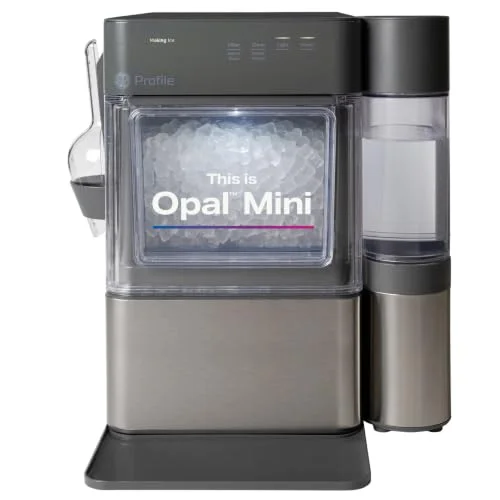
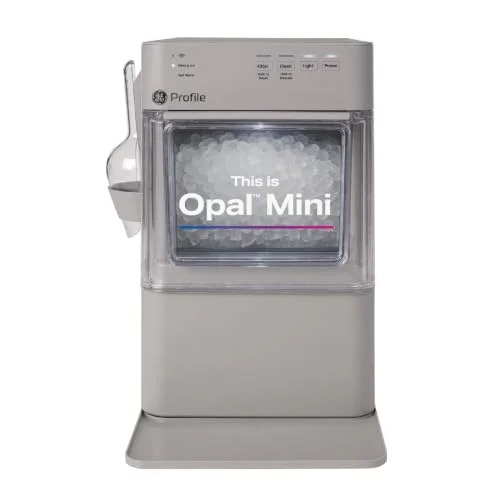
GE Profile Opal Mini

Best if you make ice once or twice a day, not constantly

36 lbs/day·1.5 lbs/hour·Top-fill reservoir·2-lb bin, Stone Grey

Nearly the Ultra's output, at just over half the price, with a top-fill design that lets it sit flush against a wall. The six-pack of descaler and scoop GE includes signal the same maintenance expectation as its pricier siblings. For a household that wants nugget ice available daily without running the machine around the clock, the Mini covers the same ground as the Ultra on the two numbers — daily output and hourly rate — that are closest between all three models.

The gallon tank is the Ultra's whole pitch. If you don't need it, this is the same ice for $250 less.

GE Profile Opal Mini nugget ice maker
Price
$299.00
Check price →
02The middle ground

GE Profile Opal MINI PRO

Best if you want a side tank without the Ultra's price or footprint

36 lbs/day·Top-fill + side tank·Stainless steel, descaler & scoop included

Priced $80 above the Mini and $170 below the Ultra, the MINI PRO adds a detachable side tank to the same top-fill design and the same stated 36 lbs a day as the standard Mini. Its listing doesn't publish a tank volume, hourly rate or bin size, so treat the side tank as a convenience feature to confirm on the product page rather than a quantified upgrade. It's the pick for a stainless-steel finish and a tank you can pull out to fill at the sink, at a price between its two siblings.

The name promises a middle ground. On the specs GE actually publishes, that's exactly what it is — and not much more.

GE Profile Opal MINI PRO nugget ice maker with side tank
Price
$379.00
Check price →
03Fewest refills

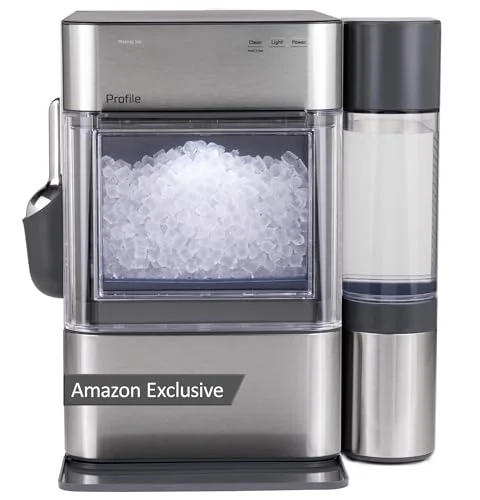
GE Profile Opal Ultra

Best if you make ice every day, or host often

38 lbs/day·1.6 lbs/hour·1-gallon side tank·3-lb removable bin, WiFi, stainless steel

The detachable 1-gallon XL side tank is the entire case for the $250 premium over the Mini, and GE states it supports up to three times more ice before a refill than a standard model. Paired with the largest bin of the three at 3 lbs and WiFi connectivity the other two don't have, this is the machine built for a kitchen that treats refilling as the actual problem to solve, not the daily-output number on the box.

Worth the premium only if refilling is the thing you're trying to eliminate. If you make ice for parties a few times a month, you're paying for headroom you won't use.

GE Profile Opal Ultra nugget ice maker with side tank
Price
$549.00
Check price →
The verdict

The verdict, by how often you make ice

Strip away the daily-output figures, which are close enough between all three to ignore, and this comparison comes down to one question: how often do you actually want to stop and refill a water tank? If the honest answer is "once or twice a day, and I don't mind," the Opal Mini delivers 94 percent of the Ultra's hourly rate for 54 percent of the price, and its top-fill design means that occasional refill is a straight pour rather than a chore. There is no spec in this comparison that makes the Mini a compromise for that kind of household — it's the right machine, not the cheap one.

If the honest answer is "constantly, because we entertain, or because ice is a daily, high-volume habit in this house," the Ultra's gallon side tank and 3-lb bin are built for exactly that pattern, and the $250 gap buys fewer trips to the sink across a week rather than better ice. GE's own claim of up to three times the runway between refills is the manufacturer's figure, not ours, but it points at the right axis: the Ultra isn't competing with the Mini on output, it's competing on how rarely you think about the machine at all.

The MINI PRO is the honest middle option for a narrower case: you want a side tank and a stainless finish, you don't want to spend $549, and you're comfortable confirming the unpublished specs — tank volume, hourly rate, bin size — directly on the listing before you buy, since GE doesn't state them where we can verify them here. For most households deciding between just the Ultra and the Mini, the question to ask yourself isn't which one makes more ice. It's how many times a week you're willing to walk back to the kitchen.
Our method

How we compared — and what we can’t tell you

What we did

Specs and prices, read directly from the listings

We compared the published daily output, hourly rate, tank and fill design, bin capacity and current Amazon price for all three GE Profile Opal machines named in this comparison. Where GE attributes a claim to its own testing — like the Ultra's "up to three times more ice" refill claim — we repeat it as the manufacturer's statement, not as something we verified ourselves.

What we didn’t

We don’t run a testing lab

We do not physically test these machines, we do not own them, and we do not publish invented scores or ratings. Where a listing — the MINI PRO's in particular — doesn't state a spec we'd want to compare, like tank volume or bin size, we say so explicitly rather than estimate one from a similar model in the same family.

FAQ

Common questions

Is the 2-lb daily output gap between the Ultra and the Mini worth $250 on its own?

No. GE states 38 lbs a day for the Ultra against 36 lbs a day for the Mini, a 6 percent difference that on its own would not justify the price gap. The hourly rates are similarly close — 1.6 lbs versus 1.5 lbs an hour. The $250 premium is almost entirely about the Ultra's 1-gallon side tank and larger 3-lb bin, not about how much ice either machine can produce in a day.

What does the Ultra's 1-gallon side tank actually change day to day?

It means fewer refills, not better or faster ice. GE states the Ultra produces up to three times more ice before you need to add water than a standard model, which matters most for households that make ice constantly or host often. For lighter, occasional use, the gallon of capacity will often sit partly unused between sessions, which is the core argument for choosing the Mini instead.

Where does the GE Profile Opal MINI PRO fit between the two?

On price, almost exactly in the middle at $379, between the Mini's $299 and the Ultra's $549. On stated specs, it matches the Mini's 36 lbs a day and top-fill design, and adds a detachable side tank the standard Mini doesn't have. Its listing doesn't publish a tank volume, hourly rate or bin size, so those details should be confirmed directly on the product page before buying.

Does a bigger bin mean more ice is sitting ready at any moment?

Not really. Nugget ice is compacted ice flakes, not a frozen block, so ice in any of these bins — 2 lb on the Mini, 3 lb on the Ultra — melts back into the reservoir and gets remade continuously rather than sitting in frozen storage. A bigger bin is a bigger buffer between batches, not a bigger stockpile. This is normal behavior across the whole nugget ice category, not a quirk of these three machines specifically.