Best Nugget Ice Makers
Honest Take · How Nugget Ice Actually Works

That puddle in the bin isn’t a defect. It’s the design.

Open the lid an hour after your nugget ice maker finishes a batch and you’ll usually find a smaller pile than you left, sitting in a little water. It reads like a malfunction. It almost always isn’t. We looked at how these countertop machines are actually built — what the bin is, where the meltwater goes, and what a 2-lb or 3-lb bin is for — so you can tell normal behavior from an actual problem before you call it broken.

By Ilane TallUpdated October 14, 2026Research-based — no testing lab, no invented scores

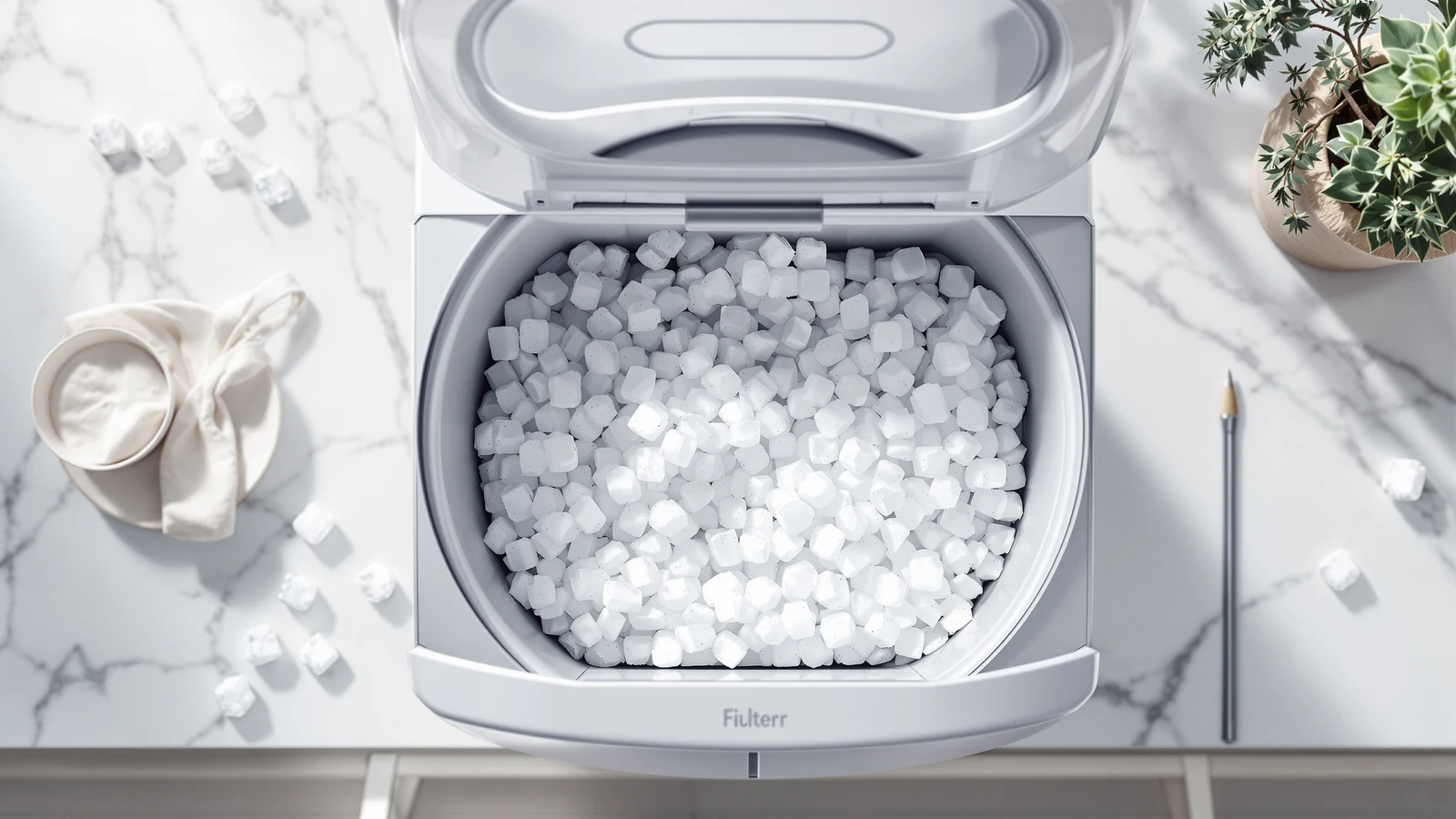
Soft chewable nugget ice pellets sitting in a countertop ice maker's bin with a small pool of meltwater at the bottom
Affiliate disclosure: we may earn a commission if you buy through the Amazon links on this page, at no extra cost to you. See how we picked below.

Search for help with a nugget ice maker and the forums fill in a predictable pattern fast: “my ice is melting in the bin,” “is this normal,” “mine turns to slush overnight.” It's the single most common complaint about this entire product category, and almost every time, the honest answer is that the machine is working exactly as designed. Nugget ice makers are not freezers with an ice-cube tray bolted on. They're small refrigeration systems built around one job — extruding soft, chewable pellets continuously — and the bin that catches the output was never engineered to keep that ice frozen solid indefinitely.

This guide isn't a troubleshooting checklist for a broken machine. It's an explanation of what's actually happening inside a countertop nugget ice maker between the moment a pellet drops into the bin and the moment you scoop it into a glass, so the gradual melt you're seeing stops looking like a fault. We'll also cover the one or two situations where melting really does point to something wrong.

What nugget ice actually is

Compacted flakes, not a frozen block

A cube from a standard icemaker is solid, cast in a mold and frozen through as one dense piece. Nugget ice is built differently from the first step. Inside the machine, a chilled evaporator plate grows a thin layer of ice, and a rotating auger continuously shaves that layer into small flakes, then feeds them through a compression chamber that presses them into the soft, cylindrical pellet most people call “the good ice” or “chewable ice.” What comes out the chute isn't one frozen mass. It's many small flakes mechanically pressed into a pellet, with a porous, slightly airy structure rather than the dense crystal lattice of a cube.

That structural difference is exactly why nugget ice is soft enough to bite through comfortably, and it's also why it melts noticeably faster than a cube of the same size. A solid cube has a relatively small surface area for its volume, so heat from the air around it only reaches the outer shell at any given moment. A compacted nugget pellet has a much higher surface-area-to-volume ratio — it's effectively a cluster of small ice flakes glued together by pressure, each flake with its own exposed surface — so warm air and warmer meltwater can get at far more of the ice at once. The texture that makes it chewable is the same texture that makes it melt quickly. You can't have one property without the other; they come from the identical manufacturing step.

None of that is specific to one brand. Every countertop nugget ice maker, including the three in this guide, uses some version of the same auger-and-compression process. If a listing advertises “soft, chewable” ice — language that appears directly in the GE Profile Opal Mini's own product name — it is, by definition, describing ice built to melt faster than a cube, not a flaw the company forgot to mention.

The part that confuses people

A bin is not a freezer, and no countertop machine has one

It's worth being direct about this, because the confusion is understandable: a countertop nugget ice maker's bin is an insulated holding container, not a sub-zero storage compartment. The refrigeration circuit does its work at the evaporator, where the ice is actually formed. Once a pellet drops into the bin below, it's no longer being actively cooled by anything — it's sitting in a plastic container at roughly room temperature, slowly losing the cold it carried out of the freezing chamber, the same way a glass of ice cubes left on a counter slowly loses theirs, just faster, for the surface-area reasons covered above.

A chest freezer or a refrigerator's freezer compartment is a different kind of appliance: it holds an entire enclosed volume of air at roughly 0°F continuously, so anything inside, including ice, stays frozen. A countertop nugget ice maker was never designed to do that for the bin. Making the bin itself a true sub-zero compartment would mean adding a second, separate refrigeration system just for storage — a far more expensive and bulkier machine than anything in this category, and not what any of these listings claim to sell.

So when a bin's ice gradually turns to slush over a few hours of sitting, that's not the bin failing at a job it was supposed to do. It's a holding container doing exactly what an uninsulated-from-the-room container does with warm air around it: nothing stops the ice from losing its cold, because nothing in a $200 to $550 countertop appliance was built to stop that.

Where the water goes

Recirculation: where the meltwater goes

Here's the detail that actually makes the system clever rather than wasteful: the bin on almost every countertop nugget ice maker is designed to drain. The bottom of the bin typically has a mesh or perforated floor, and as ice melts, that water doesn't pool and sit under the remaining pellets — it drains back down into the machine's water reservoir, the same tank that feeds the freezing chamber in the first place. The machine then draws from that reservoir to make the next batch of ice. Meltwater isn't lost down a drain or wasted; it's recirculated back into the supply and refrozen, which is why these machines are sometimes described as running a closed loop between the tank and the bin.

This is also why the reservoir level can drop even when you haven't scooped out a single pellet: ice is continuously being made, continuously melting a little in the bin, and continuously cycling back to be remade. The system is tuned to keep a buffer of ice available while quietly losing a bit of that buffer to melt and immediately replacing it, rather than building up an ever-growing frozen reserve the way a freezer would. For a deeper look at how reservoir size interacts with this cycle, see our guide to how nugget ice maker water tank sizes work.

This is also why the bin should sit level and closed when you're not scooping from it — a tilted machine or a propped-open lid can let meltwater escape the drain path instead of returning to the tank, one of the few situations below where melting crosses into worth checking.

Reframing the spec

What a 2-lb or 3-lb bin is actually for

Once you know the bin recirculates rather than stockpiles, the small capacity figures printed on these listings make more sense. The GE Profile Opal Mini states a 2 lb bin directly in its own product name. Two pounds sounds modest, and if you read it as “total ice available before you're out,” it would be. But because the machine keeps producing while the bin slowly loses ice to melt, a 2-lb bin isn't a hard ceiling you drain and wait out — it's closer to a working buffer kept topped up on its own, the same way a coffee maker's small reservoir doesn't limit how much coffee you drink in a day, just how often you refill it.

Neither the Frigidaire Countertop model nor the GE Profile Opal Ultra publish a bin-size figure the way the Opal Mini does — their listings lead with daily output instead, 33 lbs per day and 38 lbs per day respectively. We won't guess a bin capacity where a listing doesn't state one; the Opal Mini is simply the only one of the three that gives that figure in writing. What all three agree on, implicitly, is the same underlying design: a bin that's a buffer tied to a recirculating loop, not a stockpile tied to a freezer.

That reframing matters most against a built-in icemaker on a refrigerator, which drops cubes into a bin sitting inside the fridge's own cold air and barely melts. A countertop nugget machine solves a different problem — portability and that specific soft texture — and the small, melt-prone bin is the direct cost of solving it on a counter instead of inside a refrigerated cabinet. Our guide on compact nugget ice makers for a small kitchen covers the footprint side of that same trade-off.

Side by side

The three, compared on how they handle the bin

ModelBest forDaily outputNotable specPriceGet it
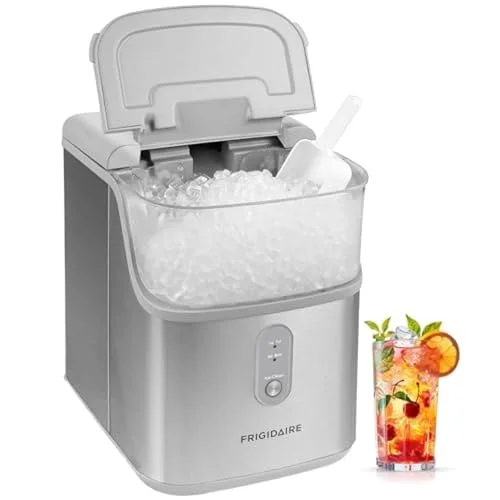
Frigidaire Countertop Nugget Ice Maker Making a small batch right before you need it 33 lbs/day Compact, metallic finish $196.80 Get it
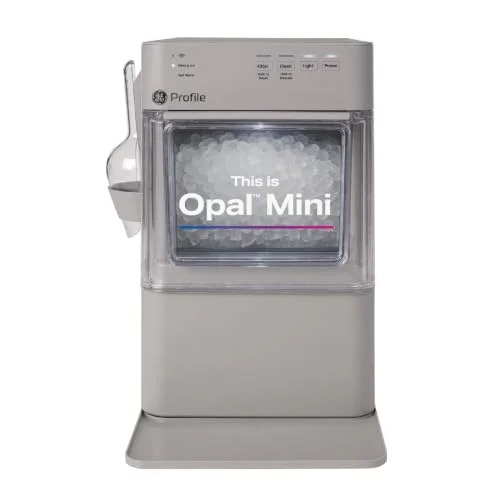
GE Profile Opal Mini Knowing exactly how big the buffer is 36 lbs/day Top-fill reservoir, stated 2-lb bin $299.00 Get it
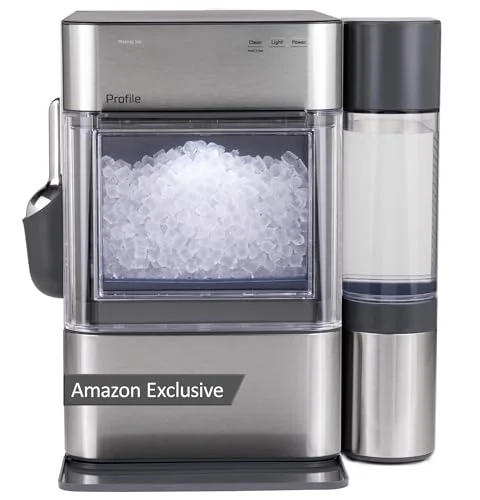
GE Profile Opal Ultra Batching ahead for a cooler or a party 38 lbs/day 1 Gal XL side tank, WiFi $549.00 Get it
What to actually do

Working with it: make on demand, or move a batch to the freezer

01Make it fresh

Run the machine shortly before you need ice, not hours ahead

Best approach for everyday glasses of water, soda or iced coffee

Because the bin is a buffer, not storage, the simplest fix for “my ice melted” is usually timing: run the machine in the thirty minutes to an hour before you actually want ice, rather than making a batch in the morning and expecting it fresh by evening. The Frigidaire Countertop model, stated at 33 lbs per day, and the GE Profile Opal Mini, stated at 36 lbs per day with a top-fill reservoir that makes topping it up a quick pour, both suit this on-demand rhythm well — neither is trying to be a reserve you stockpile from.

If the ice has to be ready the moment you want it, the fix is running the machine closer to that moment, not a bigger bin.

02Batch ahead

Scoop a batch into a container and move it to your actual freezer

Best approach for a cooler, a party, or any time you need ice to last for hours

If you genuinely need ice to hold for several hours — packing a cooler, prepping for guests — the honest fix isn't a bigger bin on the ice maker, it's using the appliance actually built to stop melt: your kitchen freezer. Scoop nugget ice into a sealed, freezer-safe container as soon as it's made and move it to the real 0°F compartment, where it holds for days instead of hours. A machine with a larger stated reservoir, like the GE Profile Opal Ultra's 1 Gal XL Side Tank and 38 lbs/day output, simply lets you produce a bigger batch in one session before transferring it — see our tank size guide for how that volume translates into fewer refills during a long batching session.

The freezer in your kitchen is the appliance built to stop melting. The nugget machine was only ever built to make it.

Either strategy works with any of the three machines above; none of them changes what the bin fundamentally is. What changes is how you time your own use around a buffer instead of fighting it. Steady daily use suits on-demand running with a smaller unit; a one-off event is better served by batching ahead into your own freezer, using whichever machine produces that volume fastest.

The exception

When melting IS a fault

Everything above describes the ordinary, built-in behavior of this category. There is a real line, though, between ordinary slow melt in a closed bin and a machine that has actually stopped working, and it's worth knowing where that line sits so you're not dismissing a real problem as “just how nugget ice works.” A few general signals, as information rather than a diagnosis of any specific unit, are worth paying attention to.

The clearest sign something is wrong is the machine failing to produce new ice at all — the bin emptying out and staying empty rather than being replenished, which points to the refrigeration or auger system itself, not the bin's insulation. A second sign is water pooling visibly outside the bin or leaking from the housing instead of draining internally to the reservoir, which usually means a blocked or misaligned drain path rather than normal meltwater doing its job. A third is the room running unusually warm, or the unit's intake and condenser coils covered in dust or crammed against a wall with no airflow — both make the refrigeration side work harder and can shorten how long a batch stays frozen, independent of the bin itself. A lid that doesn't close fully, or a machine sitting tilted, can also let warm air reach the bin more directly than intended.

None of the three machines in this guide are being singled out here; this is general information about how the category can fail, not a claim that any specific listing is defective. If a unit stops producing ice entirely, shows a persistent error indicator, or leaks rather than drains internally, that's a question for the manufacturer's support line and warranty, not something to work around with a different fill schedule. Gradual softening over an hour or two in a closed bin is expected; a bin that's bone dry with no new ice forming, or one actively leaking onto the counter, is not.
Our method

How we picked — and what we can’t tell you

What we did

General mechanism, read against published specs

We explained how the auger-and-compression process common to every countertop nugget ice maker produces a porous pellet that melts faster than a solid cube, and how the recirculating bin-to-reservoir loop works, then compared that against what the Frigidaire Countertop model, the GE Profile Opal Mini and the GE Profile Opal Ultra actually state — daily output, tank design and, where published, bin size. Where a listing states a figure, like the Opal Mini's 2-lb bin, we report it as given; where it doesn't, as with the Frigidaire and the Opal Ultra, we say so rather than estimate one.

What we didn’t

We don’t run a testing lab

We do not physically test these machines, we do not own them, and we do not publish invented scores or ratings. We also have no verified star ratings or review counts for these three listings, so we haven't paraphrased owner sentiment anywhere here — every claim is either a published spec, a price, or a general mechanical fact about how auger-driven nugget ice makers work.

FAQ

Common questions

Is it normal for nugget ice to melt in the bin?

Yes. The bin is an insulated holding container, not a freezer compartment, and nugget ice is made of compacted flakes with a lot of surface area, so it melts faster than a solid cube. Gradual softening over an hour or two in a closed bin is expected on every machine in this category, including the Frigidaire, GE Profile Opal Mini and GE Profile Opal Ultra compared here.

Why does nugget ice melt faster than regular ice cubes?

Nugget ice is made by shaving a thin layer of ice off a chilled plate and compressing the flakes into a soft pellet, giving it a much higher surface-area-to-volume ratio than a solid cube frozen as one piece. More exposed surface means faster melting — a byproduct of the same process that makes it chewable, not a flaw in any one machine.

Where does the water go when nugget ice melts in the machine?

On most countertop nugget ice makers, the bin drains and meltwater flows back into the water reservoir rather than pooling under the ice. The machine then draws from that reservoir to make the next batch, recirculating and refreezing the water instead of wasting it. Water pooling outside the bin or leaking from the housing signals a drain problem, not normal recirculation.

How do I keep nugget ice from melting if I need it to last for hours?

Scoop a batch into a sealed, freezer-safe container as soon as it's made and move it into your kitchen freezer, which holds ice far longer than the ice maker's own bin. A model with a larger stated reservoir, like the GE Profile Opal Ultra's 1-gallon XL side tank, mainly helps by letting you produce a bigger batch in one run before transferring it.