Best Nugget Ice Makers
Honest Take · How Nugget Ice Actually Works

Five minutes on the box. A different number once it's running.

Every listing in this category leads with a number for how fast the machine makes ice: five minutes, seven to ten, fifteen. Those numbers are real, but they all measure the same narrow thing — a cold machine's first batch — and none of them tell you what happens an hour later, on a hot day, with a tank of water that isn't fresh from the tap. We read what three listings actually state, did the arithmetic they don't do for you, and worked out which number is worth trusting.

By Ilane TallUpdated October 20, 2026Research-based — no testing lab, no invented scores

Countertop nugget ice maker mid-cycle with fresh soft chewable ice dropping into the bin, a kitchen clock visible in the background
Affiliate disclosure: we may earn a commission if you buy through the Amazon links on this page, at no extra cost to you. See how we picked below.

“Ready in 5 minutes.” “Ice in 7–10 minutes.” Scroll through enough nugget ice maker listings and the speed claim is almost always the second line of the title, right after the daily output figure. It's an easy number to print, which is exactly why it's worth being skeptical of. A stopwatch figure on a listing describes one specific moment under conditions nobody discloses, and it tells you almost nothing about whether the machine still feels fast on the third glass, or next August.

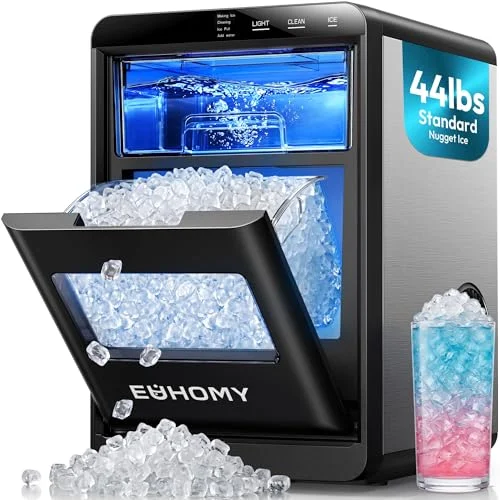
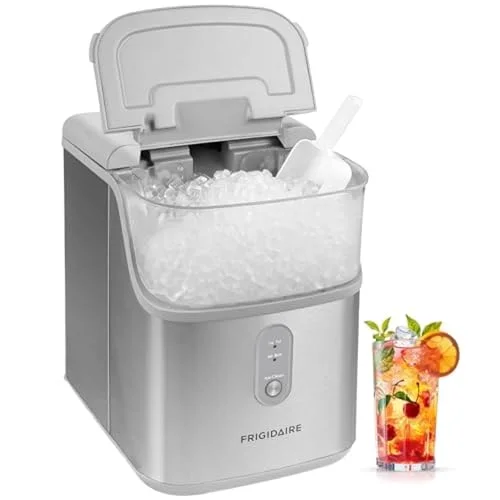
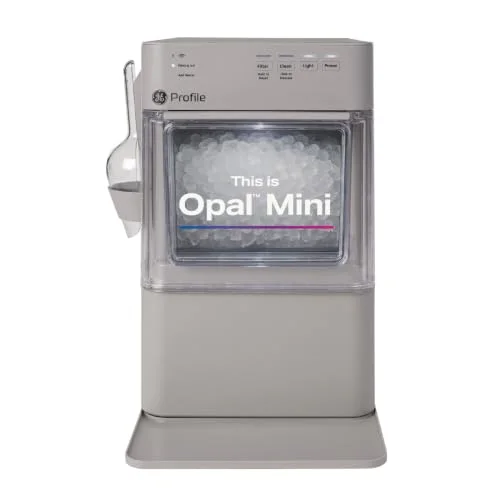
This guide isn't a speed test. We don't own these machines and haven't timed them ourselves. What we did instead is read exactly what the Frigidaire Countertop model, the EUHOMY 44 lbs Countertop, and the GE Profile Opal Mini state about speed and output, run the arithmetic those figures imply, and lay out what “fast” is actually measuring — and the variables that decide whether a machine fast in the listing photo stays fast on your counter.

The number on the box

What “time to first ice” actually measures

The figure printed in a listing title — five minutes for the GE Profile Opal Mini, seven to ten for the EUHOMY — describes a cold start. You fill an empty reservoir, plug the unit in, and press the button for the first time. The compressor has to pull the evaporator plate down from room temperature to freezing, the auger has to begin turning, and the very first flakes have to be shaved, compacted, and dropped before the clock stops. That's a real, checkable moment, and it's the easiest kind of claim for a manufacturer to make because it only has to happen once, under whatever conditions they tested it, to be true.

What it isn't is a promise about the machine's rhythm afterward. Time to first ice tells you how long you'll wait the very first time you use a brand-new unit, or any time after the reservoir has been fully drained and refilled from scratch. It says nothing about the second batch, the fifth, or the pace of a machine already running for twenty minutes. Those are different measurements, and only one listing among the three here — the GE Profile Opal Mini — gives you a second number to compare against.

The gap nobody prints

The first batch is not the same test as steady state

A refrigeration system behaves differently the moment it starts than it does twenty minutes in. On a cold start, the compressor works against a warm evaporator plate and a reservoir at whatever temperature it came out of the tap, and the first pellets are the reward for getting that plate down to freezing for the first time. Once the plate is already cold and the cycle has settled into a rhythm, the machine isn't repeating that uphill climb for every batch — it's maintaining a temperature it has already reached, a mechanically different job. That's steady-state operation, and it's the condition the machine spends nearly all its working life in, not the five-to-fifteen-minute window the listing title is built around.

None of the three listings here state whether their quoted speed is the time to the first batch only, or something expected to hold for batch two and batch ten. That's not unusual for the category, and it's not something we'll fill in with a guess. A single cold-start number, repeated as the headline claim across nearly every competing listing, is structurally the easiest claim to make and the hardest to use for predicting how the machine feels an hour into a party.

The honest number

Why the hourly rate is the figure worth trusting

If time-to-first-ice measures a one-time moment, the hourly production rate measures what you actually experience: how much ice shows up per hour once the machine is in its working rhythm. It's a steady-state figure by definition, which makes it the more honest number on a spec sheet, and it's also the easiest to cross-check, because a daily output figure and an hourly rate should agree with each other if both are published and both are real.

Of the three machines here, only the GE Profile Opal Mini states an hourly figure directly: 1.5 lbs per hour, alongside its stated 36 lbs per day. Run that arithmetic and it checks out exactly — 1.5 lbs an hour for 24 hours is 36 lbs, so GE's two numbers describe the same machine consistently. The EUHOMY and the Frigidaire don't publish an hourly rate at all, only a daily total: 44 lbs per 24 hours and 33 lbs per day. Divide either by 24 and you get an implied hourly rate — about 1.8 lbs an hour for the EUHOMY, about 1.4 for the Frigidaire — but that's our division, not their claim.

The practical takeaway: a published hourly rate that matches its own daily total, like the Opal Mini's, is a spec you can lean on. A daily total with no hourly rate attached is a real number too, but it's an average smeared across a full day nobody runs continuously, telling you less about any single hour at the counter.

What the listing doesn't say

Room temperature, water temperature, and the numbers nobody states

Every speed and output figure on all three listings is presented as a flat fact — 33 lbs a day, ready in 5 minutes — with no mention of the conditions it was measured under. That omission matters, because a compressor-driven ice maker's output isn't a constant. It's a function of how much heat the system has to move, which depends directly on how warm the incoming water is and how warm the surrounding air is. Colder tap water needs less work to freeze; a cooler kitchen lets the condenser shed heat faster. Warmer water and a warmer room both make the same compressor work harder for the same pellet.

None of the three listings state the water or room temperature their figures were measured under, and we won't invent a number that isn't published. These are lab-style figures measured under whatever conditions produced the best-looking result, and few kitchens replicate that exactly — especially in summer, when tap water runs warmer and a kitchen running its own oven nearby is measurably hotter than a controlled bench. If your kitchen runs warm, expect the real pace to land somewhat behind the number on the box, on any of these three, not because the number is false, but because it was true under conditions your kitchen may not share.

Side by side

The three, compared on speed

ModelBest forTime to first iceDaily outputPriceGet it
GE Profile Opal Mini The fastest stated first glass 5 minutes 36 lbs (1.5 lbs/hr stated) $299.00 Get it
EUHOMY 44 lbs Countertop A short, honest wait at a lower price 7–10 minutes 44 lbs/24h (~1.8 lbs/hr implied) $189.90 Get it
Frigidaire Countertop Nugget Ice Maker A known name if you can wait the longest 15 minutes 33 lbs/day (~1.4 lbs/hr implied) $191.33 Get it
The picks

Our picks, by how soon you need the first glass

01Need it now

GE Profile Opal Mini

Best if five minutes is the longest you're willing to wait

5 minutes to first ice·36 lbs/day·1.5 lbs/hour·Top-fill reservoir, 2-lb bin, descaler and scoop included

This is the one machine in the comparison that backs its speed claim with a second number that actually agrees with it: a stated 1.5 lbs an hour lines up exactly with its stated 36 lbs a day, which is the kind of internal consistency that's worth something when every other figure in this category is a single unverifiable moment. At five minutes to first ice, it's also the quickest stated start of the three, and the top-fill reservoir means that wait doesn't come with wrestling a tank out from behind the unit first.

The only one of the three whose hourly and daily numbers actually check each other — that consistency is worth more than the five-minute claim by itself.

GE Profile Opal Mini nugget ice maker
Price
$299.00
Check price →
02A short wait, less money

EUHOMY 44 lbs Countertop

Best if seven to ten minutes is fine and the highest daily total matters

7–10 minutes to first ice·44 lbs/24h·No stated hourly rate·1.8 L tank, one-touch control

EUHOMY states its speed window as a range rather than a single number — seven to ten minutes — which, if anything, reads as more candid than a single round figure, since it leaves room for the exact conditions of any given start. It also carries the highest stated daily output of the three, 44 lbs over 24 hours, which divides out to roughly 1.8 lbs an hour if you want a comparable figure — useful for sizing it against the other two, but worth remembering that EUHOMY itself doesn't publish that hourly number; it's our arithmetic on their daily total, not their claim.

A wider, more honest-looking window on the clock, and the biggest daily number of the three — just without a maker-stated hourly rate to check it against.

EUHOMY countertop nugget ice maker
Price
$189.90
Check price →
03Willing to wait, want the name

Frigidaire Countertop Nugget Ice Maker

Best if the brand matters more than the first fifteen minutes

15 minutes to first ice·33 lbs/day·No stated hourly rate·Compact, metallic finish

This is the slowest stated start and the lowest stated daily total of the three, at fifteen minutes and 33 lbs a day. That's not a hidden flaw — it's printed plainly, and a 33 lbs/day figure implies roughly 1.4 lbs an hour by the same division we applied to the EUHOMY, the lowest implied rate of the three. What you're weighing against that longer stated wait is a manufacturer with a service network behind it and a compact, metallic-finish unit that's easy to tuck away. If your priority is the badge rather than shaving minutes off the first batch, that's a legitimate trade to make with your eyes open.

The longest stated wait and the lowest implied hourly rate of the three — a trade worth making only if the name on the front is what you're actually paying for.

Frigidaire countertop nugget ice maker
Price
$191.33
Check price →
What changes over time

When a machine that was fast becomes slow

A nugget ice maker that felt quick out of the box doesn't necessarily stay that way, and the reasons are mechanical, not a defect in any listing here. The first is recirculation: these machines don't drain meltwater away, they return it to the same reservoir feeding the next batch, as covered in our guide to why nugget ice melts in the bin. Run the machine for an hour at a party and the water it's drawing from is no longer the cold tap water it started with; it's a mix of fresh fill and its own meltwater, warming slightly with every cycle. The compressor then works a little harder for the same pellet than it did on batch one — the direct reason a long session can feel like it's slowing down even though nothing has broken.

The second is seasonal, not mechanical wear: a kitchen running warm in summer, or a unit pushed into a tight, poorly ventilated corner, makes the compressor work against hotter surrounding air than whatever controlled setting produced the number on the box. Tank size plays in here too — a smaller reservoir heats up faster under repeated recirculation than a larger one, simply because there's less cold volume to dilute the returning meltwater into; see our guide to how tank size affects a long session for that trade.

The third, compounding over months rather than hours, is scale. These machines recirculate the same water continuously, and mineral buildup on the evaporator is a known, expected maintenance issue in hard-water areas, not a sign of a specific unit failing. A machine that made ice in five minutes in January and takes noticeably longer by summer has, in nearly every case, simply never been descaled — our guide to cleaning and descaling a nugget ice maker covers the routine. None of this makes the stated figures on these three listings false. It means they describe one favorable moment, and real-world pace a season later depends on water chemistry, ventilation, and maintenance far more than the number printed in the title.
Our method

How we picked — and what we can’t tell you

What we did

Listing claims, checked against each other

We compared the published time-to-first-ice claims, daily output figures and current Amazon prices for the Frigidaire Countertop model, the EUHOMY 44 lbs Countertop and the GE Profile Opal Mini, then ran the arithmetic that connects daily output to an hourly rate — checking, where a maker states both, whether the two numbers actually agree. We flag clearly when a figure is our own calculated average rather than a number the manufacturer states directly.

What we didn’t

We don’t run a testing lab

We do not physically test these machines, we do not own them, we have not timed a single batch ourselves, and we do not publish invented scores or ratings. We also have no verified star ratings or review counts for these three listings, so nothing here paraphrases owner sentiment — every claim is either a published spec, a price, a direct calculation we show our work on, or a general fact about how compressor-driven ice makers behave.

FAQ

Common questions

What does “time to first ice” on the box actually measure?

It measures a single cold start: filling an empty reservoir, powering on the unit for the first time, and timing how long until the first pellets drop. It's a real, checkable moment, but it says nothing about the pace of the second batch, the tenth, or how the machine performs after it's already been running a while — only one of the three machines compared here, the GE Profile Opal Mini, publishes a separate hourly rate to describe that ongoing pace.

Is the hourly rate a better number than the daily total?

Where a manufacturer publishes both and they agree with each other, yes — the GE Profile Opal Mini's stated 1.5 lbs an hour multiplies out to exactly its stated 36 lbs a day, which is a sign the two figures describe the same machine consistently. The EUHOMY and Frigidaire listings state only a daily total with no hourly rate attached, so any hourly figure for those two is our own division of their daily number by 24, not a claim either maker makes directly.

Does room or water temperature really affect how fast these machines work?

Yes, by basic refrigeration mechanics: a compressor has to move more heat to freeze warmer water in a warmer room than it does under cooler conditions, which is why colder tap water and a cooler kitchen generally produce ice faster. None of the three listings in this guide state the water or room temperature their speed figures were measured under, so treat the printed number as a best-case figure rather than a guarantee under your own kitchen's conditions.

Why did my nugget ice maker that used to be fast get slower?

Three mechanical reasons, none of them unique to one brand: recirculated meltwater gradually warms the reservoir during a long session, a warm or poorly ventilated spot for the unit makes the compressor work harder than it did under test conditions, and mineral scale builds up over months in hard-water areas and slows the whole cycle. The first two resolve on their own once the machine rests and cools; the third needs an actual descaling, covered in our cleaning guide.