Best Nugget Ice Makers
Buying Guide · Water Tanks & Reservoirs

The tank is the spec that decides your week.

A pounds-per-day number is printed in the title of nearly every nugget ice maker listing, and it is almost never the number that predicts how often you'll be standing at the sink with the tank in your hands. That number is the reservoir — litres, a side tank, a gallon — and how it's filled. We looked at what three current listings actually state about tank volume, worked out how to convert the figures that are published into something a household can plan around, and said plainly where a listing simply doesn't tell you.

By Ilane TallUpdated October 12, 2026Research-based — no testing lab, no invented scores

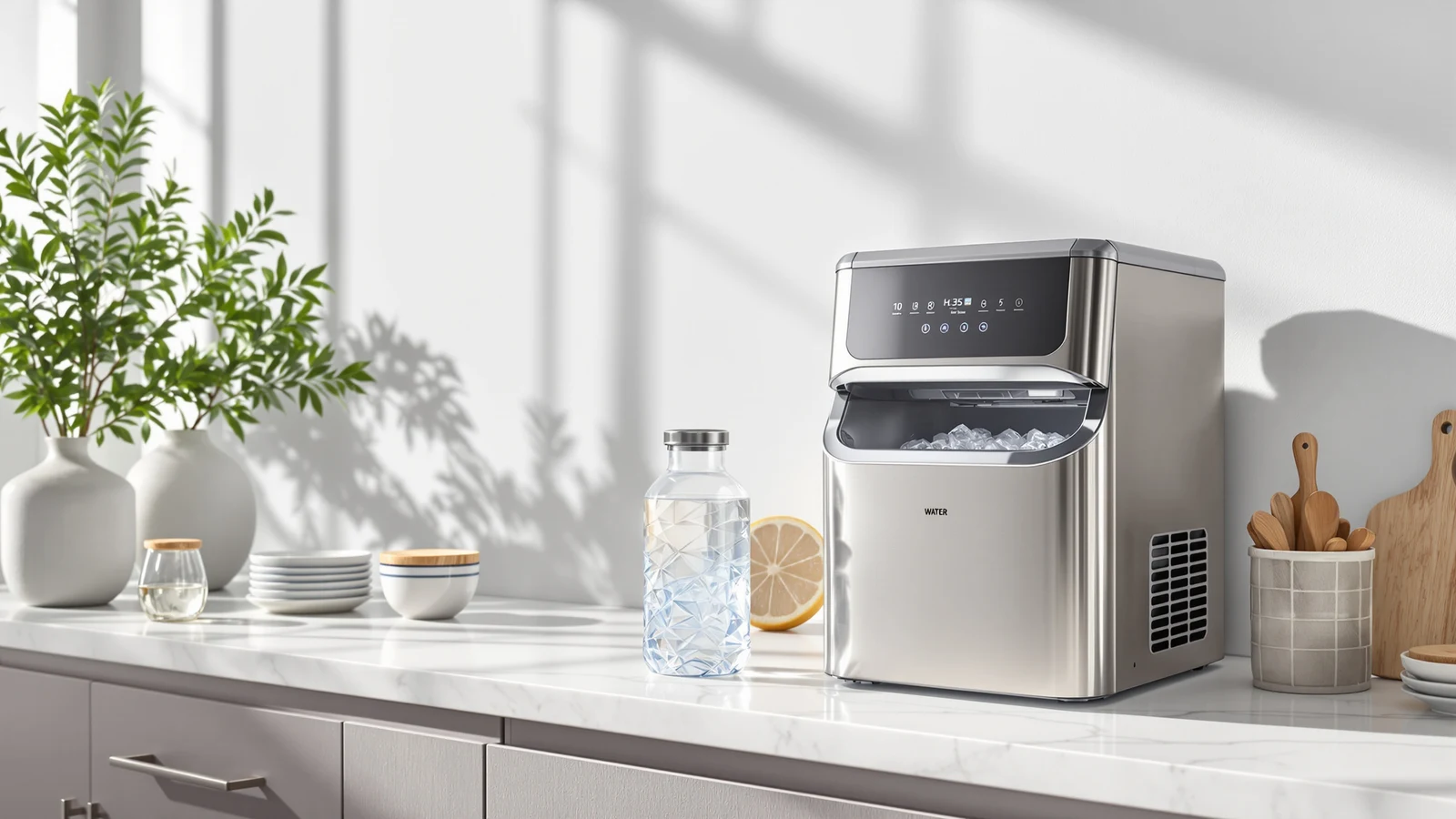
Close-up of a countertop nugget ice maker's open water reservoir being filled from a jug, beside a glass of soft chewable ice pellets
Affiliate disclosure: we may earn a commission if you buy through the Amazon links on this page, at no extra cost to you. See how we picked below.

Shop for a nugget ice maker for more than five minutes and you'll see the same figure over and over: pounds per twenty-four hours. Forty-four is the most common claim in this category right now, and it sits in bold in the title of listing after listing, because a buyer scanning search results reads it as "biggest number wins." It isn't a lie, exactly. It's just answering a question nobody asked. You don't run an ice maker for twenty-four unbroken hours with the reservoir perpetually topped off by an invisible assistant. You run it until the water runs out, then you go refill it, and how often that happens is governed by a completely different spec — one that's often harder to find on the page and sometimes isn't published at all.

This guide is about that spec: the water tank. We compared what three current listings state about reservoir size and fill design — a gallon side tank, a three-litre removable tank, and a model that states neither — worked through the arithmetic for converting a daily figure into something closer to how a household actually uses the machine, and we're explicit about which numbers come straight from a listing and which are simple unit conversion, so you can tell the two apart.

The assumption

A daily figure assumes something nobody does

"44 lbs per 24 hours" is a real number, taken from a real test cycle, but it bakes in an assumption that doesn't survive contact with an actual kitchen: that the reservoir stays full for the entire 24-hour stretch, with no gap in supply. In practice, you fill a tank, the machine runs until that water is gone, and then it stops making ice until a person walks over and pours more in. The daily figure tells you the theoretical ceiling of the compressor and auger working flat out. It tells you nothing about how long you personally go between trips to the sink, because that's set by the tank, not the compressor.

This is exactly why two machines can publish the same headline number and feel completely different to live with. The Silonn and EUHOMY models in this guide both state 44 lbs per 24 hours. The GE Profile Opal Ultra states a lower 38 lbs per day. On the spec sheet, the Opal Ultra looks like it loses. In the kitchen, it's built around a 1-gallon XL side tank — a noticeably larger reservoir than a few litres — which is the entire reason it costs more. A lower daily ceiling paired with a bigger tank can mean fewer interruptions than a higher daily ceiling paired with a small one. The headline number and the lived experience are not the same ranking.

None of this makes the daily figure useless — it's a legitimate measure of raw output, and worth comparing when two tanks are the same size. It just isn't the number that predicts your week. That number is sitting lower on the page, if it's on the page at all.

Doing the math

Litres, hours of running, and converting one into the other

The two kinds of numbers you'll find scattered across nugget ice maker listings are a daily or hourly output (how fast it makes ice while it's running) and, less consistently, a reservoir volume (how much water it's running on). They measure different things, and converting between them honestly requires a step most listings don't give you: how much water the machine actually consumes per pound of ice it produces. None of the three listings compared in this guide publish that conversion rate, so we won't invent one to make the arithmetic look tidier than it is.

What you can convert safely is a daily figure into an hourly one, because that's simple division, not a new fact: a published "44 lbs per 24 hours" works out to roughly 1.8 lbs an hour; the Opal Ultra's "38 lbs per day" works out to roughly 1.6 lbs an hour. That's useful for comparing two machines' raw speed on an hour-for-hour basis — closer than the daily headline makes them look, since 38 and 44 sound further apart than 1.6 and 1.8.

Tank volume itself is also just a unit conversion away from being readable at a glance: a US gallon is about 3.8 litres. The Opal Ultra's 1-gallon side tank and Silonn's 3-litre removable tank are closer in size than "gallon" versus "litres" makes them sound — the gallon tank holds roughly 26% more water than the 3-litre one, not several times more. Where the conversion breaks down is turning either of those volumes into "hours of continuous running," because that step needs the water-per-pound rate neither listing states. Silonn's spec sheet does include a 12-hour timer, but read that as a programmable run-length control — an auto-shutoff setting you dial in — not as a published claim that one full tank lasts twelve hours. Those are two different things wearing the same number, and a listing is allowed to state one without implying the other.

Side by side

The three, compared on tank, not just output

ModelBest forDaily outputStated tankPriceGet it
GE Profile Opal Ultra Fewest trips to the sink 38 lbs/day 1 gal (≈3.8 L) XL side tank $549.00 Get it
Silonn 44 lbs A programmable run timer 44 lbs/24h 3 L removable tank $229.96 Get it
EUHOMY 44 lbs Lowest price, check the listing 44 lbs/24h Not stated $199.97 Get it
Two designs

The side-tank approach versus the bigger-reservoir approach

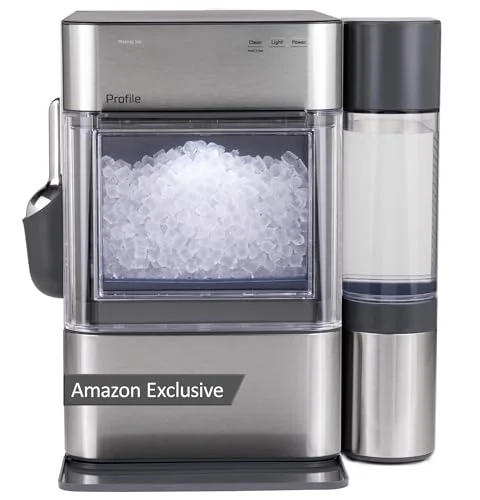
There are two distinct ways a manufacturer answers the refill problem, and the two machines at the top of this guide represent each of them cleanly. The GE Profile Opal Ultra's listing calls its reservoir an "XL Side Tank" — a dedicated one-gallon container mounted to the side of the unit, built to be the primary water source rather than a backup. The design logic is straightforward: make the tank big enough on its own that most households refill it on a daily or near-daily rhythm rather than several times a day, and accept the larger overall footprint and the higher price that come with carrying that much water on the side of the machine.

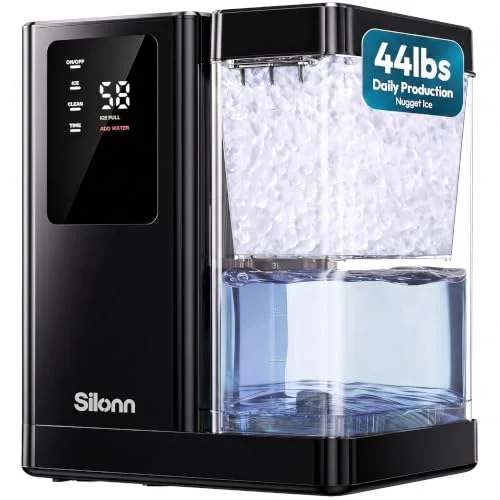
Silonn's listing takes the other route: a 3-litre removable tank built into the body of the unit rather than attached as a separate side component. It's a smaller volume than the gallon tank, but it's also a smaller, lighter unit overall, and "removable" means you lift the whole tank out to fill it at the sink rather than pour water into it in place — useful if your counter layout makes pouring from a jug awkward, less useful if lifting the tank out and back in several times a day gets old.

Neither approach is objectively correct. A side tank buys you fewer refills at the cost of a bigger box and a higher price; a smaller removable tank keeps the unit compact and the price down, in exchange for topping it up more often. The question worth asking before you compare prices is which inconvenience you'd rather have: a bigger appliance taking up counter space, or a smaller one that asks for more attention. That's a household decision, not a spec sheet one, which is also why neither design "wins" the comparison outright below.

The picks

Our picks, read through the tank, not the headline number

01Biggest tank

GE Profile Opal Ultra

Best for a household that wants to refill less often than daily

38 lbs/day·1 gal XL side tank·WiFi, stainless steel·Amazon Exclusive

This is the machine on this page built explicitly around the tank, not the daily number — its own listing leads with the "1 Gal XL Side Tank" before the output figure. At roughly 3.8 litres, that's about a quarter more water on board than Silonn's 3-litre tank, carried in a dedicated side-mounted container rather than a compartment inside the body. The trade for that extra water is the one you'd expect: a bigger unit and the highest price of the three compared here, at $549.00. It's a WiFi-connected stainless steel machine, and the "Amazon Exclusive" on the listing means this particular configuration is sold specifically through Amazon rather than through other retail channels. If the whole point of upgrading is fewer trips to the sink in a week, this is the design built for exactly that question, not a side benefit of a faster compressor.

You're not paying for faster ice here. You're paying to refill less often, which is the actual spec this guide is about.

GE Profile Opal Ultra nugget ice maker with side tank
Price
$549.00
Check price →
02Stated run timer

Silonn Nugget Ice Maker, 3L Tank

Best if you want the tank to lift out and the run length to be programmable

44 lbs/24h·3 L removable tank·12-hour timer

Silonn's listing states a 44-lb daily figure matching the EUHOMY below, but backs it with two specs the EUHOMY listing doesn't give: a stated 3-litre removable tank and a 12-hour timer. Read that timer as a run-length control you set, not a promise that a full tank lasts twelve hours unattended — the listing doesn't state a water-consumption rate, so we won't convert the timer into a guaranteed runtime on your behalf. What the 3-litre figure does let you do is compare this tank honestly against the Opal Ultra's gallon: about three-quarters the volume, in a tank that lifts fully out of the unit for filling at the sink rather than pouring in place. At $229.96, it sits in the middle of this group on price, with the most completely specified tank of the three.

The only one of the three that tells you both the tank size and gives you a timer to set — even if the timer isn't a runtime promise.

Silonn nugget ice maker with removable 3 litre tank
Price
$229.96
Check price →
03Lowest price

EUHOMY 44 lbs Countertop

Best price, but confirm the tank yourself before you buy

44 lbs/24h·Ready in 7–10 minutes·Black finish

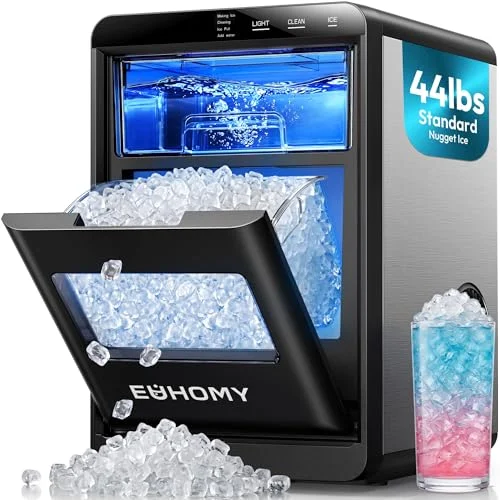
EUHOMY's listing leads with the same 44-lb daily figure as Silonn and adds a stated time-to-first-ice of 7 to 10 minutes — useful for knowing how long you wait after switching it on, but a different measurement from tank size entirely; it tells you nothing about how long the reservoir lasts once it's running. We don't have a stated tank or reservoir volume on file for this listing, which makes it the clearest example in this guide of the gap between the number every listing prints and the number that actually governs refills. At $199.97 it's the least expensive of the three, and that price may well reflect a smaller reservoir, a larger one, or nothing in particular — without the listing stating a figure, that's a guess we won't make for you.

The cheapest way in, and the strongest argument in this guide for checking the tank spec yourself before you order.

EUHOMY countertop nugget ice maker
Price
$199.97
Check price →
The household math

Refills per week: the arithmetic that actually matters

The question a household actually needs answered isn't "how many pounds a day can this machine theoretically produce." It's "how many times this week do I have to stop what I'm doing and pour water into this thing." That number scales with tank volume relative to how your household uses ice, not with the daily output figure printed in the title. Here's the arithmetic, worked through with only the volumes the listings actually state, so you can see exactly where it comes from.

Say a household currently empties the Opal Ultra's 1-gallon (≈3.8-litre) side tank once a day — seven refills a week. Move that same household's water use onto Silonn's 3-litre tank, and because 3 litres is about 79% of 3.8 litres, the arithmetic scales the other direction: the same weekly water throughput now needs roughly 1.26 refills a day to cover the same ground, which works out to around nine refills a week instead of seven — two extra trips to the sink, not a dramatically different routine, but a real one if you're the person doing it. That gap would be bigger set against a one- or two-litre tank, and it's exactly why "44 lbs a day" alone can't tell you which machine asks more of you; the tank-to-tank ratio is doing all the actual work in that sentence.

The honest caveat on this math: it assumes water use scales in proportion to tank size, which holds reasonably well if your household's ice habits don't change between machines, and it says nothing about EUHOMY, because EUHOMY's listing doesn't give us a tank figure to put into the ratio at all. If you're choosing between a stated gallon and a stated 3 litres, this is the calculation to run with your own current refill frequency as the starting point, not the daily-output number on the box.

The gap

What to do when a listing doesn't state the volume

EUHOMY's listing is the example in this guide, and it's a common one across this entire category: a daily output figure and a time-to-first-ice are both printed clearly, and a tank or reservoir volume simply isn't given anywhere in the title, bullets, or the data we have on file for this product. That's not unusual, and it isn't automatically disqualifying — it just means the one spec this entire guide is about is the one spec you have to go find yourself before you can compare it honestly against a Silonn or an Opal Ultra.

A few places that gap is worth checking before you order. The listing's full specification table, below the main bullets, sometimes carries a dimension or capacity figure that doesn't make it into the headline copy. The product images themselves occasionally show a fill line or a measurement overlay, though a photo is not a substitute for a published number and shouldn't be treated as one. The Q&A section on the Amazon listing is often the most reliable source for exactly this kind of gap, because previous buyers frequently ask the tank-size question directly, and either the seller or another owner answers it in writing. Failing all of that, the manufacturer's own product page or the included manual — searchable once you have the model number — is the last honest stop before you're guessing.

What we won't do, and what you shouldn't accept from any guide making this comparison, is infer a tank volume from the daily output figure. A 44-lb daily claim doesn't imply a specific litre count; we've already shown in this guide that two machines quoting the same 44 lbs can run on tanks that aren't the same size, because the published figure measures compressor speed, not reservoir volume. If the number isn't stated, the correct answer is "we don't know yet," followed by the steps above — not a confident-sounding estimate dressed up as a spec.

Our method

How we picked — and what we can’t tell you

What we did

Tank specs, read directly, converted honestly

We compared the published daily output, tank or reservoir volume, and current Amazon price for three countertop nugget ice makers, then did only the arithmetic that unit conversion allows — dividing a daily figure by 24 for an hourly rate, converting a stated gallon into litres, and comparing two stated tank volumes as a ratio. Where a listing states a figure, like Silonn's 3-litre tank or GE's 1-gallon side tank, we report it as given. We did not invent a water-per-pound-of-ice conversion rate to turn a tank volume into a guaranteed number of running hours, because none of these three listings publish one.

What we didn’t

We don’t run a testing lab

We do not physically test these machines, we do not own them, and we do not publish invented scores or ratings. What we can do honestly is read each listing's own stated numbers, convert between units where the conversion is pure arithmetic, and say plainly when a spec — like EUHOMY's tank volume — simply isn't published, rather than estimate one and present it as fact.

FAQ

Common questions

Why do two machines both rated 44 lbs a day feel so different to live with?

Because 44 lbs a day measures how fast the compressor and auger can work when water is continuously available, not how much water is in the tank feeding them. Two machines can publish the identical daily figure while one runs on a 3-litre reservoir and the other on a tank twice that size, and the smaller tank empties — and needs refilling — sooner. The daily number is a real spec, but it answers a question about speed, not about how often you'll be at the sink.

How do I convert a tank's litres into hours of ice-making?

You can't, not accurately, without a water-consumption rate the manufacturer would need to publish, and none of the three listings in this guide give one. What you can convert safely is a daily output figure into an hourly one by dividing by 24 — 44 lbs a day works out to roughly 1.8 lbs an hour — and a stated gallon into litres, since a US gallon is about 3.8 litres. Treat a "12-hour timer" as a run-length setting you choose, not a stated guarantee that one tank of water lasts that long.

Is a one-gallon side tank actually better than a smaller built-in reservoir?

It holds more water — about 26% more than a 3-litre tank — and that generally means fewer refills across a week, which is the entire design point of GE's "XL Side Tank" on the Opal Ultra. The trade is a bigger overall unit and a higher price. A smaller removable tank like Silonn's 3-litre reservoir keeps the machine more compact and the price lower, at the cost of topping it up more often. Neither is objectively correct; it depends whether counter space or refill frequency bothers you more.

What should I do if a listing doesn't state the tank size at all?

Check the full specification table further down the listing, read the Q&A section where previous buyers often ask this exact question directly, and look up the model number against the manufacturer's own product page or manual if needed. Don't estimate the tank size from the daily output figure — we've shown in this guide that the two numbers aren't tied together, so a guess dressed up as a spec is worse than an honest "not stated."