Best Nugget Ice Makers
Small-Kitchen Buying Guide · Countertop Nugget Ice Makers

Counter space is the limit. Tank size is the trade-off.

Every nugget ice maker makes the same soft, chewable pellet ice. What actually changes in a small kitchen is duller and more useful: how much counter the box occupies, how you get water into it, and how often you have to come back and do that again. We looked at three countertop machines built and marketed around a smaller footprint, and compared what their listings actually state — not what we'd guess from the photos.

By Ilane Tall3 compact picks comparedResearch-based — no testing lab, no invented scores

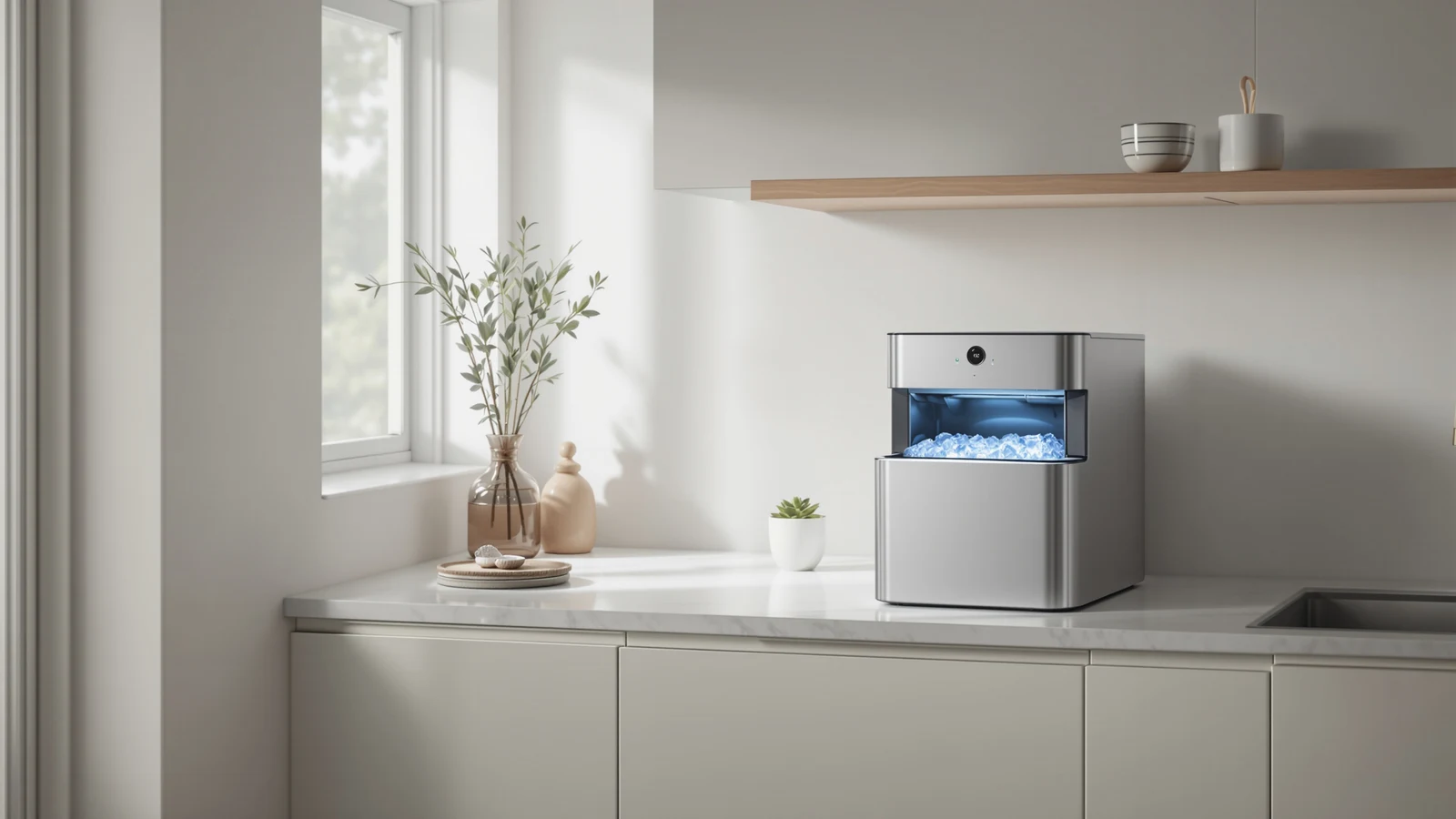
Compact stainless-steel nugget ice maker sitting on a narrow kitchen counter beside a glass of soft chewable ice
Affiliate disclosure: we may earn a commission if you buy through the Amazon links on this page, at no extra cost to you. See how we picked below.

If you've shopped for a nugget ice maker, you've seen the same number everywhere: pounds per day. Thirty-three, thirty-six, forty-four. It's printed in bold in the title of nearly every listing, because it's the number that sells the machine. It is also almost never the number that decides whether the machine fits in your kitchen. A small kitchen doesn't have a pounds-per-day problem. It has an inches problem — a strip of counter next to the coffee maker, a shelf under a cabinet with eleven inches of clearance, a corner that has to also hold the knife block.

This guide is about three machines whose own listings lean into being small: a Silonn model sold with a carry handle, a Frigidaire unit whose name literally includes the word “compact,” and the GE Profile Opal Mini, built around a top-fill design rather than the side tank on GE's larger Opal. None of them are the highest-output nugget makers on the market. That's the point. We compared what their listings state about capacity, fill method and included accessories, and we're explicit below about the one spec none of the three publish with any confidence: the actual footprint.

Spec #1

Footprint is the specification nobody publishes clearly

Open any of these three listings and the headline numbers are daily output, bin size and price. Width and depth in inches — the number that actually tells you whether the machine clears your microwave and still leaves room for the lid to open — sits buried in a secondary specifications table, if it's there at all consistently. None of the three products in this guide publish a footprint figure we're confident enough in to repeat here as fact, which is itself the useful finding: if you're buying for a tight counter, do not trust the hero image for scale. Pull up the specification table on the actual listing, or the product's own size chart, before you order.

What the listings do tell us, reliably, is how each brand is positioning the machine. The Silonn Nugget Ice Maker with Carry Handle ships with, as the name says, a handle — a strong signal that the company expects you to lift and move it, not just set it down once and leave it. A machine designed to be carried is, by implication, designed to be smaller and lighter than one that's expected to stay bolted to one corner of the counter permanently. The Frigidaire unit is sold explicitly as “Compact,” the word appearing in the product name itself, next to its stated 33 lbs per day output — the lowest of the three we compared, which is consistent with a smaller internal mechanism. GE markets its Opal Mini as a “Portable Countertop Pellet Ice Machine,” language GE does not use for its larger Opal line.

None of that is a substitute for a tape measure. It is, though, a reasonable signal that these three were engineered toward a smaller footprint rather than simply discounted versions of bigger machines. If you want the number in inches, treat the listing's own specification table as the only source, confirm it against the product images' stated dimensions where given, and measure your counter before you measure the machine.

Spec #2

Top-fill versus pulling the machine forward

In a normal-sized kitchen, how you add water to a nugget ice maker is a minor inconvenience. In a small one, it can decide where the machine is allowed to live. Some designs fill from a reservoir accessed from the top, so you can pour a jug of water straight in while the unit sits pushed back against a wall or tucked under a cabinet. Others store their tank lower down or at the back, which means every refill involves pulling the whole machine forward, off the shelf or out from the wall, finding the access panel, and then pushing it back and squaring it up again.

Of the three machines here, the GE Profile Opal Mini is the one whose listing states its fill method outright: it's built around a Top Fill Water Reservoir. That's stated in the product name itself, not inferred from a photo, and it is the single most useful fact in this entire guide for anyone working with a narrow counter. A top-fill design means the Mini can sit flush against a backsplash with nothing behind it, and a refill is a straight pour from above rather than a two-handed shuffle.

We don't have an equivalent statement for the Silonn or the Frigidaire in the information we have on file for either listing. That's not the same as saying they're rear-fill — it's that we won't assert a fill method we can't point to in the product's own data, and neither should you take it on faith from a thumbnail. If the fill method matters to your counter layout, which in a small kitchen it usually does, check the listing's own description and images for the words “top fill” or a visible reservoir lid on the lid of the unit before you buy either of those two.

Spec #3

What you give up in tank volume when you shrink the box

Shrinking the footprint of a nugget ice maker has to take the volume from somewhere, and it's almost always the water reservoir and the ice bin. Larger countertop nugget machines in this category typically ship with multi-litre side tanks and bins that hold several pounds of ice before they need attention; that's the trade a compact model asks you to make in the other direction. Smaller tank, smaller bin, more frequent refills — in exchange for the inches of counter you get back.

The GE Profile Opal Mini is the one machine here with a stated bin size: a 2 lb bin, per the listing. That's a modest amount of standing ice at any one time, though it matters less than it sounds, because nugget ice isn't frozen solid in that bin — it's compacted flakes that melt back into the reservoir and get remade continuously, the same way it works on every countertop nugget machine regardless of size. A 2 lb bin isn't really "2 lbs of storage you'll run out of"; it's closer to a buffer that the machine keeps topped up on its own while it's running. GE pairs the Mini with a 6-pack of descaler and a scoop included in the box, which is a reasonable sign the company expects regular upkeep rather than a set-and-forget appliance.

We don't have a stated tank or bin volume for the Silonn or the Frigidaire in the data we're working from here, beyond their daily output figures — 36 lbs per 24 hours for the Silonn, 33 lbs per day for the Frigidaire. Daily output and reservoir size are related but not the same number, and a listing that only states one tells you less than it seems to. If tank volume is the deciding factor for you, that's a detail worth confirming on the listing itself rather than assuming from the output figure alone.

Side by side

The three, compared

ModelBest forDaily outputNotable specPriceGet it
GE Profile Opal Mini A flush fit against the wall 36 lbs/day Top-fill reservoir, 2-lb bin $242.10 Get it
Silonn Nugget Ice Maker Moving it out of the way 36 lbs/24h Built-in carry handle $161.99 Get it
Frigidaire Countertop Nugget Ice Maker A known name, compact size 33 lbs/day Metallic finish $179.00 Get it
The picks

Our picks, and who each one is for

01Best top-fill

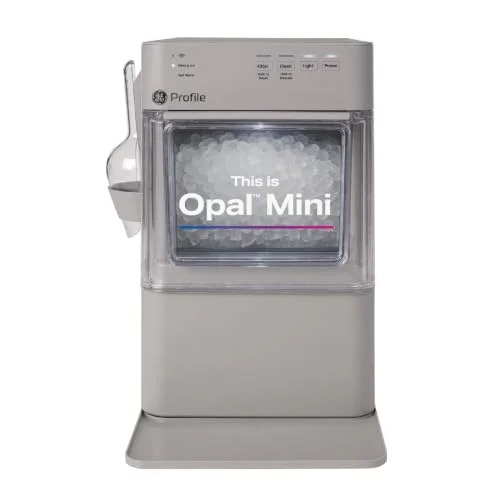
GE Profile Opal Mini

Best for a counter with nothing behind it to pull forward into

36 lbs/day·Top-fill reservoir·2-lb bin·6-pack descaler and scoop included, Stone Grey

Of the three machines here, this is the only one whose own listing states a top-fill design outright, and in a small kitchen that single detail does more work than any output figure. You can push it back against a backsplash or wedge it into a corner and still refill it by pouring straight down into the reservoir, instead of dragging the whole unit forward to reach a rear tank. Daily output is stated at 36 lbs, in line with the Silonn, and GE ships it with a 6-pack of descaler and a scoop — a sign the company expects you to maintain it regularly rather than ignore it until it slows down. The 2-lb bin is the smallest stated capacity of the three, but because nugget ice recirculates and remakes rather than sitting in frozen storage, that number matters less day to day than it looks on paper.

If the machine has to live flush against a wall, this is the one spec that actually solves your layout problem.

GE Profile Opal Mini nugget ice maker
Price
$242.10
Check price →
02Best to move around

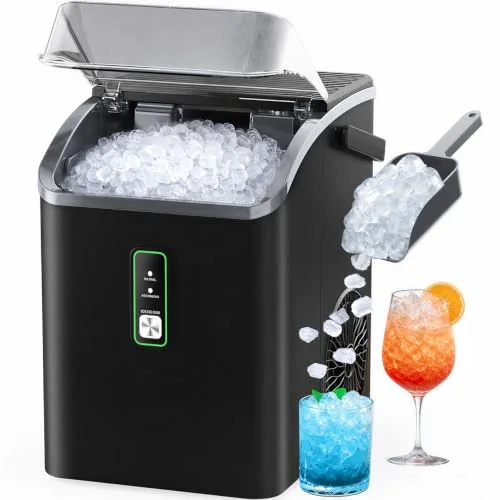
Silonn Nugget Ice Maker with Carry Handle

Best for a kitchen where the machine doesn't get one permanent spot

36 lbs/24h·Built-in carry handle·36lbs capacity variant

This is the lowest price of the three, and the carry handle built into the design is the detail that earns it a place here: a small kitchen often doesn't have room to dedicate a permanent spot to an appliance you use occasionally, and a machine designed to be picked up and moved to a pantry shelf or a cabinet between uses solves that without needing a bigger counter. Stated output is 36 lbs per 24 hours, matching the GE Mini. We don't have a published fill method or tank volume for this listing, so if either of those is the deciding factor for your layout, check the product page directly before ordering — we're not going to guess at a spec the listing itself doesn't commit to.

The cheapest way into this category, and the only one of the three built to be carried, not just placed.

Silonn nugget ice maker with carry handle
Price
$161.99
Check price →
03Best known name

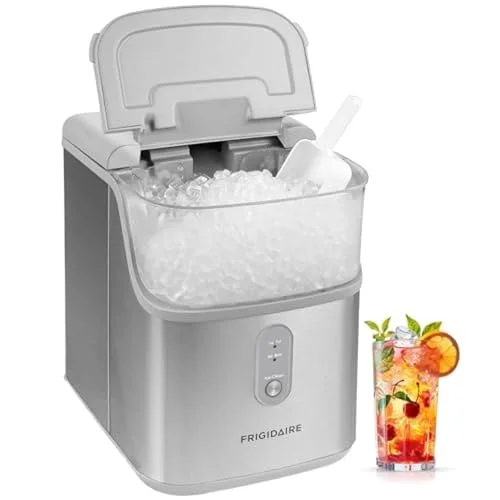
Frigidaire Countertop Crunchy Chewable Nugget Ice Maker

Best if you want a brand with a service network behind a compact machine

33 lbs/day·Compact design·Metallic finish

The lowest stated daily output of the three at 33 lbs, and the listing calls the unit “Compact” in its own name rather than leaving footprint to inference. What you're paying a little more than the Silonn for here, at roughly the same size class, is the Frigidaire name and the metallic finish rather than a documented capacity advantage — we don't have a stated tank size or fill method for this listing either, so treat those as unknowns to confirm yourself rather than assumed wins. For a small kitchen where brand recognition and a tidy metallic look matter as much as the spec sheet, this is the reasonable version of that trade-off.

You're buying the name and the finish at this size point, not a documented edge in capacity.

Frigidaire countertop nugget ice maker
Price
$179.00
Check price →
The real trade-off

When a smaller machine means more refills, not less convenience

It's tempting to read “compact” as a strictly better version of “convenient,” and for a small kitchen it often is — but not because the machine needs less attention. It's the opposite: a smaller reservoir and a smaller bin, which is what makes the footprint smaller in the first place, generally need topping up more often than a machine built around a gallon side tank. The GE Profile Opal Mini's 2-lb bin and top-fill design mean short, frequent refills rather than long stretches of unattended running. The convenience a compact machine offers isn't fewer interruptions during the day. It's getting the counter back the rest of the time, and not needing to plan around an appliance that occupies two square feet permanently.

That trade is the right one for a one- or two-person household that wants ice available daily but doesn't run through it constantly, and the wrong one for anyone who entertains often or goes through ice in volume — a weekend of guests will mean several refills on any of these three machines, where a larger-tank model elsewhere in the category would need only one or two. If that's your household, the honest answer is to look at machines with bigger stated reservoirs, even if it costs you some counter space. If your real constraint is the counter itself, and you're fine topping up a reservoir once or twice a day rather than once every several hours, any of the three machines above does that job without asking for room you don't have.

See our full comparison of six countertop nugget ice makers on the homepage if a bigger-tank model is a better fit for how you actually use ice, and our side-by-side spec table there for daily output and tank size across the wider range.

Our method

How we picked — and what we can’t tell you

What we did

Listing data, compared directly

We compared the published product names, stated daily output, included accessories and current Amazon prices for three countertop nugget ice makers marketed around a smaller footprint, then read each listing specifically for fill method and tank or bin size — the two specs that matter most once counter space is the constraint. Where a listing stated a spec directly, like the GE Mini's top-fill reservoir and 2-lb bin, we report it. Where it didn't, we say so rather than fill the gap with a guess.

What we didn’t

We don’t run a testing lab

We do not physically test these machines, we do not own them, and we do not publish invented scores or ratings. What we can do honestly is read every listing's own claims, set them against each other, and be explicit about which figures are published specifications and which are simply absent from the data we have. For footprint specifically — the spec that matters most for this guide — none of the three listings publish a dimension we'd repeat here with confidence, and we say that plainly rather than estimate one from a photo.

FAQ

Common questions

What's the actual footprint of these machines?

None of the three listings we compared publish a width-and-depth figure we're confident enough in to state here as fact, and that's worth knowing before you shop by photo alone. What each listing does make clear is its positioning toward a smaller size: the Silonn ships with a carry handle, the Frigidaire's own name includes the word “Compact,” and GE markets the Opal Mini as a “Portable Countertop Pellet Ice Machine.” Treat those as directional signals, and check the seller's own specification table or size chart for exact inches against your counter before ordering.

Does top-fill matter if the machine is already small?

It matters more, not less. A smaller machine is more likely to end up pushed into a corner or against a backsplash with little room behind it, and a rear or internal reservoir in that spot means pulling the whole unit forward every time you refill. The GE Profile Opal Mini is the one machine in this guide whose listing states a top-fill reservoir outright, which means it can sit flush against a wall and still be refilled by pouring from above. We don't have an equivalent statement for the Silonn or the Frigidaire, so check each listing's own description if fill method decides your layout.

What do I give up in tank size by choosing a compact model?

Generally, reservoir volume and bin capacity, which is where the size savings usually come from. The GE Profile Opal Mini states a 2-lb bin, the smallest stated capacity of the three machines compared here; the Silonn and Frigidaire don't publish a tank or bin figure in the data we have, only their daily output — 36 lbs per 24 hours and 33 lbs per day respectively. A smaller bin isn't frozen storage running out; nugget ice recirculates and remakes continuously on every countertop machine in this category regardless of size, so the practical difference is how often you top up the water, not how much ice is available at any instant.

Will a smaller machine mean I'm refilling it constantly?

More often than a machine built around a larger side tank, yes — that's the direct trade for the smaller footprint. For a household that wants ice daily without running through large volumes, that trade is usually worth it in exchange for the counter space back. If you entertain often or go through ice quickly, a compact model will mean noticeably more interruptions over a busy weekend than a machine with a bigger stated reservoir, and in that case it's worth looking at larger-tank options even if they cost more counter room.