Best Nugget Ice Makers
Buying Guide · Countertop Nugget Ice Makers

Does a nugget ice maker need a timer?

One machine in this comparison states a 12-hour timer by name. The other two don't mention one at all — one replaces it with an app and a voice assistant, the other asks you to simply remember. We looked at what a stated timer actually switches off, what the alternatives cover instead, and whether it's worth paying for versus just setting a reminder on your phone.

By Ilane TallUpdated November 6, 2026Research-based — no testing lab, no invented scores

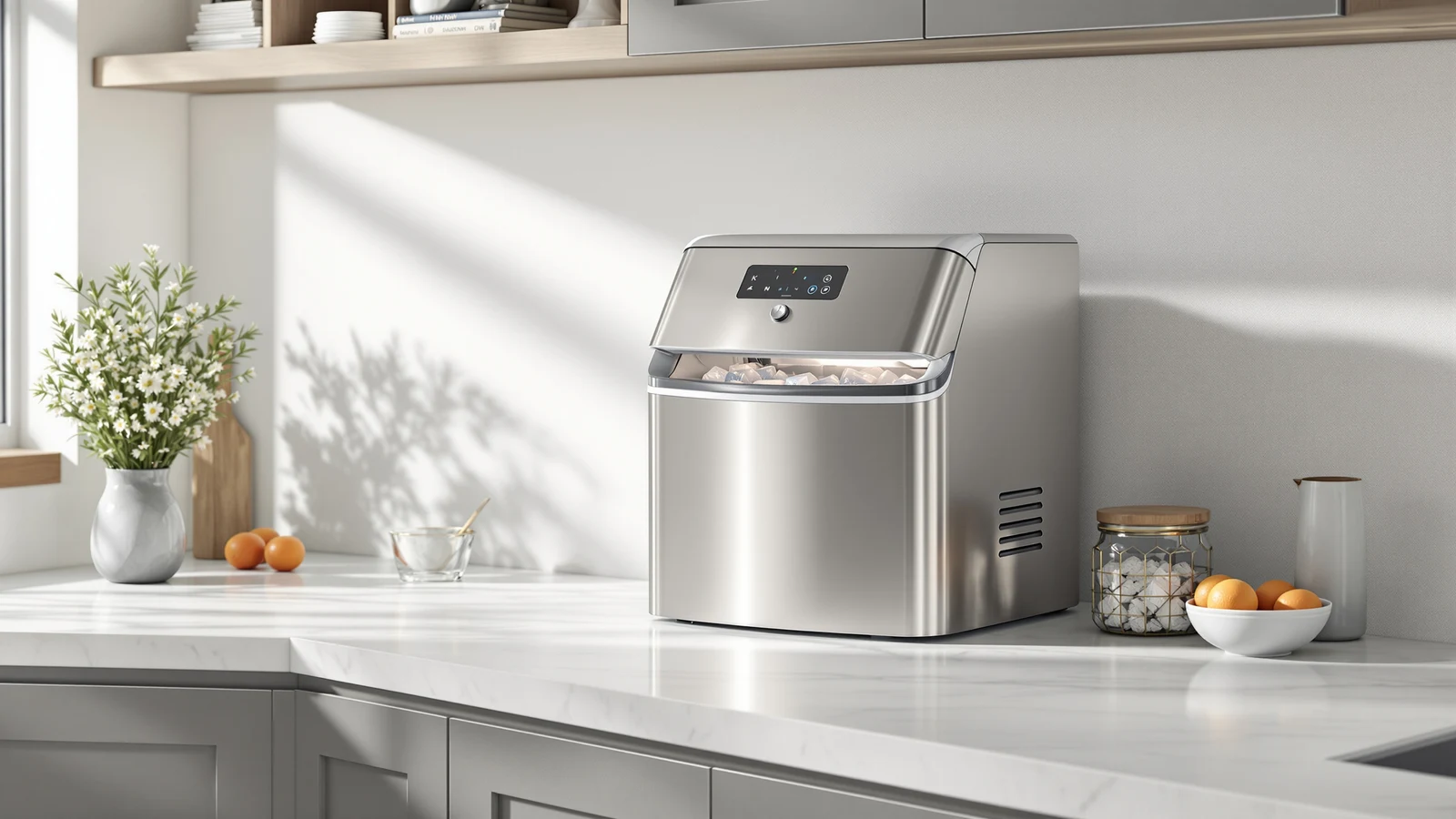
Countertop nugget ice maker control panel showing a timer setting, beside a glass filled with soft chewable ice
Affiliate disclosure: we may earn a commission if you buy through the Amazon links on this page, at no extra cost to you. See how we compared below.

Scroll through enough nugget ice maker listings and you'll notice that most of them don't mention a timer at all. They mention pounds per day, tank size, how fast the first batch comes out. Then, every so often, one listing breaks the pattern and states a specific number: a 12-hour timer. It reads like a minor convenience feature, tucked in after the headline specs. It's worth taking seriously anyway, because it's actually answering a question the other listings never raise: what happens to this machine if nobody is standing next to it when it finishes.

Of the three machines we're comparing here, exactly one names a 12-hour timer in its own title: the Silonn 44 lbs model with a 3-litre removable tank. The second, a different Silonn model built around app and voice control, replaces a physical dial with a phone and a smart speaker. The third, an EUHOMY countertop unit, states neither — no timer, no app, just a machine you start and, implicitly, a machine you're expected to come back to. None of that makes one of them broken. It makes them three different answers to the same underlying question, and this guide is about figuring out which answer actually fits how you use the kitchen.

What the spec means

What a stated 12-hour timer actually switches off

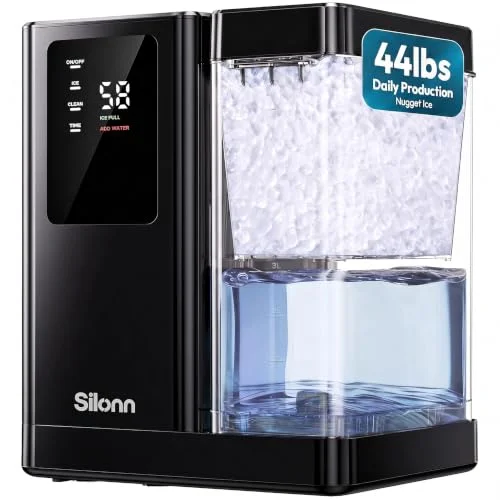
The one machine in this comparison that names the feature directly is the Silonn Nugget Ice Maker 44lbs/24H with 3L Removable Tank and 12H Timer (ASIN B0H3KR9255), and the listing's own name is specific: a 12-hour timer. We don't have a manufacturer manual in front of us describing the exact logic down to the second, so we won't invent one — but the function such a timer serves in this category of appliance is well understood, and it's worth being precise about what it is and isn't.

A stated timer of this kind on a countertop ice maker is an auto-shutoff: a cap on how long the machine is allowed to keep running once a cycle starts, rather than a scheduling feature that turns it on later. It's the same basic idea as the auto-off timer on a space heater or a window air conditioner — not "start me at 6pm," but "don't let me run forever if nobody's watching." On a nugget ice maker specifically, that distinction matters because of how the category works: a countertop unit recirculates its own water continuously, melting and remaking ice in a loop, for as long as it's powered and has water to draw from. Nothing inherent in that loop tells the machine to stop on its own. A timer is the thing that imposes a stopping point.

What it is not is a guarantee against every failure mode. A 12-hour cap doesn't know whether the bin is already full after three hours, and it doesn't know whether the tank ran dry at hour two. It knows one thing: how much time has elapsed since the cycle started. That's a narrower job than "watch the machine for me," and it's worth holding that distinction in mind before deciding how much the feature is worth to you.

The alternative to a dial

The app-and-voice alternative: scheduling without a physical dial

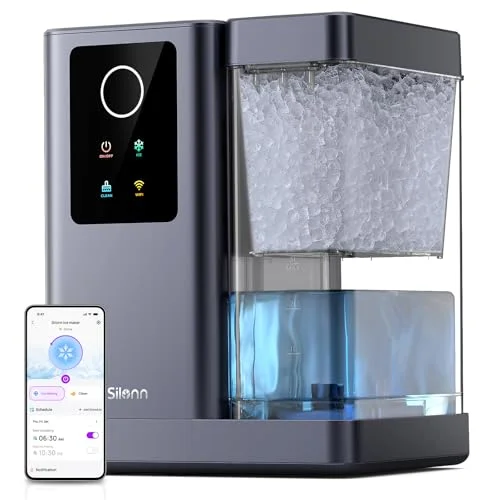
The second machine in this comparison takes a different approach entirely. The Silonn Nugget Ice Maker Countertop with APP & Voice Control (ASIN B0G194Y31M) doesn't list a physical timer dial in its name — it lists app and voice control instead, alongside a 3-litre water tank and a stated 44 lbs per 24 hours. That's a meaningfully different piece of automation. A dial-based timer is fixed logic built into the unit: set it, and it enforces one rule. App control hands the scheduling to software you carry around, which means the rule isn't fixed at all — you can start it, stop it, or check on it from another room, in principle without ever touching the machine's own panel.

The trade-off is what each one asks of you in the moment. A built-in timer works the instant you press it, with no network, no app update, and nothing to pair. App and voice control ask you to have a phone nearby, a working connection, and the patience to open an app instead of pressing a button on the unit itself — in exchange for being able to do that from the next room, or stop a cycle you forgot about before you even reach the kitchen. For comparison, the GE Profile Opal Ultra's WiFi app works the same way: the value isn't a feature the dial version lacks, it's being able to act on the machine without being next to it.

Neither approach is strictly more capable than the other at the single job a timer exists to do — stopping a cycle that's gone on too long. App control can do that job and more, as long as the app and the network cooperate. A built-in timer does one job, reliably, with nothing else to go wrong. Which one you want depends on whether you'd rather have fewer things that can fail, or more control over when the machine stops.

Neither feature

What a basic machine without either asks you to remember instead

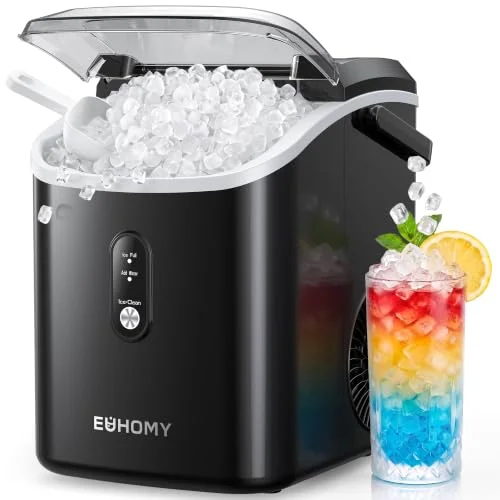
The third machine here, the EUHOMY Nugget Ice Maker Countertop with Handle (ASIN B0GXB42S3F), states neither a timer nor an app. Its listing leads with what it does well: ready in 6 minutes, 34 lbs of ice per day, a removable top cover, auto-cleaning, and a handle that makes it genuinely portable — the brief calls out home, party, RV and camping use. None of that is a smaller or lesser machine than the other two. It's a different set of priorities, and automated shutoff simply isn't one of the ones EUHOMY chose to build in or advertise for this model.

What that means in practice is straightforward: the thing a timer or an app would otherwise track is now on you. If you start a batch and walk away, there's no built-in mechanism stopping the cycle at a fixed point, and no phone notification checking in on it from another room. That's not a defect specific to this ASIN — it's true of any countertop appliance that doesn't advertise an auto-shutoff, and plenty of perfectly good kitchen equipment works exactly this way. It just shifts the job of noticing from the machine to the person who turned it on.

Whether that's a real cost depends entirely on the household, which is a theme that comes up across this whole category: see our comparison of name-brand machines against the unfamiliar brands for how much a manufacturer's own reputation does or doesn't substitute for a feature like this. A machine with a carry handle, meant to move between a kitchen counter and a cooler on a camping trip, is already being used in short, attended bursts by design. The absence of a timer matters a lot less on a machine you're actively watching than on one you'd be tempted to start and forget.

The failure it's meant to prevent

Overflow and continuous operation: the failure a timer is meant to prevent

To understand why a timer exists on some of these machines at all, it helps to be specific about the failure it's guarding against. Every countertop nugget ice maker in this category works the same basic way: water sits in a tank, the machine freezes and shaves it into soft pellets, the pellets drop into a bin, and whatever melts goes back into the tank to be remade. That loop has two limits that a timer can sit in front of — the bin filling with ice faster than it's used, and the tank running low on water while the machine keeps trying to draw from it. A machine left running well past the point its bin is full doesn't have anywhere for new ice to go, and a machine that keeps cycling with insufficient water in the tank is running outside the conditions it was designed for. Neither outcome is dramatic on its own, but both are the kind of thing an unattended, continuously operating appliance can drift into if nothing ever tells it to stop.

This is exactly where daily-output numbers like the 44 lbs stated for both Silonn models, or the 34 lbs stated for the EUHOMY, can be misleading if read in isolation — they describe what the machine can produce under ideal, continuously-topped-up conditions, not what happens once that condition stops being true. We go into this more directly in how many pounds of ice a day you actually need, and the same logic extends to machines rated for the higher end of this category's output, which we cover in our look at the highest-capacity nugget ice makers currently available: a bigger number on the box doesn't change what happens if the machine runs unattended for longer than anyone planned.

A 12-hour timer doesn't solve bin overflow or a dry tank directly — it can't see either condition. What it does is put an outer boundary on how long the cycle that could lead to either one is allowed to continue without a person checking in. That's a narrower, more honest description of the feature than "prevents overflow," and it's the right way to think about what you're actually buying when a listing states one.

The actual cost of each answer

Whether a timer is worth paying more for — or just worth setting a phone reminder instead

Put the three prices next to each other and the premium for built-in automation is smaller than you'd expect. The EUHOMY, with no timer and no app, is $139.80. The Silonn with app and voice control is $251.69. The Silonn with the stated 12-hour timer is $218.45 — fifteen dollars above the app-controlled model, and about $133 above the EUHOMY. Both Silonn models also carry a larger 3-litre tank and a 44 lbs daily rating against the EUHOMY's 34 lbs, so the price gap isn't purely about the automation; tank size and output are moving at the same time. Still, the fifteen-dollar difference between the two Silonn models is close enough to isolate: that's roughly what a built-in timer costs over app-and-voice control on a comparable machine, which tells you the timer itself isn't the expensive part of either listing.

Compare that to the free alternative: a phone alarm. If the only thing you want from a timer is "stop me from forgetting this is running," your phone already does that job for nothing, on any machine, including the EUHOMY. You lose the one advantage a built-in auto-shutoff has over a reminder — it acts even if you ignore the notification, sleep through it, or leave the house — but you keep every dollar of that $133 gap. For a machine you're going to be standing near anyway, like one with a Silonn-versus-EUHOMY-style comparison usually turns up, a reminder is arguably doing the same job as the built-in feature, just with a person in the loop instead of a circuit.

Where that logic breaks down is exactly the case app control is built for: you're not near the machine, and you want the ability to check on it or stop it from somewhere else. A phone reminder tells you a cycle has probably gone on long enough; it does nothing about actually stopping it if you're not in the kitchen. That's the gap the app-and-voice model is pricing in at $251.69, and it's a different value proposition from the flat $15 premium the built-in timer carries over it. The honest framing isn't "timer versus no timer." It's three separate answers to "who or what is responsible for noticing when this has run long enough" — a circuit, an app on your phone, or you, unassisted — each at a different price and each asking something different of you in return.
Side by side

The three, compared

ModelShutoff methodDaily outputWater tankPriceGet it
Silonn 44 lbs with 12H Timer Built-in 12-hour timer 44 lbs/24h 3 L removable $218.45 Get it
Silonn with APP & Voice Control App / voice, remote stop 44 lbs/24h 3 L removable $251.69 Get it
EUHOMY with Handle None stated — manual only 34 lbs/24h Not stated $139.80 Get it
The picks

The picks, by how much you trust yourself to check the bin

01If you forget things

Silonn Nugget Ice Maker 44lbs/24H with 3L Removable Tank and 12H Timer

Best if you know you'll walk away and not come back on schedule

44 lbs/24h·3 L removable tank·12-hour timer·Price $218.45

This is the one machine here that states an automatic stopping point by name. It costs $15 more than the app-controlled Silonn and roughly $133 more than the EUHOMY, for a feature that works without a phone, a network, or you remembering anything at all once the timer is set. If the honest answer to "will you check on this" is "probably not within twelve hours," this is the model built around that answer, not around hoping you do better next time.

The cheapest insurance against your own memory, not against overflow specifically — it just caps how long the risk window stays open.

Silonn nugget ice maker with removable tank and 12-hour timer
Price
$218.45
Check price →
02If you want control, not just a cap

Silonn Nugget Ice Maker Countertop with APP & Voice Control

Best if you're often away from the kitchen but want to act, not just be protected

44 lbs/24h·3 L tank·App & voice control·Price $251.69

Fifteen dollars cheaper than the timer model, but doing a different job. A fixed timer enforces one rule automatically; an app lets you check on the machine or stop it from wherever you actually are, as long as your phone and the network are cooperating. If you'd rather glance at a screen and decide than rely on a cap you set hours ago and forgot the exact length of, this is the one built for that instinct.

More capable than a dial when the network holds. A dial doesn't care whether the network holds.

Silonn nugget ice maker with app and voice control
Price
$251.69
Check price →
03If you check the bin anyway

EUHOMY Nugget Ice Maker Countertop with Handle

Best if you're already standing near it when it runs

34 lbs/24h·Ready in 6 min·Removable top cover, auto-cleaning·Price $139.80

No timer, no app, and over $130 cheaper than the model that has one. That's a reasonable trade if a shutoff cap isn't solving a problem you actually have — a portable, handled machine meant for a party, an RV or a camping trip is already being used in short, attended runs where someone's nearby by default. Set a phone reminder if you want a backstop; you'll have spent nothing extra to get most of what the built-in timer offers.

You're not buying the absence of a feature. You're buying $133 back, in exchange for doing the watching yourself.

EUHOMY nugget ice maker with handle
Price
$139.80
Check price →
Our method

How we compared — and what we can’t tell you

What we did

Listing names, specs and prices

We compared what each of these three listings states in its own product name and specifications — a 12-hour timer on one, app and voice control on another, neither on the third — against current Amazon prices, and against general, well-documented facts about how continuously-recirculating countertop ice makers operate as a category. Where a listing doesn't state a spec, such as the EUHOMY's tank volume, we say so rather than assume one.

What we didn’t

We don’t run a testing lab

We do not physically test these machines, we do not own them, and we have not timed how long any of them actually runs before shutting off. We have no owner reviews or star ratings for these three ASINs, so none are cited here, paraphrased or implied. What we can do honestly is read what each listing states, compare it against the others, and explain what a feature like a stated timer does and does not guarantee.

FAQ

Common questions

Does a 12-hour timer start the machine, or stop it?

Stop it. A stated timer of this kind on a countertop nugget ice maker is an auto-shutoff that caps how long a cycle is allowed to keep running once it's started — it isn't a scheduling feature that turns the machine on later in the day. Think of it the same way you would an auto-off timer on a space heater: a safety boundary on an ongoing cycle, not an alarm clock.

Can app and voice control do everything a built-in timer does?

For the specific job of stopping a cycle, yes, and more — as long as your phone is nearby and connected and the app itself is responding. The Silonn model with app and voice control lets you start, stop or check on the machine remotely, which a fixed dial-based timer can't do. The trade is reliability versus flexibility: the built-in timer works the same way every time with nothing to pair, while app control depends on the network cooperating.

If my machine has no timer, will it overflow if I forget about it?

Not necessarily, but nothing is actively preventing it either. Every countertop nugget ice maker recirculates water and remakes ice continuously for as long as it's running, and a machine with no stated auto-shutoff relies entirely on a person noticing the bin is full or the tank is low. That's a real difference from a machine with a timer, but it isn't automatically a failure — a lot depends on whether the machine is the kind you'd be using unattended for long stretches in the first place.

Is it worth paying extra for a built-in timer over just setting a phone reminder?

It depends on what you're protecting against. A phone reminder is free and works on any machine, but it only works if you actually hear it, act on it, and are physically present to do so. A built-in timer keeps working even if you ignore every notification or leave the house. Comparing the two Silonn models here, the built-in timer costs about $15 more than the app-controlled version — a small premium for automation that doesn't depend on you noticing anything.