Best Nugget Ice Makers
Buying Guide · Countertop Nugget Ice Makers

How many pounds of ice a day do you actually need?

The daily figure on the box ranges from 33 lbs to 60 across this category, and almost nobody shopping for one of these machines knows which end of that range their household belongs on. The number means nothing on its own. It only becomes useful once you attach it to how many people live in the house and how they actually use ice — and that's the question this guide answers before tank size or price ever enters the decision.

By Ilane TallUpdated November 2, 2026Research-based — no testing lab, no invented scores

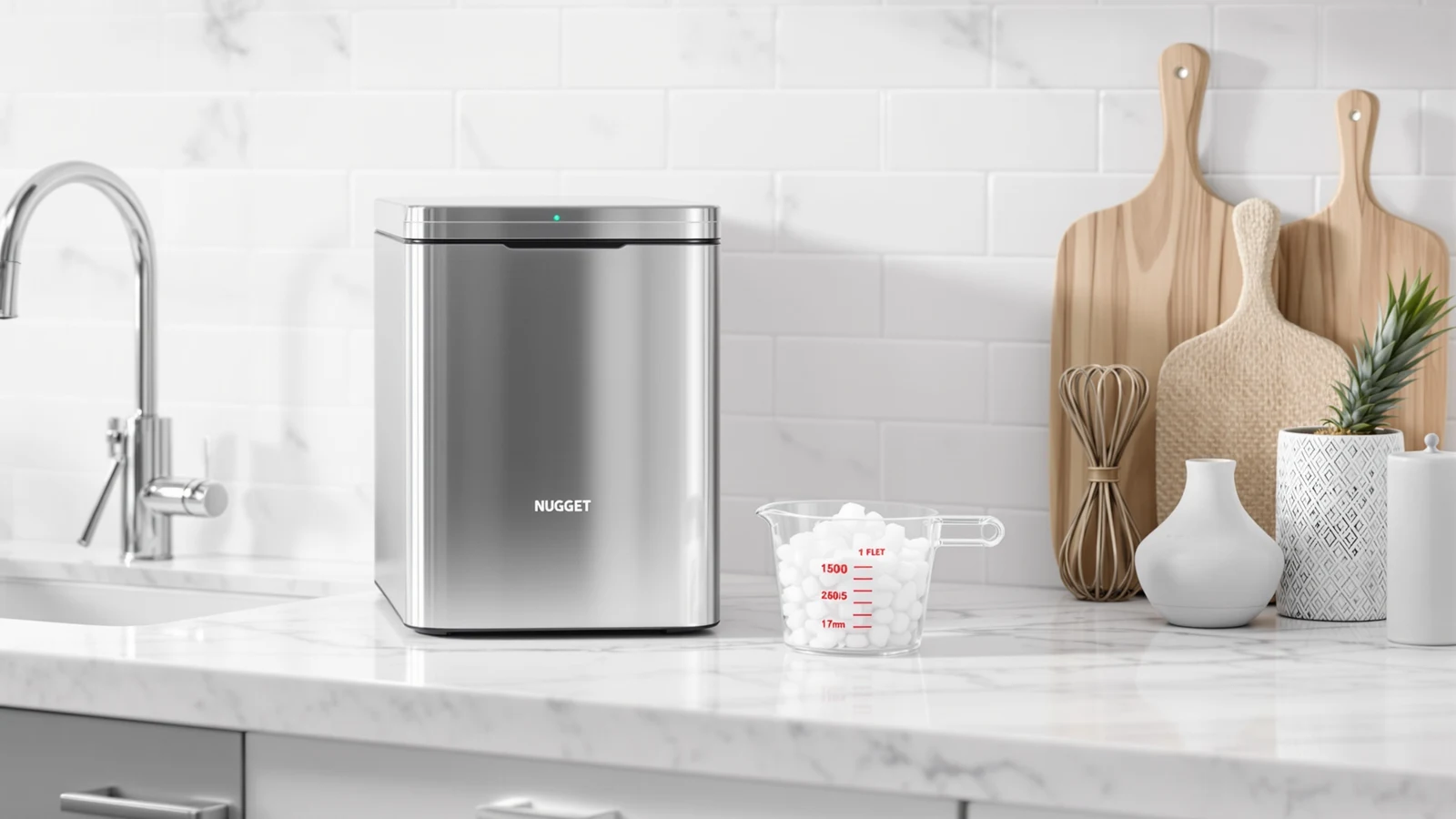
Countertop nugget ice maker on a kitchen counter next to a measuring cup of chewable ice pellets, illustrating how to size daily ice output to household size
Affiliate disclosure: we may earn a commission if you buy through the Amazon links on this page, at no extra cost to you. See how we picked below.
Quick answer

The short version

Figure roughly 1 to 1.5 cups of ice per person, per day, for ordinary daily drinking — a glass of water at lunch, a soda in the afternoon, an iced coffee or two. Multiply that by the number of people in the house and you'll land on a number in cups, not pounds; a gallon of loosely packed nugget ice runs somewhere around 3 to 4 lbs, so a household of two or three drinking normally is very rarely burning through more than a few pounds in an ordinary day. That's the gap almost every published spec sheet ignores: a 33–38 lbs/day machine, like the EUHOMY 38 lbs or the Frigidaire 33 lbs, covers that household with room to spare, every single day, forever. A 60 lbs/day machine like the GoveeLife Pro only earns its keep if you regularly fill a cooler, run a party of a dozen-plus, or keep a drink station going for hours at a stretch. For most one-, two- and three-person households, the right answer to “how many pounds a day do I need” is: fewer than the box in front of you is probably trying to sell you.

Before you buy

Things to know before the number on the box decides anything

01

The daily figure assumes 24 hours of running

Every manufacturer's pounds-per-day number assumes the machine runs continuously for a full day with the reservoir kept topped up. Nobody does that. The honest number is the hourly rate, which is a fraction of the headline figure.

02

The bin isn't storage, it's a buffer

Nugget ice is soft, compacted flakes, not a frozen block. It melts back into the reservoir and gets remade continuously. A bigger daily rating doesn't mean more ice sitting ready at 6pm — it means the machine can replace what melts faster.

03

Tuesday and the party are two different problems

Sizing for the one afternoon a year you host twelve people means overbuying for the other 364 days. The better approach, covered below, is to size for the household you actually live with and plan separately for the occasional event.

04

Price scales with tank and speed, not just capacity

A machine rated at 60 lbs a day usually also has a bigger reservoir and a faster cycle, which is where most of the price difference actually lives — not in some hidden daily-output premium.

Why trust us

Why you should trust us

This guide is written by Ilane Tall for Best Nugget Ice Makers, a site that compares countertop nugget ice makers on published specifications, current Amazon prices and public product data. We do not own every machine in this category and we do not run a physical testing lab — nobody credibly runs two dozen ice makers side by side on a kitchen counter for a season. What we do is read the manufacturer's own numbers closely, compare them against each other, and say plainly which figures are checkable facts and which are marketing. We have no star ratings or review counts for the products named in this guide, so we don't manufacture any; every claim below is anchored to a published spec, a price, or a general fact about how nugget ice machines work.

Our method

How we picked

We started from the three daily-output tiers that actually exist in this category — roughly low-30s, mid-30s, and high-50s to 60 lbs a day — and picked one representative machine per tier where the manufacturer publishes a checkable daily figure. We excluded machines where the daily rating isn't stated clearly, and we didn't fill in a tank size, hourly rate or noise figure for any product unless it's published for that specific listing. Where we don't have a number, we say so rather than estimate one.

Side by side

How we compared

We compared the three machines below on the one number that matters for this question — stated daily output — plus current Amazon price, since the price difference between a 38 lbs machine and a 60 lbs machine is often the clearest signal of what you're actually paying for. We did not compare them on tank volume, hourly rate or noise level unless that spec is given in the listing data we have on file for that specific product; several of those figures simply aren't published for every model in this guide, and guessing at them would be worse than leaving the cell blank.

ModelBest forDaily outputPriceGet it
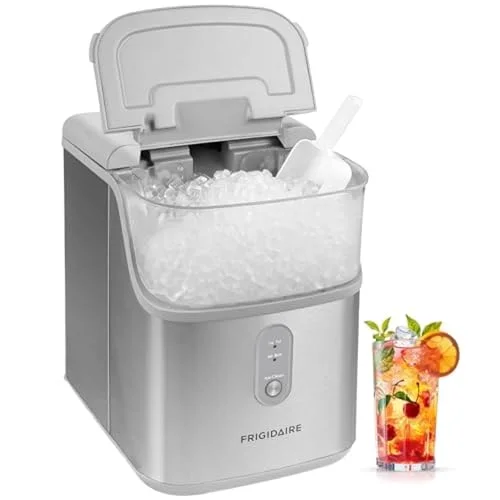
Frigidaire Compact A household that barely dents 33 lbs 33 lbs/day $191.33 Get it
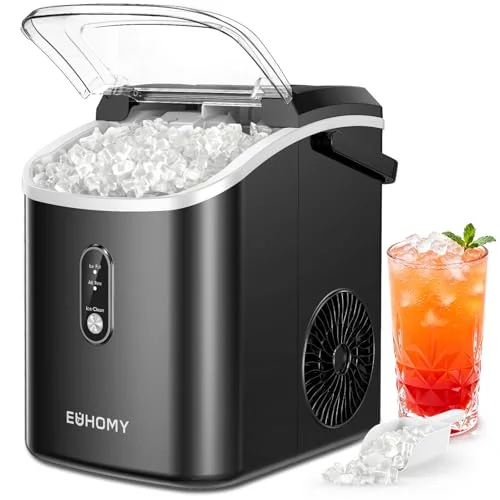
EUHOMY 38 lbs with Handle Most 1–4 person households 38 lbs/day $161.40 Get it
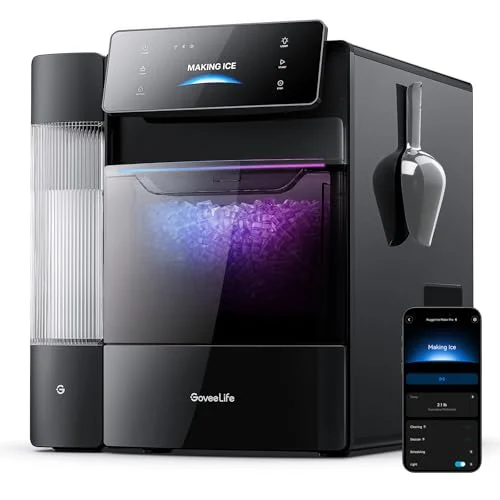
GoveeLife Nugget Ice Maker Pro Parties, coolers, a drink station 60 lbs/day $349.99 Get it
The math

A rough rule: cups per person, times people in the house

Here's the calculation worth doing before you look at a single spec sheet. A typical person drinking ice water, soda, and the occasional iced coffee or cocktail across a normal day uses somewhere around 1 to 1.5 cups of ice. That's not a precise clinical figure — it's a planning assumption, and it's deliberately on the generous side so you don't undersize. Multiply it by the number of people actually in the house, not the number of people who might theoretically visit, and you get a daily cup total. Convert cups to pounds using the rough rule that a gallon (16 cups) of loosely packed nugget ice weighs about 3 to 4 lbs, since nugget ice is less dense than solid cubes — it's compacted flakes with air between them, which is also why it's soft enough to chew.

Run the numbers for a one-person household drinking on the generous side — say 2 cups a day, every day — and you land at roughly half a pound of ice. A family of four at the same generous 2 cups each comes out around 2 lbs a day. Even doubling that for a household that goes through pitchers of iced tea and a round of after-dinner drinks, you're still well under 5 lbs a day for most homes. That's the number that should actually drive your decision, and it's an order of magnitude below every daily rating printed on these boxes.

The reason the gap between "what you use" and "what's printed on the box" is so wide isn't dishonesty — it's that the daily rating measures something different: how much ice the machine can produce in 24 hours of continuous operation, not how much a household consumes. Those two numbers only converge if you're running the machine non-stop to build up a stock, which brings us back to the point made earlier: the bin isn't storage, so building up a stock mostly just means melting ice back into the reservoir and remaking it. For almost everyone, the daily rating should be read as a ceiling you'll never approach, not a target to hit.

The low end

Where a 33–38 lbs machine is already more than enough

Run the cups-per-person math from the section above for almost any household of one to four people, even a generous one, and the daily total lands somewhere under 5 lbs. A machine rated at 33 lbs a day, like the Frigidaire Countertop Crunchy Chewable, or one rated at 38 lbs, like the EUHOMY 38lbs Daily Sonic Ice, is rated to produce six to ten times that household's actual daily use. That headroom isn't wasted — it's what lets the machine keep up on the one busier day a month without you thinking about it, and it's why neither of these two needs to run anywhere close to its rated ceiling on an ordinary Tuesday. For the full range of machines sized around this everyday tier, see our overall buying guide.

Both of these machines are priced accordingly. The EUHOMY, at $161.40, is the lower-priced of the two and includes a carry handle, suggesting it's built to be moved around rather than bolted permanently to one corner of the counter. The Frigidaire, at $191.33, carries a name with a longer service history in major appliances, which for some buyers is worth the premium over a less established brand even at a lower stated daily output. Neither machine's listing data we have gives us a tank volume or hourly rate, so if either of those specifics matters to your routine — how long a single fill lasts, or how fast the first batch comes out — check the current listing directly rather than assume a number we can't confirm here.

The households that should stop right here, at the 33–38 lbs tier, are the ones drinking ice daily but not hosting regularly: one or two people, a couple with the occasional guest, a small family that goes through a few glasses of iced tea and a soda or two a day. If that's your household, paying more for a 60 lbs machine buys you capacity you'll essentially never use.

The high end

When the 60 lbs machine is the right answer, and when it's overkill

The GoveeLife Smart Nugget Ice Maker Pro is rated at 60 lbs a day, and GoveeLife states it makes a batch in 6 minutes — both figures that only start to matter once your actual use looks less like a household drinking routine and more like an event. That's the real dividing line: a 60 lbs rating is the right answer when you're regularly filling a cooler for a boat trip or a tailgate, running a home bar through a long evening with a dozen guests, keeping a drink station stocked for back-to-back refills at a party, or running any scenario where the ice gets used faster than one person's daily cup or two. In those situations, a fast cycle time and a high ceiling both matter, because you're trying to outrun demand in real time rather than just topping off a reservoir once a day.

It's overkill for the household math worked out earlier in this guide. If your actual daily use is under 5 lbs, a 60 lbs rating gives you roughly twelve times more ceiling than you'll use on a normal day — headroom you're paying for in both price ($349.99, more than double the EUHOMY's price) and counter footprint, since higher-output machines generally need a larger reservoir to sustain that rate. GoveeLife also states a 40 dB operating volume for this model, which matters if the machine lives somewhere you'll actually hear it running, like an open kitchen or a shared office; that's a real, checkable differentiator this specific listing provides and the two smaller machines in this guide don't state a comparable figure for. For a closer look at how this model stacks up against another premium smart machine, see our GE Profile Opal Ultra vs GoveeLife Nugget Ice Maker Pro comparison, and for the wider field of machines at this output tier, see the highest-capacity nugget ice makers we've compared.

The practical test is simple: if you can picture more than two or three occasions a year where you'd genuinely run out of ice on a smaller machine, the 60 lbs tier is buying you something real. If you're picturing an occasional family holiday dinner, you're better served buying a cheaper everyday machine and adding a bag of store ice for the one or two days a year that need more than it can keep up with.

Our picks

Our picks, by the number you actually land on

01Most households

EUHOMY Nugget Ice Maker Countertop with Handle

Best if your math landed under 5 lbs a day

38 lbs/day·$161.40·Carry handle

If you ran the cups-per-person math above and landed where most one- to four-person households land — well under 5 lbs of actual daily use — this is the sensible size. A 38 lbs daily rating is roughly seven to ten times a typical household's real consumption, which is exactly the kind of headroom you want for the occasional heavier day without paying for capacity built around a party you host twice a year. At $161.40 it's also the lowest price of the three machines in this guide, and the included carry handle suggests it's built to be moved rather than permanently installed. We don't have a stated tank volume or hourly rate for this listing, so if either matters to your routine, confirm it on the current Amazon page before ordering. If this price point is itself a concern, our separate look at nugget ice makers under $100 covers what a sub-$100 machine typically gives up.

The daily number to size for is the one your household actually uses, not the one that sounds impressive on the box.

EUHOMY nugget ice maker countertop with handle
Price
$161.40
Check price →
02A known name

Frigidaire Countertop Crunchy Chewable Nugget Ice Maker

Best if you want a familiar brand at a similar daily number

33 lbs/day·$191.33·Compact, Metallic Finish

A slightly lower daily rating than the EUHOMY at 33 lbs, still comfortably past what almost any household actually consumes in a day, at a higher price of $191.33. What you're paying the difference for is the Frigidaire name, a brand with a long history in major kitchen appliances, and a metallic finish that reads less like a small-appliance gadget on the counter. We don't have a stated tank volume, hourly rate, or fill method for this listing, so those remain unknowns to check on the current page rather than specs we'll assert here.

Same tier of daily output as the EUHOMY. The extra cost here buys the badge, not more ice.

Frigidaire countertop crunchy chewable nugget ice maker
Price
$191.33
Check price →
03Parties and coolers

GoveeLife Smart Nugget Ice Maker Pro

Best if you regularly outrun a smaller machine

60 lbs/day·6-minute batch·40 dB·$349.99

The only machine in this guide rated for the scenario where daily household math doesn't apply — a party, a filled cooler, a drink station running for hours. GoveeLife states 60 lbs a day, a 6-minute batch cycle, and a 40 dB operating volume, all figures that matter specifically when you're trying to keep pace with demand in real time rather than topping off a reservoir once a day. At $349.99 it costs more than double the EUHOMY, and that premium is overkill for a household whose actual daily use sits in the low single digits of pounds. It earns its price for the smaller set of buyers who genuinely need the ceiling, not the average household drinking ice daily.

Buy this for the party you host, not the Tuesday you live. The math in this guide tells you which one you're actually buying for.

GoveeLife Smart Nugget Ice Maker Pro
Price
$349.99
Check price →
The real trade-off

Buying for the party you host twice a year, instead of the Tuesday you live

The single most common sizing mistake in this category is buying for the best-case entertaining scenario instead of the household's ordinary week. It's an understandable instinct — nobody wants to be the person whose ice maker can't keep up when the guests are already there — but it means the other 360-plus days a year, you're running a machine built for twelve people to make ice for two, and paying the price and counter-space premium for that capacity every single day in exchange for covering roughly two afternoons.

There's a cheaper way to solve the occasional-party problem than buying the biggest machine on the shelf. A 38 lbs machine like the EUHOMY can still run continuously for hours ahead of a gathering, building up what ice it can into the bin before guests arrive; it just can't do it as fast as a 60 lbs machine, and the bin still isn't frozen storage, so ice made too far ahead will start softening before you serve it. For most people hosting a handful of times a year, the practical answer is to run a smaller daily-use machine a bit longer before the event, supplement with a bag of store-bought ice for the busiest evening, and skip paying a 60 lbs premium for 363 days you don't need it. The GoveeLife-tier machine only wins this trade-off if parties, coolers, or heavy drink-service use are a routine part of your week, not an occasional exception — in which case the math in this guide is simply telling you that your "Tuesday" already looks like a party.

The honest way to decide: do the cups-per-person math from earlier in this guide for your actual household, see which tier it lands in, and then ask separately whether you entertain often enough that the gap between tiers is a recurring cost of convenience rather than a rare inconvenience solved more cheaply with a bag of ice. Most households will find the smaller, cheaper machine is the correct year-round answer, with the occasional party handled the old-fashioned way.

Our method

What we didn’t do

What we did

Specs, prices, arithmetic

We compared the stated daily output and current Amazon price for three machines across the three daily-output tiers that exist in this category, and worked through a cups-per-person estimate anyone can apply to their own household using a published approximate weight for a gallon of nugget ice.

What we didn’t

We don’t run a testing lab

We do not physically test these machines, we do not own them, and we do not publish invented ratings or review counts. We also didn't assert a tank volume, hourly rate or noise figure for any product unless it's published in the specific listing data we have on file — where it isn't, we say so rather than guess.

FAQ

Common questions

How much ice does the average person actually use in a day?

Figure roughly 1 to 1.5 cups a day for ordinary use — water, soda, iced coffee, the occasional drink. That's a planning estimate, not a precise measurement, and it's set generously so you don't undersize. Multiply it by the number of people in your household to get a daily cup total, then convert to pounds using the rough rule that a gallon of loosely packed nugget ice weighs about 3 to 4 lbs.

Is a 33–38 lbs machine enough for a family of four?

For almost all ordinary daily use, yes. Even a generous estimate of 2 cups per person per day across four people comes out to roughly 2 lbs a day, which a 33–38 lbs-rated machine covers many times over. The exception is a household that regularly entertains or runs through ice far faster than typical daily drinking, in which case a higher-output machine is worth the extra cost.

Why is the daily rating so much higher than what I actually use?

Because the daily rating measures what the machine can produce running continuously for 24 hours, not what a household consumes. Those numbers only converge if you're running the machine non-stop to build a stock — and the bin isn't a freezer, so stockpiled ice melts back into the reservoir and gets remade rather than staying stored. For nearly everyone, the daily rating is a ceiling you'll never approach, not a target.

Should I size my machine for the parties I host, or for an ordinary day?

For an ordinary day, in almost every case. Buying the highest-output machine to cover two or three occasional entertaining days a year means paying a price and counter-space premium every other day of the year for capacity you don't use. It's usually cheaper to run a smaller daily-use machine a bit longer ahead of an event and supplement with store-bought ice on the busiest evening than to buy at the top tier for year-round use.