Best Nugget Ice Makers
Honest Take · Countertop Nugget Ice Makers

A self-clean button and a descaled machine are two different promises.

The button labeled self-clean is not the same claim as a button labeled descale. We read what three listings that advertise the cycle by name actually say it does, matched that against what a continuously recirculated water loop needs on a schedule no listing publishes, and wrote down exactly where each machine leaves the rest of the job to you.

By Ilane TallUpdated October 26, 2026Research-based — no testing lab, no invented scores

Close-up of a countertop nugget ice maker's control panel beside a glass of soft chewable ice, representing the self-clean cycle
Affiliate disclosure: we may earn a commission if you buy through the Amazon links on this page, at no extra cost to you. See how we picked below.

Every listing in this category puts a word on the control panel: self-clean, auto-clean, or just CLEAN. It reads like a solved problem — press the button, the machine cleans itself, move on. What that word actually buys you depends entirely on what the listing tells you it does, and the honest answer across the three machines compared below is: not very much, and not necessarily the thing you're picturing.

A self-clean cycle on a nugget ice maker is a plumbing step, not a chemistry step. It runs water through the parts that already touch water — the auger, the ice-forming chamber, the drain path — and flushes out what's loose. It does not, in the data available on any of these three listings, remove the mineral scale that hard water leaves behind on the same surfaces over weeks of continuous recirculation. That's a separate job, done by hand, with a separate product, on a schedule none of the three states.

We compared what the product titles claim against what the published feature text for each listing actually describes, for three countertop nugget ice makers that each put a cleaning claim in their own name. One of them tells you exactly how to trigger the cycle. The other two don't, in the text available to us — and that gap is worth knowing before you buy any of them expecting a button that handles maintenance on its own.

What's on the box

What “self-cleaning function” means on the box, versus what it means in the manual

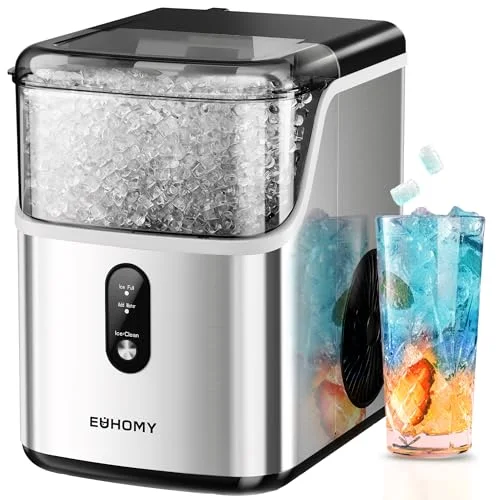
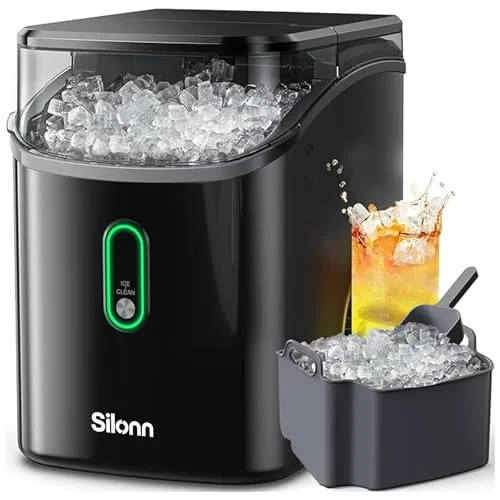
All three machines here carry a cleaning claim in the product title itself, not as a buried feature but as a selling point. The EUHOMY is titled a “Self-Cleaning Countertop Sonic Ice Maker.” The Silonn with the removable cover is sold with a “Self-Cleaning Function.” The second Silonn's listing uses “Auto-Cleaning” in its own name. On the box, all three make the same promise: you won't have to scrub this thing by hand.

What differs is how much of that promise the listing backs up once you read past the headline. For the Silonn with the removable cover, the published feature text is specific: the self-cleaning cycle is activated by pressing and holding the ICE/CLEAN button for five seconds, and the unit also has a removable cover so you can reach the mechanism directly for a deeper manual clean when the automatic cycle isn't enough. That's a real instruction — a button, a hold time, a manual fallback — not just a word in the title.

The EUHOMY and the second Silonn don't get the same treatment in the feature text we have. The EUHOMY's description talks through its single ICE button and how simple the machine is to operate; it doesn't say what the self-clean step does, when it runs, or how you trigger it separately from making ice. The second Silonn's description focuses on its status lights — green when the bin is full, red when the tank needs water — and says nothing about how its own “Auto-Cleaning” name translates into an actual control. Both are real machines with a real advertised cycle. Neither listing tells us, in the text available, how to use it.

That's not proof the cycle doesn't exist on either machine — plenty of legitimate detail lives in a printed manual that ships in the box and never makes it into the online listing. It is proof that “self-cleaning” on the label is a marketing claim first, and an operating instruction only sometimes. If you haven't settled on a machine yet and want to weigh this kind of gap against everything else that decides the purchase, our buying guide covers the questions that matter more than this one.

The plumbing

Rinsing the circulating loop is not the same as removing scale

Here's the plumbing, in the amount of detail that matters for this decision. A countertop nugget ice maker holds a small reservoir of water — the EUHOMY's own listing states 1.1 litres — and recirculates it continuously: a pump pushes it past a refrigerated surface where it freezes into flakes, an auger compacts those flakes into the soft pellets this whole category is built around, and the leftover water melts back into the same reservoir. That loop runs every time the machine makes ice, on the same water, over and over, for as long as you keep topping up the tank rather than draining and refilling it. If reservoir design and how often you can avoid that refill matters to you, see our comparison of nugget ice makers with a removable water tank.

A self-clean or auto-clean cycle, wherever a listing actually describes one, is built to flush that loop: run water through the same path at a higher flow or for a longer stretch, clear out loose ice chips, and whatever debris built up in the auger housing since the last cycle. That's a genuinely useful thing to do regularly, and it's exactly what these buttons are built for. It is a rinse.

What a rinse cannot do is remove scale — the hard, adhered mineral deposit that calcium and magnesium in tap water leave behind on surfaces that water sits on and evaporates from repeatedly. Scale doesn't rinse off at normal flow; it has to be dissolved, usually with a mild acid, or physically scraped off. None of the three listings here describe their clean-cycle button as doing that, and there's a straightforward physical reason why: a cycle gentle enough to run at the push of a button, with no acid involved and no warning to keep hands clear, isn't strong enough to dissolve scale that's already bonded to a surface. The two jobs use different mechanisms, which is exactly why a machine can run its advertised self-clean faithfully every time and still accumulate scale underneath it the whole time.

The job the button skips

Why hard water still needs a manual descale on every one of these machines

None of the three listings in this comparison mentions a separate descale mode, a descaling solution included in the box, or even the word “descale” anywhere in the published feature text we have. That's worth stating plainly rather than assuming one way or the other: we're not told any of these three ships with a dedicated descaling step, so we won't claim one exists.

What we can say with confidence is general to the category, not specific to any one of these three machines: any countertop ice maker that recirculates its own water, rather than connecting to a continuous fresh supply, accumulates mineral scale faster in hard-water areas than in soft-water ones, because the same water sits and evaporates from internal surfaces repeatedly instead of passing through once. The U.S. Geological Survey classifies most of the country's groundwater as moderately hard to hard, so for a large share of owners this isn't an edge case — it's the default condition the machine runs under from the first fill.

The self-clean button on any of these three machines, however it's triggered, is not described in the data we have as an answer to that. If scale is building up on the refrigerated plate or inside the pump housing, a rinse cycle moves water past it without removing it. The manual step — typically a mild acid solution, such as diluted white vinegar or a nugget-ice-maker-specific descaler, run through the machine and then flushed with several clean-water cycles — is the job that actually addresses it, and it's one you schedule yourself, not one any of these three listings schedules for you.

What the listing doesn't say

How often the button should run, by the listing's own schedule

Ask any of these three listings how often to press the clean button, and the honest answer is: they don't say. We read the published feature text for all three machines looking specifically for a stated interval — daily, weekly, after some number of cycles — and found none. The Silonn with the removable cover tells you how to trigger its cycle; none of the three tells you how often to do it.

In the absence of a manufacturer-stated interval, the only honest frequency to publish here is a general one, tied to how the machine is actually used rather than to a specific product claim: a recirculating ice maker run daily in a hard-water home benefits from the self-clean cycle being used roughly weekly, simply because that's about how long it takes for mineral and ice debris to accumulate in the loop — not because any of these three listings says so. If you use the machine occasionally rather than daily, running the cycle each time you refill a tank that's sat empty for more than a few days is a reasonable substitute for a fixed weekly schedule. How often you run the machine at all also affects what it costs you to operate, which our guide to running cost and noise covers separately.

That's a routine we're recommending from general knowledge of how recirculating ice machines work, not a number pulled from any of the three product pages. If the printed manual that ships with your specific unit states an interval, follow that instead — it's written for the exact mechanism inside that one machine, which is more than any of the three online listings tells either of us.

The limit of the cycle

What a machine never tells you when the cycle is not enough

Every one of these three listings describes its cleaning feature in a way that implies closure — the box uses a complete-sounding word, “self-cleaning” or “auto-cleaning,” and stops there. None of the three tells you what to watch for if the cycle genuinely isn't keeping up: slower ice production, ice that comes out smaller or clumped, a reservoir that smells different than it did on day one, or a first batch that takes noticeably longer than the roughly 6 to 7 minutes each of these listings quotes when new — a figure our guide to how fast these machines really make ice looks at across the wider category.

Those are the practical signs that a rinse-only cycle has stopped being enough and scale has started to affect performance, and none of them are covered in the published feature text for any of the three machines here. The Silonn with the removable cover is the only one of the three whose listing gives you a manual fallback at all — that cover exists specifically so you can reach the mechanism directly rather than relying on the automatic cycle alone. The EUHOMY and the second Silonn don't describe an equivalent manual-access option in the data we have, which doesn't mean one doesn't exist in the printed manual, only that the online listing doesn't tell you about it.

The practical takeaway is to treat a slowdown as information rather than a fault to report: it's very likely what hard water does to any recirculating ice maker over time, on every brand in this category, and the fix is the manual descale step covered above, not a warranty claim or a different machine.

Side by side

The three cleaning claims, compared

ModelCleaning claimHow it's triggeredDaily outputPriceGet it
Silonn Self-Cleaning Function Self-Cleaning Function Hold ICE/CLEAN 5 sec, plus removable cover 36 lbs/24h $159.99 Get it
EUHOMY Self-Cleaning Self-Cleaning (named) Not stated in listing 35 lbs/24h $124.66 Get it
Silonn Auto-Cleaning Auto-Cleaning (named) Not stated in listing 33 lbs/day $143.89 Get it
The three

Each machine, and what its own listing actually tells you

01Best-documented cycle

Silonn Nugget Ice Maker with Self-Cleaning Function

The only one of the three that explains its own button

36 lbs/24h·Self-Cleaning Function·Hold ICE/CLEAN 5 sec·Removable cover for manual access

Of the three machines in this comparison, this is the one whose self-cleaning claim is backed by an actual instruction in the published listing: hold the ICE/CLEAN button for five seconds to start the automatic cycle, and lift the removable cover whenever you want to reach the mechanism directly for a manual wipe-down the automatic cycle doesn't reach. The listing states 36 lbs of ice every 24 hours. Nothing in the data we have describes a separate descale mode or a stated cleaning interval — the trigger instruction is specific; the schedule for using it is still yours to set.

The one of the three that actually tells you how to use its own button.

Silonn nugget ice maker with self-cleaning function
Price
$159.99
Check price →
02Named, not explained

EUHOMY Nugget Ice Maker Countertop

A real self-cleaning claim, a mechanism left to the manual

35 lbs/24h·1.1 L tank·Ice in 7 min·Single ICE button, self-cleaning named in title

EUHOMY's listing puts “Self-Cleaning” in the product name and backs it with a stated 1.1 litres of recirculating tank water and 35 lbs of ice every 24 hours, with the first batch ready in about 7 minutes. What the published feature text doesn't cover is how the self-clean step is triggered — the description we have talks through the single ICE button and the machine's general simplicity, not a separate cleaning sequence. That's not evidence the feature is missing; printed manuals routinely cover detail the online listing skips. It's a reason to read that manual rather than assume the listing told you everything.

A real claim in the title; the mechanism lives in the manual, not the listing.

EUHOMY nugget ice maker countertop
Price
$124.66
Check price →
03Same brand, less detail

Silonn Nugget Ice Maker with Auto-Cleaning

Status lights explained, the cleaning step is not

33 lbs/day·Auto-Cleaning (named)·Ice in 6 min·Front-panel status lights, scoop included

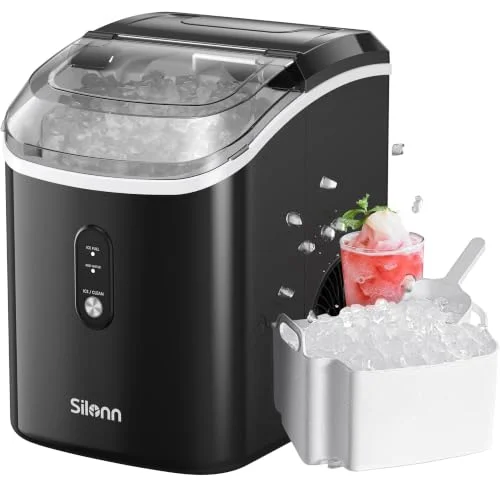
This Silonn's listing leads with “Auto-Cleaning” in the product name and a stated 33 lbs of ice per day, with front-panel status lights that tell you at a glance whether the bin is full (green) or the tank needs water (red). The feature text we have is specific about those lights and the roughly 6-minute first batch, but it doesn't describe how the auto-cleaning step is activated or what it does differently from the other Silonn in this comparison, even though both carry a Silonn-branded cleaning claim. Treat the name as the claim and the manual in the box as the source for how to actually use it.

Same brand, same kind of claim, less detail in the listing than its sibling.

Silonn nugget ice maker with auto-cleaning
Price
$143.89
Check price →
What to actually do

A routine that actually keeps up with recirculated water

None of the three machines compared here publish a maintenance schedule, so this is the routine we'd recommend building yourself, based on how recirculating ice makers work rather than a specific instruction from any of these three listings.

Run the self-clean or auto-clean cycle roughly weekly if the machine runs daily, using whichever button or hold-sequence the manual for your specific unit describes — for the Silonn with the removable cover, that's holding ICE/CLEAN for five seconds; for the EUHOMY and the second Silonn, check the printed manual in the box, since the online listing doesn't spell it out. Treat this as the rinse it is: it clears loose debris and keeps the loop from carrying anything into the next batch, but it is not solving the scale problem on its own.

Empty and dry the reservoir if the machine sits idle for more than a few days, rather than leaving standing water in the tank — stagnant water sitting in a reservoir encourages both scale and odor faster than water that's actively cycling through.

Descale by hand on a schedule tied to your own water hardness, not a number from a listing: monthly is a reasonable starting point in a hard-water area, stretching to every couple of months if your water is soft, using a diluted food-safe descaling solution and then running several clean-water cycles afterward to clear the residue before making ice again. Most U.S. municipal water utilities publish hardness in an annual water quality report, which is a more reliable number than guessing from how the ice tastes. If descaling frequency alone is pushing you toward a different machine entirely, our overall picks are a reasonable place to compare alternatives.

Use the removable cover on the Silonn with the self-cleaning function for a direct manual wipe-down between descales if you want extra reassurance the self-clean cycle reached everything — the other two machines here don't describe an equivalent panel in the data we have, so a full descale cycle is the more reliable option for keeping their internal surfaces clear.
Our method

How we picked — and what we can’t tell you

What we did

Listing claims, read against the plumbing

We compared the product titles and the full published feature text for three countertop nugget ice makers that each advertise a self-cleaning or auto-cleaning function by name, read each listing specifically for how the cycle is triggered, how often it should run, and whether a separate descale step is mentioned, and set what's actually stated against how a continuously recirculated reservoir generally behaves. Where a listing states a mechanism, like the five-second button hold, we report it. Where it doesn't, we say so rather than guess.

What we didn’t

We don’t run a fake testing lab

We do not run a fake testing lab, we do not own these three machines, and we have not run their self-clean cycles ourselves to see what comes out. What we can do honestly is read what each listing actually commits to in writing, compare that against how recirculating ice machines are built, and be specific about which claims are published specifications and which are simply absent from the data available to us.

FAQ

Common questions

Does the self-clean button remove hard water scale?

No, not on any of these three machines based on the published listing data. A self-clean or auto-clean cycle flushes loose debris through the same recirculating loop the machine already uses to make ice; removing bonded mineral scale needs a separate descaling step with an acid-based solution, done by hand, on a schedule none of these three listings states.

How do I actually trigger the self-clean cycle on these machines?

Only one of the three tells you in the data we have: the Silonn with the removable cover is activated by holding the ICE/CLEAN button for five seconds. The EUHOMY and the other Silonn carry the same kind of claim in their product names, but the published feature text doesn't describe a trigger sequence for either — check the printed manual that ships with the unit.

How often should I run it?

None of the three listings states an interval. As a general routine for a recirculating ice maker used daily, roughly weekly is a reasonable starting point; if your water is notably hard, lean toward more often. That's general guidance based on how these machines work, not a number published by any of the three products compared here.

What should I do if ice production slows down even with the cycle running?

Treat it as a sign the self-clean rinse isn't keeping up with scale, not a fault with the self-clean feature itself. Descale by hand with a diluted food-safe solution, then run a few clean-water cycles before making ice again. None of the three listings describes this step, so this is general maintenance advice for the category, not a product-specific instruction.