Best Nugget Ice Makers
Wet Bar & Outdoor Kitchen Guide · Built-In Nugget Ice Makers

Past 70 lbs a day, it stops being a countertop appliance.

Once a nugget ice maker is rated past 70 lbs a day, the conversation changes from "where do I set it down" to "what does the cutout need to look like." A drain, clearance for ventilation, a storage bin sized for people other than you — these are fixture questions, not appliance questions. We compared three undercounter machines at three very different prices, on exactly those terms.

By Ilane Tall3 undercounter machines comparedResearch-based — no testing lab, no invented scores

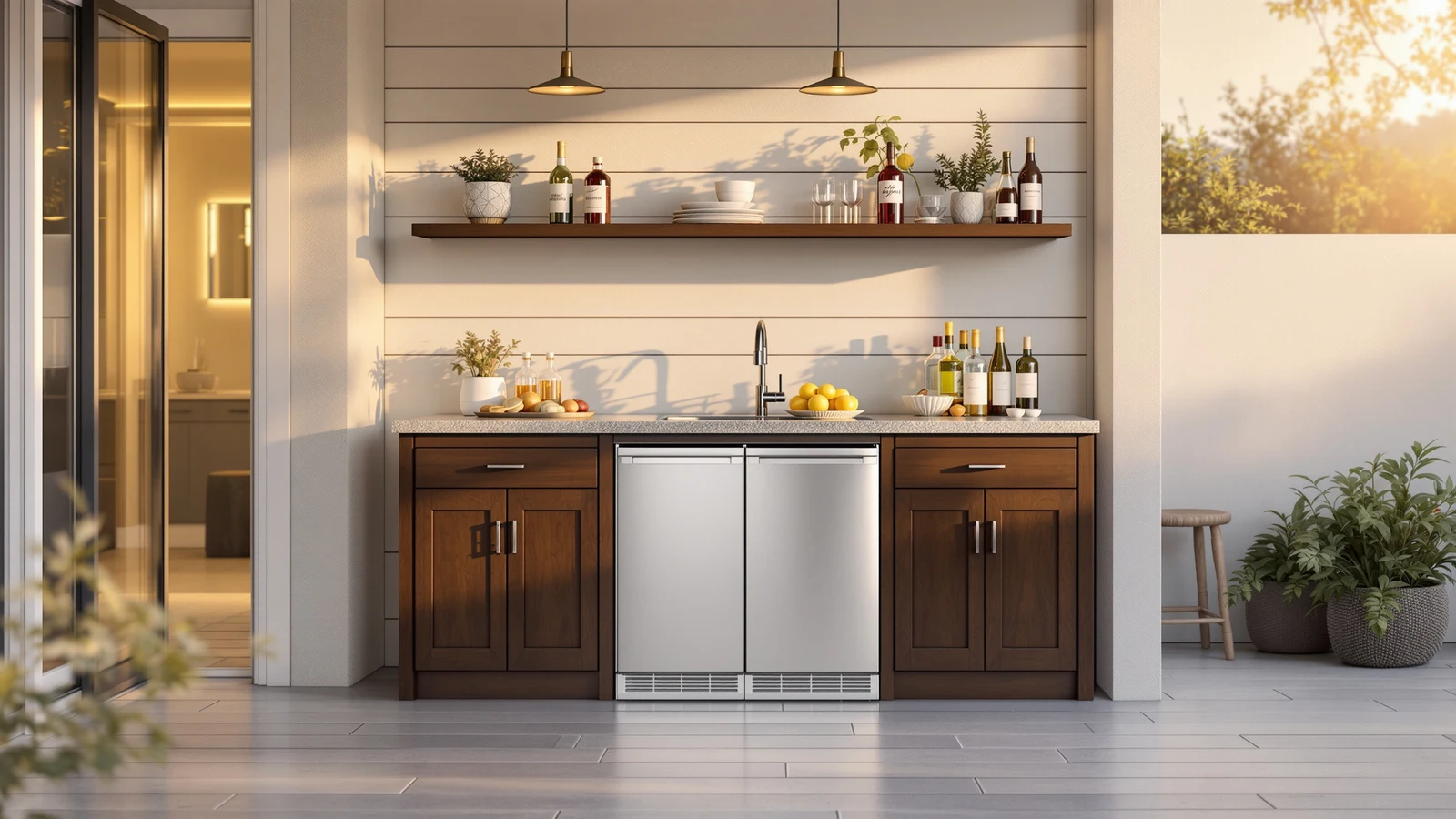
Stainless-steel undercounter nugget ice maker built into a wet bar cabinet cutout, beside a glass of soft chewable ice
Affiliate disclosure: we may earn a commission if you buy through the Amazon links on this page, at no extra cost to you. See how we picked below.

By Ilane Tall · Updated November 22, 2026 · Research-based.

Every countertop nugget ice maker we've compared on this site tops out somewhere between 33 and 44 lbs a day, built around one assumption: plug it in, pour water in from a jug, set it on a counter you still use for other things. The three machines in this guide don't live in that world. Each is rated at 70 lbs a day or more, sized to a standard undercounter cabinet opening, and marketed for an installation a countertop unit was never meant for — a wet bar, an outdoor kitchen island, a basement bar cart that's become permanent.

That jump in output changes what you should be comparing. A countertop machine's pitch is daily pounds per dollar. A built-in machine's pitch also has to answer: does it need a plumbed drain or does meltwater just sit in a bin, how much ice does it hold once a dozen people are pouring, and what happens once it's behind a door you can't see or hear through. We compared the published specifications and current prices for three undercounter nugget ice makers against exactly those questions, from a $409.99 freestanding unit to a $1,039.99 machine with a plumbed gravity drain.

What's different

What changes once the machine stops sitting on a counter

A countertop nugget ice maker has one installation requirement: a flat surface and an outlet. Pull it out, set it down, plug it in. An undercounter machine is sized to slide into a cutout — typically the 15-inch-wide opening standard in undercounter appliance cabinetry — and once it's in that opening, it isn't coming back out for a quick wipe-down or a move to a different corner of the room. That single fact changes a few things you'd otherwise never think about with a countertop unit.

First, clearance: a built-in machine needs ventilation space to exhaust compressor heat, a cabinetry question solved before the machine arrives, not after. Second, drainage: some undercounter machines expect a plumbed connection — a drain line run to the cabinet before installation day, not a reservoir topped up by hand. Third, and most overlooked, you lose the countertop machine's easiest troubleshooting advantage once it's behind a door — you can't glance over and see the bin filling or hear it cycling. Alerts and auto-stop, covered further down, matter more once that door is closed.

None of this makes a built-in machine strictly better or worse than a countertop one — see our countertop versus built-in comparison if you haven't settled that question yet. "100 lbs a day" on an undercounter listing is doing a different job than "44 lbs a day" on a countertop one: it describes a fixture meant to serve a bar or a kitchen full of people, not a machine that sits next to your coffee maker.

Same number, different machine

100 lbs a day at $1,039.99 against 100 lbs a day at $409.99

Two of the three machines here are rated at 100 lbs of ice a day. The Coolski Undercounter Nugget Ice Maker Machine lists at $1,039.99. A compact freestanding undercounter unit from the same category lists at $409.99. On the headline spec — daily output — they're identical, so the $630 gap has to be buying something else.

The Coolski's listing states a 20 lb dual storage bin and, critically, a gravity drain. That second detail is the real price driver: a gravity drain means the unit expects an actual plumbed drain connection — water leaves by design, rather than collecting in a tray you empty yourself. That's a built-in appliance the way a dishwasher is built-in. The $409.99 unit's listing makes no such claim. It's described as freestanding and compact, with no stated drain connection and no stated bin size, so we won't guess at either on your behalf — check that listing's own specification table before assuming it handles meltwater the same way.

So the honest read on the $630: part of it is the dual 20 lb bin, a real, checkable capacity advantage; part is the plumbed gravity drain, a built-to-code feature the freestanding unit doesn't claim; part, almost certainly, is brand and finish quality neither listing states in numbers we can print here. If your installation already has a drain line and you want the dual bin, the Coolski's price buys something specific. If it doesn't, you're paying $630 for a feature your cabinet can't use yet.

The number that matters more than daily output

Storage bin size versus daily output, at this scale

On a countertop machine, bin size barely matters, because nugget ice isn't frozen solid in storage — it's compacted flakes that melt back into the reservoir and get remade continuously. At wet-bar scale, with a dozen or more pours in a short window, the bin matters differently: it's the buffer between "the machine can technically make 100 lbs over 24 hours" and "there's enough ice ready right now for a party that lasts three hours, not a day."

Of our three machines, only two publish a bin figure. The Coolski states a 20 lb dual storage bin against its 100 lbs/day rating — roughly a fifth of a day's output held in reserve, split across two compartments. The Commercial Nugget Ice Maker Machine (its size/variant field states 71 lbs per 24 hours, its title rounds to 70) pairs that with a stated 16 lb storage bin, keeping the bin-to-output ratio roughly consistent with the Coolski's. The $409.99 unit rated at 100 lbs a day doesn't publish a bin size at all: the highest claimed daily output of the three, and the one machine where we can't tell you how much ice is sitting ready at any moment. That's a reason to check the listing's own photos and specification table before assuming a comparable reserve.

The practical takeaway: daily output tells you how fast the compressor works running continuously, which almost nobody does. Bin size tells you what's ready to pour when six people show up at once. For a wet bar serving guests in bursts, weight the bin figure at least as heavily as the daily number.

Behind a cabinet door

LED alerts and auto-stop: the features that matter once you can't see it

A countertop nugget ice maker sits in the open. If the bin is full, you can see the lid won't close right. If the water runs out, you hear the motor change pitch. None of that visibility survives installation behind a cabinet door, which is exactly why features that sound minor on a spec sheet — indicator lights, an automatic shutoff — stop being minor once the door is closed.

Of the three machines here, the $409.99 undercounter unit is the one whose listing calls these features out directly: LED alerts and auto-stop, alongside a water filter. Auto-stop means the machine halts production on its own once the bin is full or water runs low, rather than running the compressor against a full bin or a dry reservoir until something fails. LED alerts give a visual signal of that state — close to essential on a unit you can't hear or see without opening a cabinet door. We don't have the same stated features for the Coolski or the Commercial Nugget Ice Maker Machine; their listings emphasize storage capacity and, in Coolski's case, the gravity drain, rather than alert behavior. That's not evidence either lacks a safety shutoff — compressor-driven ice machines generally include some form of it — it's that neither listing names it, so we won't claim a feature neither publishes.

If your plan has this machine behind a closed cabinet door with no sightline and no easy way to check on it between uses, a stated auto-stop and a visible alert light are worth weighting more heavily than on an open counter. It's a case where the cheapest of the three machines published the most about how it behaves when you're not watching it.

What "undercounter" actually commits to

Freestanding versus a true cutout installation

All three machines here are sized and marketed for an undercounter installation, but "undercounter" and "built-in" aren't quite the same promise, and the listings split on which one they're making. The Coolski is the only one whose listing states a gravity drain — the detail that makes it a true cutout installation in the way a dishwasher is: a fixed drain connection as part of going in, and once that line is run, the machine is committed to that spot. It's built-in in the literal, plumbing-code sense.

The other two machines are both described in their own listings as freestanding — the $359.99 Commercial Nugget Ice Maker Machine explicitly as a "Freestanding Undercounter Ice Maker," the $409.99 unit as "Compact Freestanding." Freestanding here means sized to slide into the same cutout footprint as a true built-in unit, without claiming a plumbed drain connection to do it. Neither listing states a drain hookup, so meltwater handling on those two is either internal or simply not detailed — we won't assert a plumbing claim neither listing makes.

That distinction matters most at installation time. A freestanding unit can go into a cabinet opening today and come back out next year, with no plumber involved either way. A gravity-drain unit asks you to commit a drain line to that cabinet permanently. If you're renovating a wet bar from scratch, the Coolski's true cutout installation is the more finished appliance. If you're retrofitting an existing cabinet and don't want to call a plumber, a freestanding unit gets you the same undercounter look and comparable output without the construction project.

Side by side

The three, compared

ModelBest forDaily outputStorage binDrainPriceGet it
Coolski Undercounter A true cutout install 100 lbs/day 20 lbs, dual bin Gravity drain $1,039.99 Get it
Commercial Nugget Ice Maker Machine Middle ground, no plumbing 71 lbs/24h 16 lbs Not stated (freestanding) $359.99 Get it
100 lbs Under Counter Nugget Ice Maker LED alerts, auto-stop, no plumbing 100 lbs/day Not stated Not stated (freestanding) $409.99 Get it
The picks

Our picks, and who each one is for

01Best true built-in

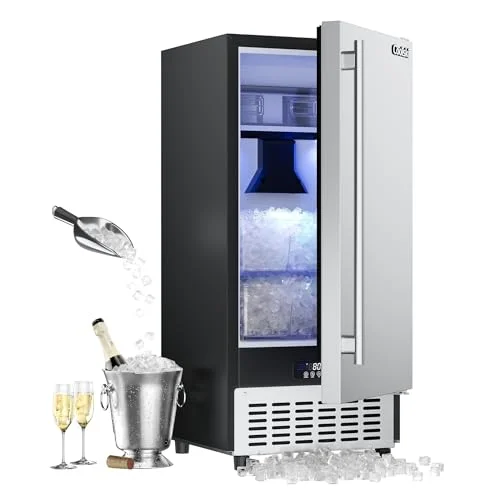
Coolski Undercounter Nugget Ice Maker Machine

Best for a wet bar with a drain line already in the plan

100 lbs/day·20-lb dual storage bin·Gravity drain·Commercial-class, sonic/pebble pellet ice

The only one of the three machines here with a stated plumbed drain, which is what makes it a built-in fixture rather than an appliance that happens to fit under a counter. The 20-lb dual storage bin is the largest stated reserve in this guide, which matters once you're pouring for more than one or two people. At $1,039.99 it's by far the most expensive machine compared here, and that price buys a real, checkable installation feature, not just a bigger number on the same spec sheet. It's the right choice when the cabinet already has, or will have, a drain line run to it.

You're not paying $630 more for the same machine. You're paying for a plumbed drain and twice the storage.

Coolski undercounter nugget ice maker with dual storage bin
Price
$1,039.99
Check price →
02Best no-plumbing middle ground

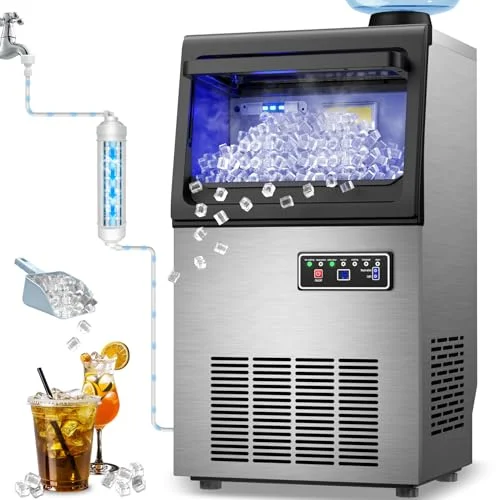
Commercial Nugget Ice Maker Machine, 71 lbs/24h

Best for the same undercounter look without a drain line

71 lbs/24h·16-lb storage bin·Self-cleaning·Stainless steel, freestanding undercounter

This one sits in the middle on every number that matters: a stated 71 lbs per 24 hours (its title rounds that to 70), a 16-lb bin that keeps a sensible ratio against that output, and a price at $359.99 that's a third of the Coolski's. Its listing calls it a freestanding undercounter unit, sized to slide into the same cabinet opening as a true built-in without asking for a plumbed drain connection, and states a self-cleaning cycle, which matters on any machine that recirculates water continuously. For a retrofit where running a drain line isn't on the table, this is the stainless-steel undercounter look without the construction project.

The undercounter footprint and the stainless finish, without committing your cabinet to a drain line.

Commercial freestanding undercounter nugget ice maker
Price
$359.99
Check price →
03Best behind a closed door

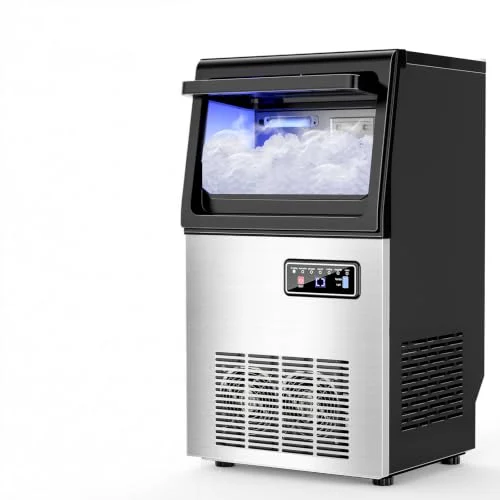
100 lbs Nugget Ice Maker Under Counter, Self-Clean, Compact Freestanding

Best for the highest output per dollar, with alerts built for a cabinet door

100 lbs/day·LED alerts·Auto-stop·Steel, filter, self-clean, freestanding

Matches the Coolski's 100 lbs/day rating at well under half the price, and its listing is the only one of the three to explicitly call out LED alerts and an auto-stop function — the two features that matter most once a machine is behind a closed cabinet door you can't see or hear through. It doesn't publish a storage bin figure, so we won't tell you it holds a particular reserve; check the listing's own images and specification table on that point before buying. At $409.99, it's the highest daily output per dollar of the three, and the most sensible pick if your installation is freestanding rather than plumbed.

The same output as the thousand-dollar machine, at a third of the price, with the alert features a closed cabinet door actually needs.

Compact freestanding under counter nugget ice maker with LED alerts
Price
$409.99
Check price →
The case against assuming price equals quality

Why a cheaper built-in unit is not automatically the worse installation

It's tempting to read the $630 gap between the Coolski and the $409.99 unit as a straightforward quality gap — see our note on what a price gap is and isn't buying elsewhere in this category. At this scale, that read misses the trade. The $409.99 unit matches the Coolski's 100-lb daily rating exactly, and states features — LED alerts and auto-stop — the more expensive machine's listing doesn't mention at all. What it doesn't have is a plumbed drain and a documented 20-lb storage bin.

The honest framing isn't "expensive equals better," it's "expensive machine assumes a more finished installation." If your cabinet has a drain line and you're pouring for a crowd big enough that 20 lbs of standing ice matters, the Coolski's price buys real, specific things you'll use. If your cabinet doesn't have a drain line and isn't getting one, paying $630 more for a feature you can't connect isn't buying quality — it's buying a capability your installation doesn't support yet. In that case the cheaper freestanding machine isn't a compromise; it's the correctly matched choice.

The same logic runs through the rest of this category. A capacity lineup mapped across price points or a brand's full range of models generally reflects the same pattern: higher prices buy specific, checkable features, not a vague, unquantifiable "better." Match the feature to the installation you actually have, not to the price tag that looks more serious.

Our method

How we picked — and what we can’t tell you

What we did

Listing data, read for installation requirements

We compared the published product titles, stated daily output, storage bin figures, drain claims and current Amazon prices for three undercounter nugget ice makers rated 70 lbs a day or higher, then read each listing specifically for the installation-level details a countertop comparison never has to consider: drain type, bin capacity, and any stated alert or auto-stop behavior. Where a listing states a spec directly, like Coolski's gravity drain or the $409.99 unit's LED alerts, we report it as published. Where it doesn't, we say so rather than fill the gap with a guess.

What we didn’t

We don’t run a testing lab

We do not physically test these machines, we do not own them, we have not installed one behind a cabinet door, and we do not publish invented scores or ratings. Nobody on our team has plumbed a gravity drain to any of these units. What we can do honestly is read every listing's own stated claims, set them against each other on price, capacity and installation type, and be explicit about which figures are published and which are absent from the data available to us. This category publishes no ratings or review counts for these models, so you won't find star ratings or review-sentiment claims anywhere on this page.

FAQ

Common questions

Do I need a plumber to install any of these?

Only for the Coolski, based on its stated gravity drain. That feature means the listing expects a drain connection as part of installation, which in most homes means running a drain line to the cabinet before the machine goes in — a job most people hire a plumber for. The other two machines are both described as freestanding, with no stated drain hookup, which is why they can go into an existing cabinet opening without that step.

Why does a cheaper machine have the same daily output as the expensive one?

Because daily output and installation complexity are different specifications on the same listing. The $409.99 unit and the Coolski both state 100 lbs of ice a day — that number describes compressor capacity, not installation finish. The Coolski's higher price is attached to its gravity drain and larger 20-lb storage bin, not to a higher daily rating; the two machines compete on different things.

What happens to meltwater if a machine doesn't have a stated drain?

We don't know, for the two freestanding units here, and we're not going to guess. Neither listing states a drain connection or describes how meltwater is handled internally. Some internal tray or recirculation is standard on nugget ice machines generally, but if that detail decides your purchase, confirm it on the listing's own images and specification table rather than assuming.

Does a bigger storage bin mean I need to refill the water less often?

No — those are separate things. The storage bin holds finished ice; the water reservoir or supply line is what you'd refill. A 20-lb bin like the Coolski's means more finished ice ready at once, useful when several people pour in a short window, but it doesn't tell you how the machine is supplied with water. Our two 100-lbs/day machines differ mainly on drain type and bin size, and neither listing gives us enough detail to compare fill methods directly.