Best Nugget Ice Makers
Comparison · Countertop vs. Built-In Nugget Ice Makers

Countertop asks for an outlet. Built-in asks for a lot more.

Both categories make the same soft, chewable pellet ice. What actually separates them is everything that happens before the first batch: whether you set the machine down and plug it in, or whether you open a cabinet, cut a hole, run a drain and maybe call an electrician first. We compared what the listings for a countertop machine and two under-counter units actually state, and what that installation gap costs once you account for it honestly.

By Ilane TallUpdated November 17, 2026Research-based — no testing lab, no invented scores

A countertop nugget ice maker beside an under-counter built-in nugget ice maker, showing the size and installation difference between the two categories
Affiliate disclosure: we may earn a commission if you buy through the Amazon links on this page, at no extra cost to you. See how we picked below.

Every nugget ice maker listing leads with a daily-output number, and the built-in machines in this category win that number by a wide margin. That makes the comparison look simple: more lbs per day, better machine. It isn't simple, because the two categories aren't really competing on output. A countertop nugget maker is an appliance you place and plug in, something you could return to Amazon in a box if it didn't work out. A built-in unit is closer to a kitchen fixture — it goes into a cabinet opening, it needs somewhere for the water to go when it's done being ice, and in most cases it stays there for the life of the kitchen. That difference in commitment is the actual decision, and it's mostly invisible on the spec sheet.

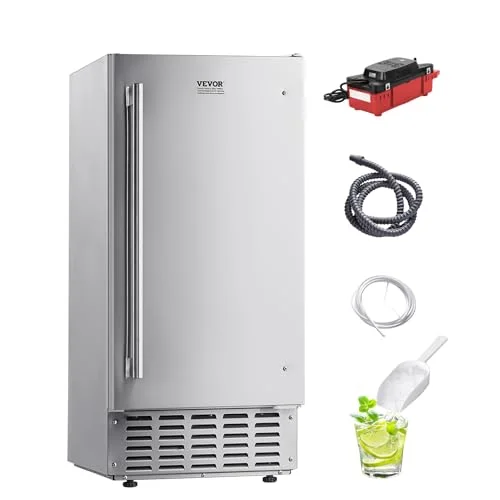
This guide sets a countertop machine, the GE Profile Opal Ultra, against two under-counter built-in units, the EUHOMY 70 lbs model and the VEVOR 66 lbs model with a drain pump. We compared what each listing actually states about output, water handling, door design and bin capacity, and we're explicit about where a built-in installation adds cost and labor that a daily-output number never shows.

Spec #1

Why 38 lbs a day and 70 lbs a day aren't actually comparable numbers

Line the three machines up and the daily-output figures look like the whole story: the GE Profile Opal Ultra states 38 lbs a day, the EUHOMY under-counter unit states 70 lbs a day, and the VEVOR under-counter unit states 66 lbs a day. Read flat, that looks like the built-ins simply make nearly twice as much ice. What it hides is that the two categories have a different relationship with water and power, and the daily figure assumes a continuous supply of both that only one of these three machines can actually get on its own.

The Opal Ultra runs on whatever water you pour into its tank, so its daily number is a ceiling bounded by how often someone refills the reservoir — nobody tops up a tank every ninety minutes around the clock. A built-in unit plumbed to a water line doesn't have that ceiling; it can run unattended for as long as the drain keeps up, which is why the category leans toward bigger published numbers that reflect what the compressor and auger can physically produce, not someone's willingness to refill a jug.

The honest comparison asks what each number is measuring. For a countertop machine, ask about tank size and refill frequency. For a built-in unit, the daily number only means something once the water and drain connection can support it continuously — the installation question the rest of this guide answers. Thirty-eight pounds from a tank you fill by hand and seventy pounds from a machine plumbed into your kitchen are answers to two different questions, not the same unit of ice. Our breakdown of three machines that all claim 40 lbs a day at very different prices makes the same point from the countertop side.

Spec #2

What a countertop machine actually asks of your kitchen

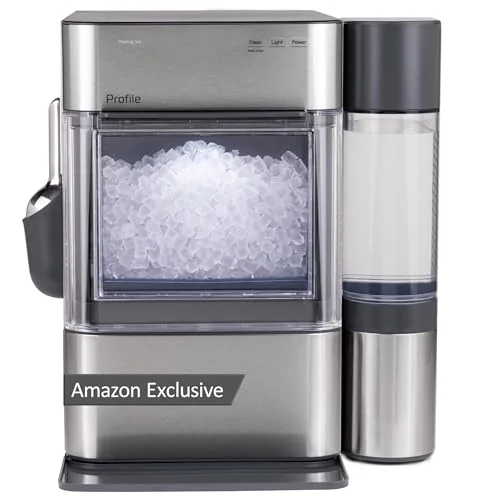
The entire appeal of the countertop category is how short this list is. The GE Profile Opal Ultra needs a worktop that can hold it, a standard outlet within reach of its cord, and nothing else — no water line, no drain, no permit, no cabinet modification. It ships with a 1-gallon side tank that detaches for filling and cleaning, GE states it produces up to three times more ice before a refill than a standard countertop model, and the headline figures are 38 lbs a day and 1.6 lbs an hour into a 3-lb removable bin. Set it down, fill the tank, and it's making ice within minutes.

That ease is the category's honest limit, too. Because the Opal Ultra depends on someone refilling its tank, its real-world output is bounded by attention, not by the compressor. It draws from a wall outlet like any other countertop appliance — it is not battery powered, despite what "portable" marketing on this category sometimes implies; our look at whether any nugget ice maker is actually battery-powered covers that confusion directly. The trade for the ceiling on daily output is a machine you can set down today and return to Amazon tomorrow, with no cabinet cutout left to patch up if it doesn't work out.

GE also lists the Opal Ultra as an Amazon Exclusive in stainless steel with WiFi, at $499.00. None of that changes the installation math — they're conveniences on a machine that still only needs an outlet and a worktop.

Spec #3

Gravity drain versus a drain pump: the choice a built-in unit makes for you

Once you move to a built-in unit, water has to leave the machine somehow, and that single requirement is where most of the installation complexity in this category originates. There are two general ways a plumbed appliance gets rid of waste water: a gravity drain, where the unit sits above the drain line and water flows downhill out on its own, or a drain pump, where the machine actively pushes water to wherever the drain line actually is. Which one a unit uses is a design decision the manufacturer makes, and it determines what your cabinet needs to look like before the machine goes in.

Gravity drain is simpler on paper but comes with a real constraint: the drain line has to sit lower than the machine's outlet, which isn't always true of an existing cabinet without rerouting. A drain pump removes that constraint, which is why pump-equipped units call it out as a selling point rather than an assumption. Of the two under-counter machines here, the VEVOR 66 lbs model states a drain pump outright, alongside a reversible door and 18 lbs of ice storage — giving the installer more flexibility about where the unit sits relative to existing plumbing, at the cost of one more powered component that can eventually fail.

We don't have an equivalent statement for the EUHOMY 70 lbs unit, whose listing details double ice baskets, self-cleaning and a 24-hour timer but doesn't commit to a drain method. That's not the same as saying it's gravity-drain; we won't assert a drain type a listing doesn't state, and neither should you. If drain routing is a constraint in your kitchen, confirm the method on the EUHOMY listing or with the installer, rather than assuming it matches the VEVOR.
Spec #4

The cutout, the clearance and the electrical a built-in installation needs

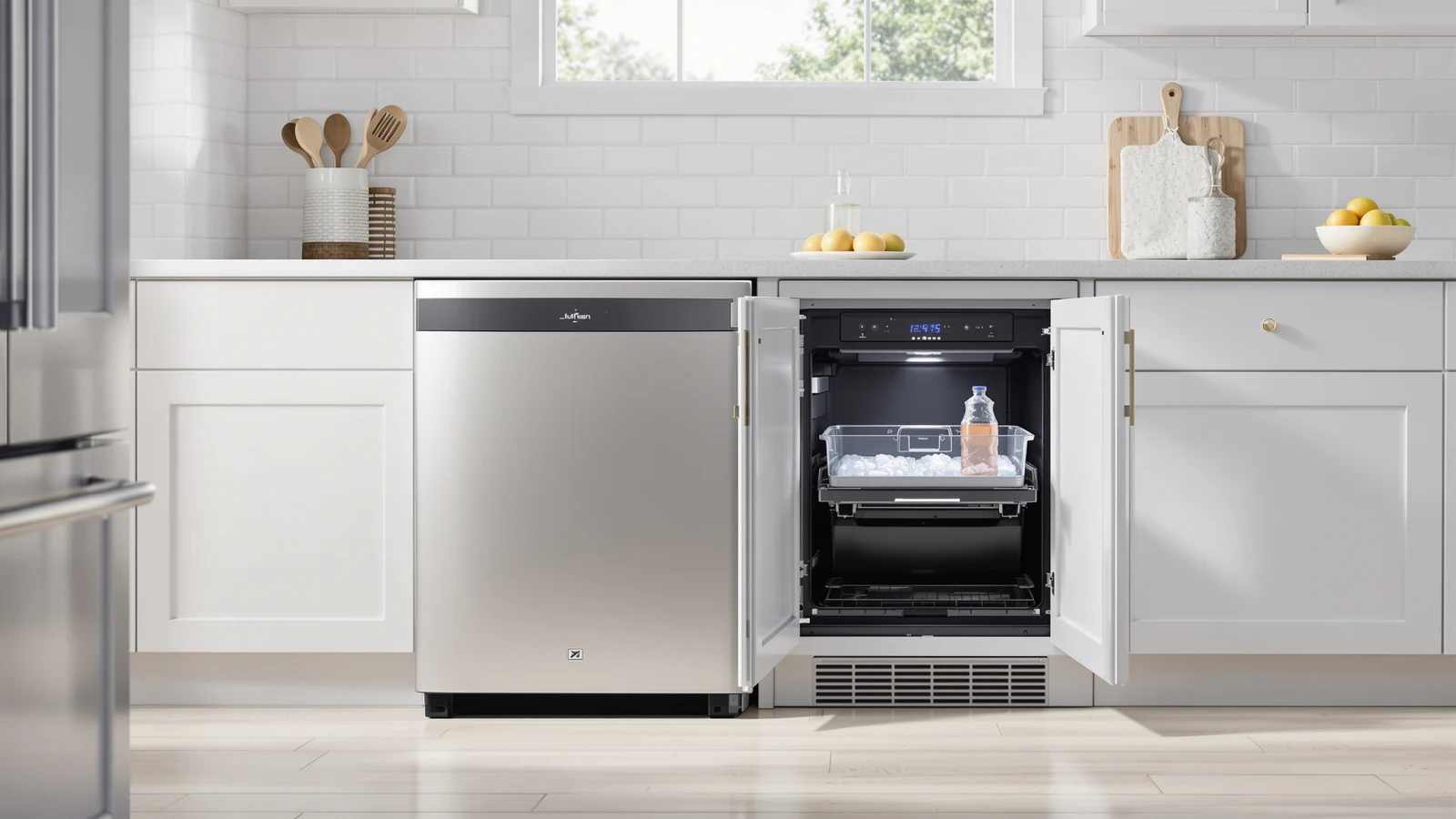
A countertop machine's footprint question is "will it fit on this worktop." A built-in machine's question is "will it fit in this hole, with room to breathe." Under-counter nugget ice makers are designed to slide into a standard cabinet cutout, but that cutout has to exist first, matched to the unit's exact width, depth and height, or be built to match it. That's carpentry, not unboxing — retrofitting an existing cabinet usually means removing a face, confirming stud and support locations, and in some kitchens hiring someone to do it correctly.

Beyond the opening, built-in compressor appliances need clearance for airflow — a sealed box with no ventilation around a working compressor runs hotter and shortens the equipment's life, which is why under-counter appliances specify minimum clearances. A freestanding countertop machine like the Opal Ultra sidesteps this entirely, venting into open room air. A built-in unit sits inside a cabinet with surfaces close on several sides, so the manufacturer's clearance requirement isn't a suggestion you can skip to save space.

Then there's power. Both built-in units here, the EUHOMY 70 lbs and the VEVOR 66 lbs, are freestanding under-counter machines that still need a grounded outlet reachable from the cabinet — not always a given in cabinetry never wired for an appliance. If the cutout doesn't already have an outlet nearby, that's an electrician's visit added to the plumber's. None of this shows up in the $999.90 or $899.99 sticker price. It's the installation gap this guide is about: the built-in category's real cost is never just the appliance.

Spec #5

Reversible doors, dual baskets and the features that only show up at this size

Scale up to a built-in cabinet appliance and design features appear that simply don't apply to a countertop box you set on a worktop and never move. A reversible door is the clearest example: because a built-in unit is fixed in one cabinet opening long-term, which side the door hinges on has to match the layout — a door that opens into a walkway is a daily annoyance you can't fix by turning the machine around, the way you could with a freestanding countertop unit. The VEVOR 66 lbs model states a reversible door directly, so the hinge side can be set to match the cabinet rather than forcing the cabinet to accommodate a fixed hinge.

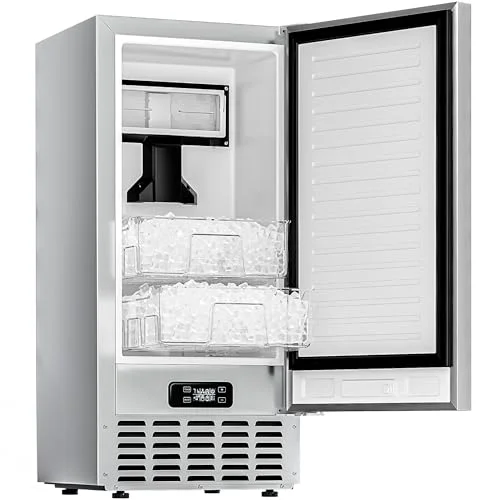
The EUHOMY 70 lbs model's listing leads with a different built-in-scale feature: double ice baskets. A single bin is standard on a countertop machine, where ice melts back into the reservoir and gets remade regardless of bin size. A dual-basket design on a larger built-in unit is about managing a bigger volume of standing ice at once, letting one basket be accessed while the other keeps filling — it matters more as daily output scales toward 70 lbs than it does on a 3-lb countertop bin. EUHOMY pairs that with a self-cleaning cycle and a 24-hour timer, aimed at a machine meant to need less daily attention than a countertop unit you refill by hand.

None of these features are wrong to want. They're evidence that the built-in category is engineered around permanence: a machine installed once, left in place, expected to fit the kitchen's specific layout rather than the other way around. You're not just paying for a cutout and a drain line; you're buying a fixture meant to disappear into your cabinetry for years, with the hinge and basket details to match.

Side by side

The three, compared

ModelTypeDaily outputNotable specPriceGet it
GE Profile Opal Ultra Countertop 38 lbs/day 1-gal side tank, plug-and-play $499.00 Get it
VEVOR Under Counter, 66 lbs Built-in 66 lbs/day Drain pump, reversible door $999.90 Get it
EUHOMY Under Counter, 70 lbs Built-in 70 lbs/day Double ice baskets, self-cleaning $899.99 Get it
The picks

Our picks, and who each one is for

01Best countertop

GE Profile Opal Ultra

Best for anyone who doesn't want a cutout, a drain or a permanent commitment

38 lbs/day·1.6 lbs/hour·1-gallon side tank·3-lb removable bin, WiFi, Amazon Exclusive

This is the machine that asks nothing of your kitchen beyond an outlet and a worktop. The 1-gallon side tank detaches for filling and cleaning, and GE states it makes up to three times more ice before a refill than a standard countertop model, at 38 lbs a day and 1.6 lbs an hour into a 3-lb bin. It's also the lowest price of the three by a wide margin once you remember the sticker price is the entire cost here — no plumber, no electrician, no carpentry.

The honest trade: a lower daily ceiling, bounded by how often you refill it, for zero installation cost beyond the price tag.

GE Profile Opal Ultra countertop nugget ice maker
Price
$499.00
Check price →
02Best built-in with flexible drain routing

VEVOR Under Counter Ice Maker, 66 Lbs/Day

Best for a cabinet where the drain line isn't conveniently below the unit

66 lbs/day·Drain pump·Reversible door·18 lbs storage, stainless steel, freestanding

The VEVOR listing states both a drain pump and a reversible door outright, which together make a built-in installation flexible rather than rigid: the pump means the unit doesn't have to sit above the drain line, and the reversible door sets the hinge side to match the cabinet instead of the other way around. At 66 lbs a day with 18 lbs of storage, it suits a kitchen already committed to the cutout that just needs the install itself less constrained.

A drain pump and a reversible door are installation-flexibility features first — the daily output is almost secondary to what they let you do with a less-than-ideal cabinet.

VEVOR under counter nugget ice maker with drain pump
Price
$999.90
Check price →
03Best built-in for standing volume

EUHOMY Under Counter Nugget Ice Maker, 70 Lbs/Day

Best for a household that wants the most ice on hand with the least daily attention

70 lbs/day·Double ice baskets·Self-cleaning·24-hour timer, silver finish, freestanding

The highest stated daily output of the three, and the only one with double ice baskets, letting one basket be used while the other keeps filling instead of drawing down a single shared bin. EUHOMY pairs that with a self-cleaning cycle and a 24-hour timer, both aimed at less day-to-day attention than a countertop unit you refill by hand. What the listing doesn't state is a drain method — if your cabinet needs a drain pump rather than a gravity drain, confirm that with the listing or installer before ordering.

The biggest number and the most basket capacity of the three — paired with the one installation detail you'll need to confirm yourself before the cutout gets cut.

EUHOMY under counter nugget ice maker with double ice baskets
Price
$899.99
Check price →
The honest line

Who should never go near a built-in unit, regardless of budget

Price is not the gate that should decide this purchase, and it's worth saying plainly who should rule out the built-in category even with $899.99 sitting comfortably in the budget. If you rent, or expect to move within a few years, a built-in unit is a fixture going into someone else's cabinetry, or into a kitchen you won't be in long enough to make the cutout, the drain routing and the electrical work pay off. A countertop machine moves with you in its original box. A built-in unit, once plumbed in, is a renovation decision, not a purchase.

The same logic applies if you're not willing to involve a plumber or electrician at all. Both built-ins here are freestanding under-counter units, not slide-in-and-forget appliances — the EUHOMY needs its drain method confirmed before installation, and even the VEVOR's drain pump still needs a drain line and grounded outlet reachable from the cabinet. With no plumbing or electrical experience and no intention of hiring someone, a countertop machine like the Opal Ultra removes that problem entirely rather than asking you to solve it.

And if you don't yet know whether nugget ice is something your household will use daily, a built-in commitment is premature at any price. A countertop machine lets you find that out for a few hundred dollars and the ability to return it. Our guide to EUHOMY's countertop lineup mapped by capacity covers the brand's lower-commitment options if the EUHOMY name specifically drew you to the 70 lbs built-in unit.

Our method

How we picked — and what we can’t tell you

What we did

Listing data, compared directly

We compared the published product names, stated daily output, drain and door details, bin capacity and current Amazon prices for one countertop nugget ice maker and two under-counter built-in units, reading each listing specifically for the installation-relevant specs a daily-output number alone doesn't capture: drain method, door reversibility and basket design. Where a listing stated a spec directly, like the VEVOR's drain pump, we report it. Where it didn't, as with the EUHOMY's drain method, we say so.

What we didn’t

We don’t run a testing lab

We do not physically test these machines, we do not own them, and we do not publish invented scores or ratings. What we can do honestly is read every listing's own claims, set published specifications against each other, and be explicit about general plumbing and electrical facts versus what's specific to the products compared here. For anything installation-specific — exact cutout dimensions, your cabinet's drain access, local electrical code — that's a conversation with a qualified installer, not something a comparison article can state as fact.

FAQ

Common questions

Can a countertop nugget ice maker make as much ice as a built-in unit?

Not on paper: the countertop GE Profile Opal Ultra states 38 lbs a day, against 66 and 70 lbs a day on the two built-in units here. But a countertop machine's number is bounded by how often someone refills its tank, while a plumbed built-in unit can draw water continuously. The real question isn't which makes more ice so much as which model of getting ice fits how you live.

Do I need a plumber to install a built-in nugget ice maker?

In most kitchens, yes, or at minimum someone comfortable running a water line and drain connection to code. Both built-in units here need a water supply and somewhere for waste water to go — a drain pump, like the one the VEVOR 66 lbs model states, adds flexibility about where the drain line sits, but doesn't remove the need for the connection itself. A countertop machine like the Opal Ultra needs none of this.

What happens if a built-in ice maker doesn't have a drain pump?

It relies on a gravity drain, sitting above the drain line so water flows downhill out on its own — a real constraint without convenient drain access below the appliance. A drain pump pushes water out instead, which is why it's called out as a feature on units like the VEVOR 66 lbs model. We don't have a stated drain method for the EUHOMY 70 lbs unit, so confirm that before committing to a cutout.

Is a reversible door worth paying for on a built-in unit?

If the unit is going into a fixed cabinet opening for years, yes — unlike a countertop machine you can simply turn around, a built-in unit's door orientation is effectively permanent once installed. The VEVOR 66 lbs model states a reversible door directly, letting the hinge side match the cabinet rather than forcing the layout around whichever side the factory shipped.