Best Nugget Ice Makers
Head-to-Head · GE Profile Opal

Same 38 lbs. Same side tank promise. Different price tags.

GE now sells three listings under the Opal Ultra name — the original Ultra, and two separate Opal 2.0 Ultra listings priced apart from each other. All three state the same 38 lbs a day. None of the three listings explains, in its own bullet points, what “2.0” is actually marking. We read all three titles line by line and compared what each one states, what it drops, and what it quietly changed.

By Ilane TallUpdated November 20, 2026Research-based — no testing lab, no invented scores

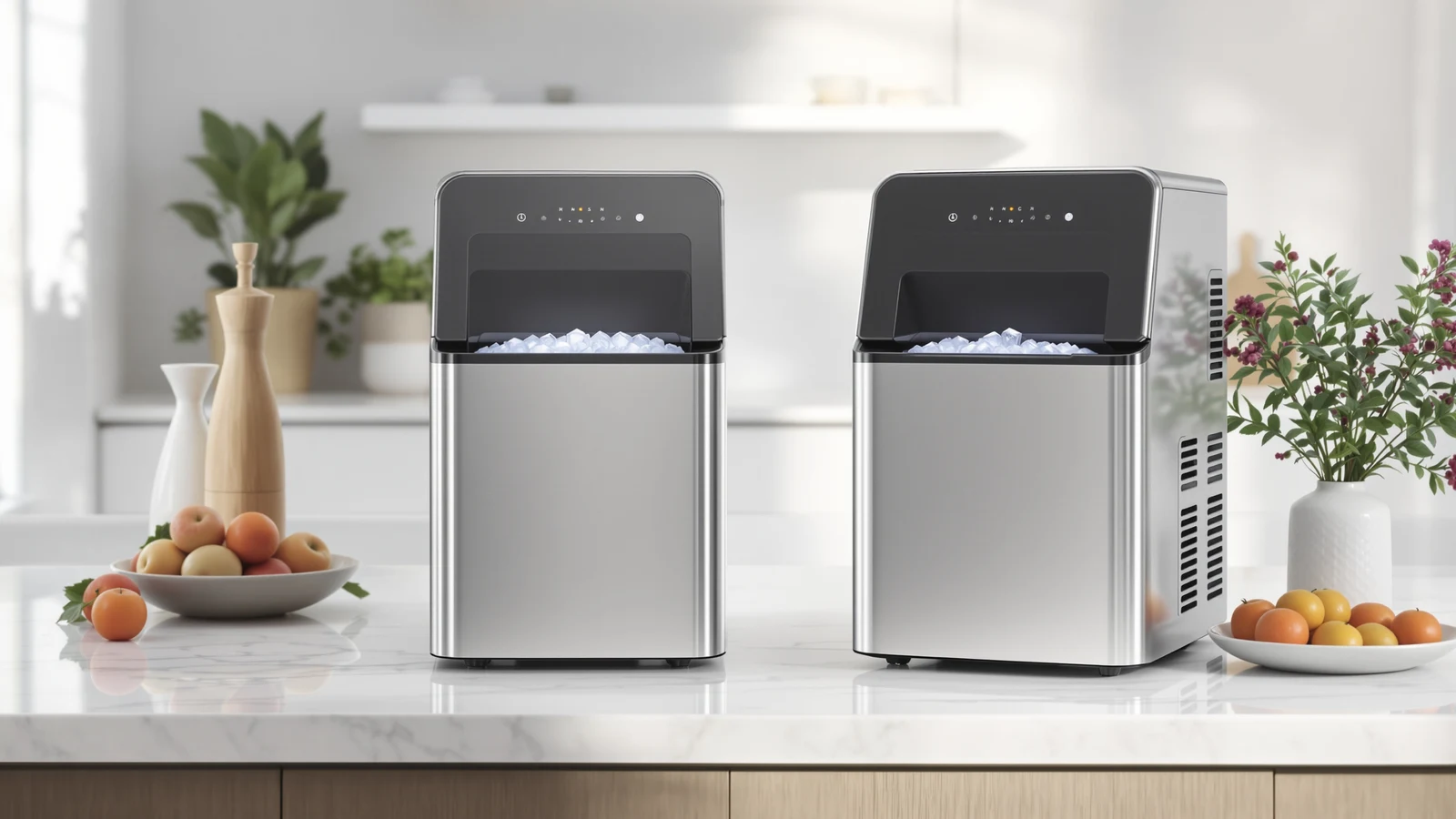
GE Profile Opal Ultra and GE Profile Opal 2.0 Ultra countertop nugget ice makers side by side on a kitchen counter
Affiliate disclosure: we may earn a commission if you buy through the Amazon links on this page, at no extra cost to you. See how we compared below.

Open the original Opal Ultra listing next to either Opal 2.0 Ultra listing and the resemblance is almost total: the same brand name, the same “Ultra” suffix, the same 38 lbs printed near the front of the title, the same core promise of a side tank you don’t have to babysit all day. If you’ve already decided you want an Opal Ultra and you’re just trying to work out why there are now three separate listings instead of one — selling, as of the prices we have on file, at $317.59, $373.35 and $499.00 — this comparison is for that exact question.

“2.0” isn’t a naming convention GE explains anywhere in these listings. None of the three bullet-point lists includes a changelog, a note about what moved between generations, or a reason the number is there at all. What we can do honestly is read all three listings exactly as published — same approach we’d take comparing any three competing titles — and report precisely what each one states and what it leaves out. We don’t run a physical testing lab and haven’t run a timed batch through any of these three machines ourselves; everything below is built from each listing’s own name, price and stated specification, nothing else. Every machine in this comparison is also a countertop unit you fill and empty by hand — if you’re actually weighing that against a plumbed-in model, our countertop vs. built-in comparison covers that larger decision first.

The headline question

Same 38 lbs a day, same side tank promise — so what does “2.0” actually mark?

Start with what doesn’t change, because it’s most of the title on all three listings. The original Ultra states “38 lbs/Day.” The cheaper Opal 2.0 Ultra states “38 lbs in 24 Hours.” The pricier Opal 2.0 Ultra states “38 lbs/day.” That is the same number, worded three different ways, and none of the three listings claims a higher output ceiling for the newer generation. If you were hoping “2.0” meant more ice per day, the titles themselves don’t support that — GE is not claiming a performance jump on the one figure every listing leads with.

The side tank concept carries over too, at least in name. The original Ultra’s title states a 1 Gal XL Side Tank. The pricier of the two 2.0 Ultra listings states a .75 Gallon Tank and separately calls out “Side Tank” among its features. Same mechanism, same side-loading idea — but a different number attached to it, which is the one concrete figure that actually moved and is worth its own section below. The cheaper 2.0 Ultra listing doesn’t state a tank volume at all, so we can’t tell you from its title whether it carries the same .75-gallon tank as its sibling listing or something else; that’s a gap in the published data, not a number we’re willing to guess at.

What else changed in the wording is mostly how GE describes connectivity. The original Ultra says simply “WiFi Stainless Steel.” The cheaper 2.0 Ultra says “WiFi & Smart Connected.” The pricier 2.0 Ultra says “WiFi & App Control.” None of the three listings spells out what, if anything, differs functionally between plain WiFi, “Smart Connected” and “App Control” — these read like marketing phrasing attached to the same underlying app, and we won’t invent a feature gap the titles don’t describe. The one fact that is unambiguous across all three listings is price: the Ultra name moved from $499.00 down to $317.59–$373.35 under the 2.0 label, while keeping an identical daily-output claim. On the numbers GE publishes, “2.0” reads less like a mechanical upgrade and more like GE repositioning the Ultra name at a lower price point, with a smaller stated tank and a reworded feature list — not a claim GE makes outright anywhere in these titles, but exactly what the three of them show once you line them up.

The one number that moved

1 Gal XL against .75 Gallon: the real change hiding in the tank line

A gallon is 128 fluid ounces; three-quarters of a gallon is 96. By GE’s own stated figures, that’s a 25 percent smaller reservoir on the Opal 2.0 Ultra listing that states a tank size at all, compared with the original Ultra’s 1 Gal XL Side Tank. That’s the one number in this whole comparison that actually changed between generations rather than just being reworded — and it’s buried in the middle of a product title, not called out as a headline difference anywhere in either listing.

A smaller tank, on the same stated 38 lbs a day, means the machine needs topping up more often to hit that daily figure, since it’s drawing from less standing water between refills. GE doesn’t publish an hourly rate or a runtime-per-tank figure for either 2.0 Ultra listing, so we can’t put an exact number of extra refills on it — only the directional fact that a quarter-gallon of capacity came out of the tank somewhere between the original Ultra and the 2.0 Ultra that states its tank size. GE isn’t the only brand that spreads one nameplate across different stated capacities and expects shoppers to notice the fine print themselves; we mapped the same pattern across a different maker’s full catalog in our guide to EUHOMY’s lineup by capacity, and the lesson carries over here just as directly.

And again: the cheaper Opal 2.0 Ultra listing, at $317.59, states no tank figure whatsoever. It may carry the same .75-gallon tank as its $373.35 sibling, or something smaller still, or something GE simply didn’t think worth printing in the title. We’re not going to assert a number the listing itself doesn’t commit to. If tank volume is the deciding spec for you — and on a machine whose whole pitch is “fewer refills,” it probably should be — check that specific listing’s own specification table before you buy, rather than assuming parity with the listing next to it.

What 2.0 adds

First batch in 10 minutes: the one spec only a 2.0 listing states

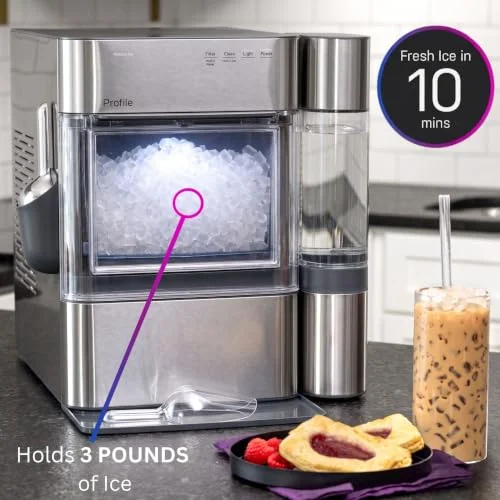
The pricier Opal 2.0 Ultra listing, at $373.35, states “First Batch in 10 Min” in its own title. That is a real spec, and it’s a different kind of number from the 38-lbs-a-day figure every listing repeats — it describes how long you wait after starting the machine before the first nugget ice actually drops, not a theoretical full day of continuous output nobody experiences on a kitchen counter. It’s a useful, concrete number, and it’s the single clearest piece of new information any of the three listings adds relative to the others.

It is also the only one of the three listings that states it. Neither the original Ultra’s title nor the cheaper 2.0 Ultra’s title mentions a time-to-first-ice figure at all. That doesn’t mean the other two machines are necessarily slower to first batch — it means we don’t have a published number for them, and we won’t apply the 10-minute figure from one listing to machines whose own titles are silent on it, even though all three are nominally the same Opal Ultra family. If how quickly you get usable ice after plugging in matters to your routine, the $373.35 listing is, on paper, the only one of the three that tells you anything concrete about it.

Same name, two prices

Two Opal 2.0 Ultra listings, for what reads like the same machine

Set the two Opal 2.0 Ultra listings next to each other and the price gap is $55.76 — $317.59 against $373.35, which works out to the pricier listing costing roughly 18 percent more. Both carry the same “Opal 2.0 Ultra” name and the same 38-lbs-a-day figure. What differs is what each title actually commits to in writing. The $317.59 listing states a Scale Inhibiting Filter, a scoop included, 38 lbs in 24 hours, and “WiFi & Smart Connected.” It does not state a tank size, a first-batch time, or descaling powder.

The $373.35 listing states a .75 Gallon Tank, “Soft Pebble Ice,” First Batch in 10 Min, “WiFi & App Control,” a side tank, a filter, descaling powder, and a scoop — six distinct things named in one title where the other names four. The extra roughly $56 correlates with three specific data points the cheaper listing’s title simply doesn’t commit to: a stated tank volume, a stated first-batch time, and descaling powder named explicitly rather than folded into a generic “filter.” That doesn’t prove the two machines are mechanically different under the hood — it’s entirely possible the cheaper listing’s seller just wrote a shorter title for the same hardware — but we have no way to confirm that from what’s published, so we’re not going to assume it either.

This is exactly the kind of same-brand, near-identical, different-price situation worth reading line by line before assuming “cheaper must be the same deal.” We’ve seen the identical pattern play out across a different brand’s catalog in our breakdown of EUHOMY’s three nearly identical handle models, where listings that look interchangeable at a glance turn out to price their features backwards from what you’d expect. GE spreading one name across a catalog with uneven detail isn’t new behavior for this category either — see how we mapped a similar spread in Silonn’s eight-model lineup. The lesson is the same each time: the brand name and the headline number tell you less than the specific listing’s own fine print.

If none of those three missing data points bother you — you don’t need a tank figure in writing, you don’t need a quoted first-batch time, and you’re fine sourcing descaler yourself later — the $317.59 listing nominally gets you the same 38-lbs headline for about $56 less. If you want those three numbers committed to in the listing before you hand over your card, the $373.35 listing is the one that actually states them. Our take on when a lower price is genuinely the same product versus when it’s a thinner listing applies the same logic we used in assessing whether an Amazon Renewed discount is worth it — the discount itself isn’t the full story; what the listing does and doesn’t promise in writing is.
Worded differently

Scale-inhibiting filter and descaling powder: named differently across the two 2.0 listings

Both Opal 2.0 Ultra listings name a filter and a scoop. The $317.59 listing calls its included filter a “Scale Inhibiting Filter” and separately states “Scoop Included” — it does not use the words “descaling powder” anywhere in its title. The $373.35 listing groups its accessories differently: “Filter, Descaling Powder & Scoop Included,” naming descaling powder as its own bundled item alongside the filter and scoop. These may well be the identical bundle described two different ways by two different listing authors — a scale-inhibiting filter and a tub of descaling powder commonly ship together on machines in this category — but the titles themselves don’t confirm that, so we’re reporting the wording gap rather than assuming the contents match.

The original Ultra is the outlier here: its title doesn’t mention a filter, a scoop, or descaling powder at all. That doesn’t necessarily mean the box ships empty of them — plenty of listings fold accessories into interior bullet points rather than the product name — but since the title is the only data point we’re working from for that listing, we won’t claim parity with either 2.0 Ultra listing on this point. If a scale-inhibiting filter and descaling powder specifically matter to your decision, check the $499.00 listing’s own bullet points directly rather than assuming it matches its cheaper siblings.

Line by line

What each listing actually states, line by line

Rather than summarize, here is every detail named in each of the three product titles, set against each other directly. “Not stated” means exactly that — the listing’s title doesn’t mention it, not that the machine definitely lacks it.

Stated in the titleOpal 2.0 Ultra · $317.59Opal 2.0 Ultra · $373.35Opal Ultra · $499.00
Daily output38 lbs in 24 hours38 lbs/day38 lbs/Day
Tank sizeNot stated.75 Gallon Tank1 Gal XL Side Tank
First batch timeNot statedFirst Batch in 10 MinNot stated
FilterScale Inhibiting FilterFilter (named)Not stated
Descaling powderNot stated by nameDescaling PowderNot stated
ScoopScoop IncludedScoop IncludedNot stated
Connectivity wordingWiFi & Smart ConnectedWiFi & App ControlWiFi
Other calloutsPellet Ice Machine, Stainless SteelSoft Pebble Ice, Side TankAmazon Exclusive, Pebble Pellet Crushed Ice Machine
Side by side

All three, compared

ListingDaily outputTankPriceGet it
Opal 2.0 Ultra — $317.59 38 lbs/24h Not stated $317.59 Get it
Opal 2.0 Ultra — $373.35 38 lbs/day .75 gallon side tank $373.35 Get it
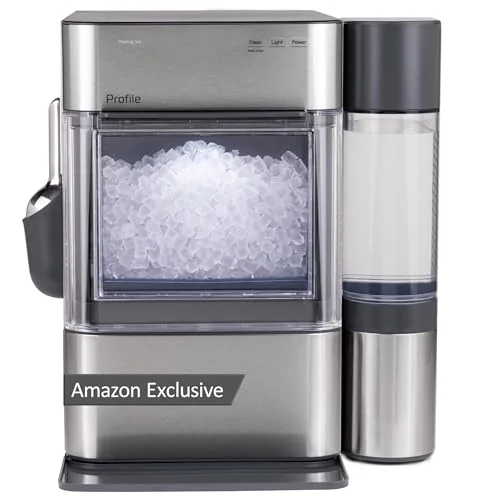
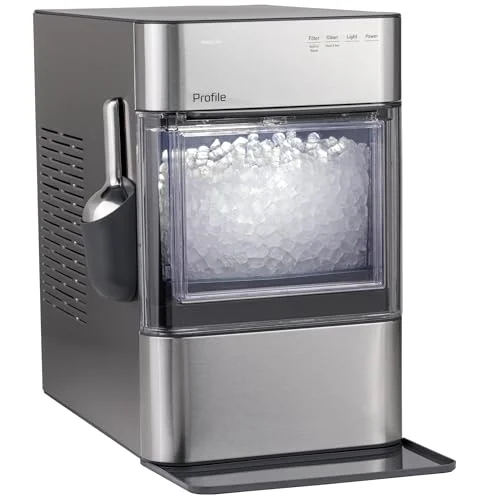
Opal Ultra (original) 38 lbs/day 1-gallon XL side tank $499.00 Get it
The picks

Which listing to buy, if you’ve decided the redesign is worth it

01Best documented

GE Profile Opal 2.0 Ultra — $373.35 listing

Best for wanting the tank and fill-time numbers in writing

38 lbs/day·.75 Gallon Tank·First Batch in 10 Min·Filter, descaling powder & scoop included

Of the two Opal 2.0 Ultra listings, this is the one whose title actually commits to the numbers that matter once you’re past the shared 38-lbs headline: a .75-gallon tank figure, a first-batch time, and descaling powder named by name rather than folded anonymously into a generic filter. It costs about $56 more than its sibling listing, and on paper that premium buys you three specific, checkable facts the cheaper listing’s title simply doesn’t state.

Pay the extra $56 for the numbers in writing, not for a different machine — we can’t confirm the hardware differs.

GE Profile Opal 2.0 Ultra nugget ice maker with side tank
Price
$373.35
Check price →
02Cheapest 2.0

GE Profile Opal 2.0 Ultra — $317.59 listing

Best if the unstated tank and fill time don’t change your decision

38 lbs in 24h·Scale Inhibiting Filter·Scoop Included·WiFi & Smart Connected

The lowest price under the Opal Ultra name by a wide margin, and the same headline 38-lbs figure as both of its siblings. What its title doesn’t commit to — a tank volume, a first-batch time, descaling powder by name — may simply be a shorter title on the same hardware as the $373.35 listing, or it may not be; we don’t have a way to confirm which from what’s published. If you’re comfortable buying on the shared daily-output figure alone and checking the rest once the listing arrives, this is the lower-risk amount to spend finding out.

Same headline number, three fewer stated facts, $56 less. Decide how much those three facts are worth to you.

GE Profile Opal 2.0 Ultra nugget ice maker
Price
$317.59
Check price →
03The original

GE Profile Opal Ultra (original)

Best if the 1-gallon XL tank specifically is non-negotiable

38 lbs/day·1 Gal XL Side Tank·Amazon Exclusive·WiFi, stainless steel

At $499.00, this is $175.65 more than the better-documented 2.0 Ultra listing and $231.41 more than the cheapest one — roughly 47 to 73 percent more money for a listing that states the identical 38-lbs figure and doesn’t name a filter, a scoop or descaling powder at all. The one number it states that neither 2.0 listing matches is the full 1-gallon XL tank, a documented 25 percent larger than the .75-gallon figure on its cheaper sibling. If that specific tank size is the reason you’re here, this is the only listing of the three that states it. If it isn’t, the redesign is hard to argue against on price alone.

You’re paying triple-digit dollars for a quarter-gallon of extra stated tank capacity. Decide if that’s your actual priority.

GE Profile Opal Ultra nugget ice maker with 1-gallon side tank
Price
$499.00
Check price →
Our method

How we compared — and what we can’t tell you

What we did

Three titles, read side by side

We compared the full published product names, stated specifications and current Amazon prices for the GE Profile Opal Ultra and both GE Profile Opal 2.0 Ultra listings. Where a listing’s own title states a figure — a tank size, a first-batch time, an included accessory — we report it attributed to that listing. Where a title is silent on a spec another listing states, we say so explicitly rather than assume parity across the three.

What we didn’t

We don’t run a testing lab

We do not physically test these machines, we do not own any of the three, and we do not publish invented scores or ratings. We have no review data for any of these three listings, so we don’t cite owner sentiment here. What we can do honestly is set three competing titles against each other and report plainly which claims are published and which are simply absent from what each listing states.

FAQ

Common questions

What does “2.0” actually change on the Opal Ultra?

Based on what the three listings themselves state, not much on the headline number: all three claim the same 38 lbs a day. What we can point to as an actual, checkable change is the side tank — the original Ultra states a 1 Gal XL Side Tank, while the pricier Opal 2.0 Ultra listing states a smaller .75 Gallon Tank. The rest of the difference is reworded connectivity language and a dramatically lower price under the 2.0 name, neither of which GE explains as a mechanical upgrade in the titles.

Why do the two Opal 2.0 Ultra listings have different prices?

The $373.35 listing states three things the $317.59 listing’s title doesn’t: a tank volume (.75 gallon), a first-batch time (10 minutes), and descaling powder named explicitly. The $56 gap tracks roughly with those three stated details. We can’t confirm from the titles alone whether the underlying hardware differs or whether the cheaper listing is simply a shorter description of the same machine.

Is the Opal 2.0 Ultra’s side tank the same size as the original Ultra’s?

No, at least for the one 2.0 Ultra listing that states a tank figure. The original Ultra states a full 1-gallon XL side tank; the $373.35 Opal 2.0 Ultra listing states .75 gallons, about 25 percent less. The $317.59 Opal 2.0 Ultra listing doesn’t state a tank size at all, so we can’t say whether it matches its sibling or differs further.

Does the Opal 2.0 Ultra ship with a scale-inhibiting filter and descaling powder?

Both Opal 2.0 Ultra listings name a filter and a scoop. Only the $373.35 listing names descaling powder explicitly in its title; the $317.59 listing calls its filter a “Scale Inhibiting Filter” without using the words “descaling powder.” The original $499.00 Ultra listing doesn’t name a filter, scoop or descaling powder at all in its title, so we won’t assume it matches either 2.0 listing on this point — check that listing’s own bullet points if this detail decides your purchase.